Clear Sky Science · en
A mechanism-based hybrid Transformer-GRU network for bridge pier hysteresis curves prediction: an interpretable research
Why smarter bridge checks matter
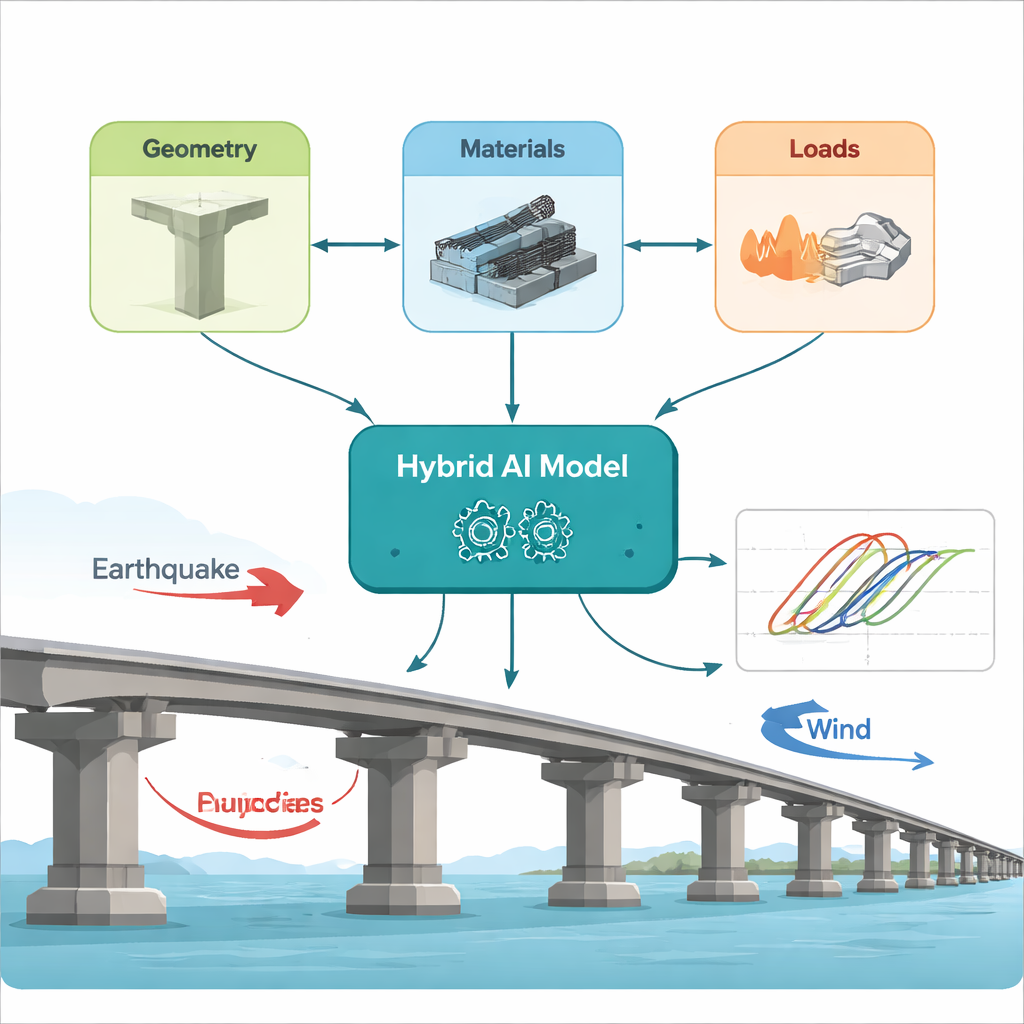
Modern societies rely on vast networks of bridges to keep people and goods moving. These structures must quietly endure traffic, wind, and especially earthquakes. Engineers use a special kind of curve, called a hysteresis curve, to see how a bridge pier bends, yields, and recovers under repeated shaking. Traditionally, getting these curves has meant time‑consuming lab tests or heavy computer simulations. This study presents a new artificial‑intelligence approach that predicts these curves quickly and accurately while still respecting basic physics, offering a potential step forward for safer, more efficient bridge design and monitoring.
Watching a bridge sway on paper
When an earthquake or strong wind rocks a bridge, its piers do not simply bend and spring back like perfect elastic rulers. Instead, each loading cycle leaves a trace in the form of a loop on a force‑versus‑displacement plot. These hysteresis loops reveal how much energy the pier can absorb, how its stiffness fades with damage, and how much permanent tilt it may keep. Because such behavior is highly nonlinear, engineers have long relied on detailed experiments and complex numerical models to capture it. While powerful, those methods can be slow and expensive, making it hard to analyze many bridges quickly after a disaster or to routinely assess aging infrastructure.
Adding physics into machine learning
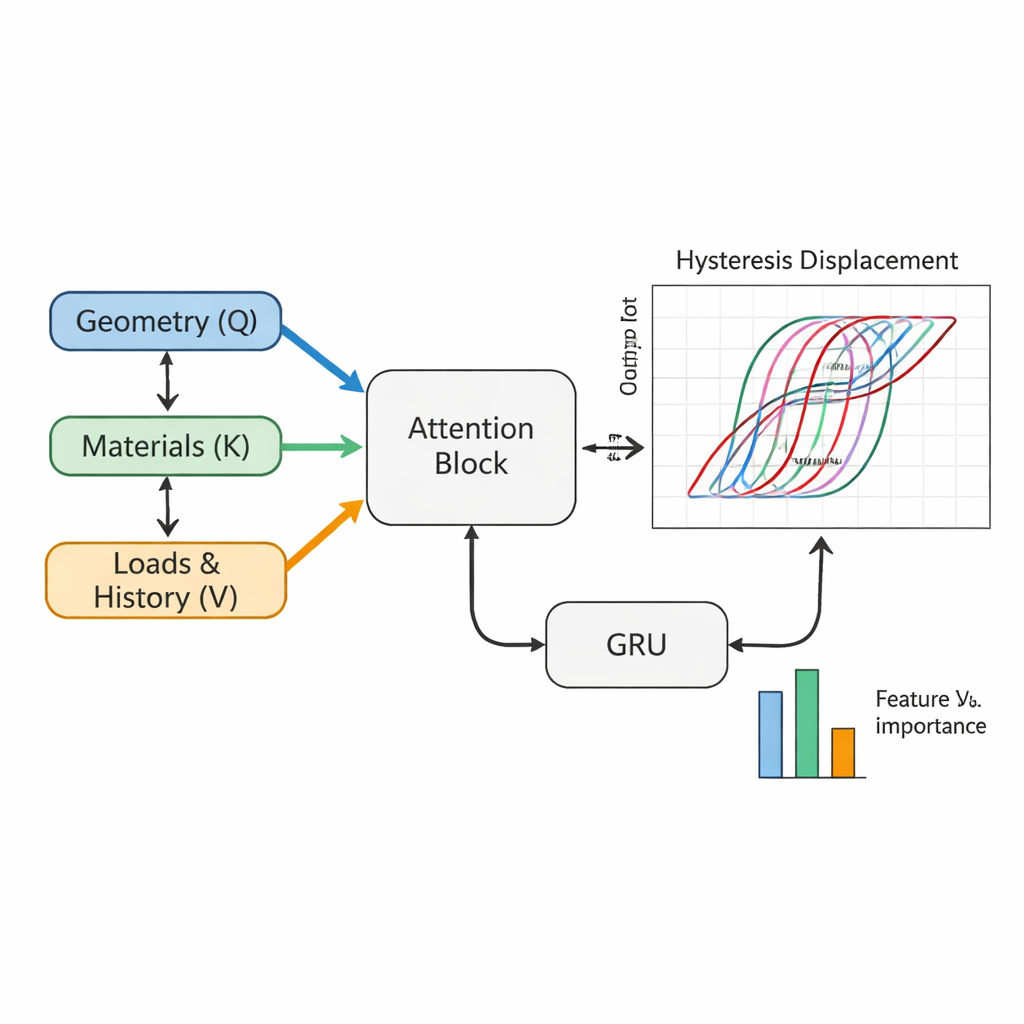
Recent progress in artificial intelligence has made it possible to learn complicated structural behavior directly from data. However, purely data‑driven models can act like black boxes: they may fit past results well but fail when asked to predict new structures or rare loading conditions, and they often provide little insight into why a particular prediction was made. To tackle these shortcomings, the authors designed a hybrid model that blends a popular language‑processing tool, the Transformer, with a time‑series network called a GRU. Crucially, they organized the inputs and network so that basic mechanics are built in: one stream carries geometric details of the pier (such as cross‑section type and dimensions), another carries material strengths, and a third carries the applied loads and parts of previous hysteresis loops.
How the hybrid model "pays attention"
Inside the model, a modified multi‑head attention mechanism plays matchmaker between geometry, materials, and loads. Instead of treating all input numbers alike, the network explicitly uses geometric features as the “query,” material features as the “key,” and load and history data as the “value.” This structure encourages the model to learn patterns that echo simple mechanical thinking: the shape and size of a pier and the strength of its concrete and steel set its stiffness, while the applied forces and past cycles determine how that stiffness degrades. After attention distills these relationships, a GRU layer takes over to follow how the pier’s response evolves from one loading cycle to the next, capturing fatigue‑like effects over time.
Training with many real‑world tests
To teach and validate the model, the researchers drew on 207 cyclic tests of reinforced‑concrete columns from the PEER Structural Performance Database. They carefully filtered and reorganized this rich dataset into 15 input parameters covering geometry, reinforcement details, material strengths, loading records, and history from the previous loop, plus the target displacement for the current loop. Each hysteresis loop was resampled to a common length so different tests could be compared fairly. They then benchmarked the hybrid network against several alternatives, including plain GRU, bidirectional GRU, and an attention‑based GRU, tuning all models with the same training procedure and optimization strategy.
Accuracy, data efficiency, and insight
The mechanism‑based Transformer‑GRU outperformed all comparison models. Relative to the best competing attention‑GRU, its predictions showed a modest but meaningful increase in goodness‑of‑fit and noticeable reductions in both average and peak errors. Importantly, it maintained strong performance even when trained on relatively small portions of the available data, a key advantage in fields where high‑quality tests are scarce. The authors also examined how prediction errors build up when forecasting many hysteresis loops in sequence and found that a training strategy that preserves the natural order of loops keeps error growth under control. To peek inside the “black box,” they applied a game‑theory‑based interpretability tool called SHAP. This analysis revealed that, in the new model, cross‑section shape and other geometric and material properties play a much larger role than in a plain GRU model, while still giving proper weight to load history—behavior that closely matches engineering expectations.
What this means for real bridges
In everyday terms, the study shows that a carefully designed AI system can learn to “think” about bridge piers in a way that mirrors basic structural mechanics, rather than just memorizing data. By embedding geometry, materials, and loading into the heart of the model, the authors obtain fast predictions of how a pier will bend and degrade under repeated shaking, with accuracy suitable for engineering use and with tools to see which inputs matter most. Such models could eventually help engineers screen large inventories of bridges after earthquakes, plan retrofits more efficiently, and extend similar ideas to other column‑like structures in buildings and infrastructure.
Citation: Wang, J., Zeng, W. & Zhong, H. A mechanism-based hybrid Transformer-GRU network for bridge pier hysteresis curves prediction: an interpretable research. Sci Rep 16, 4961 (2026). https://doi.org/10.1038/s41598-026-35626-y
Keywords: bridge seismic performance, hysteresis curves, physics-informed AI, Transformer-GRU model, structural health monitoring