Clear Sky Science · en
Data-driven classification of ordinary chondrites and asteroidal metal potential evaluation
Tracing the Metal in Falling Space Rocks
Most meteorites that land on Earth are rocky fragments called ordinary chondrites, leftovers from the dawn of the Solar System. Besides preserving a record of how planets formed, these rocks are also natural samples of asteroids that could someday supply metals for off-world industry. This study shows how modern data science can sort these meteorites into types and estimate how metal-rich their parent asteroids might be, using only simple chemical measurements.
Why These Meteorites Matter
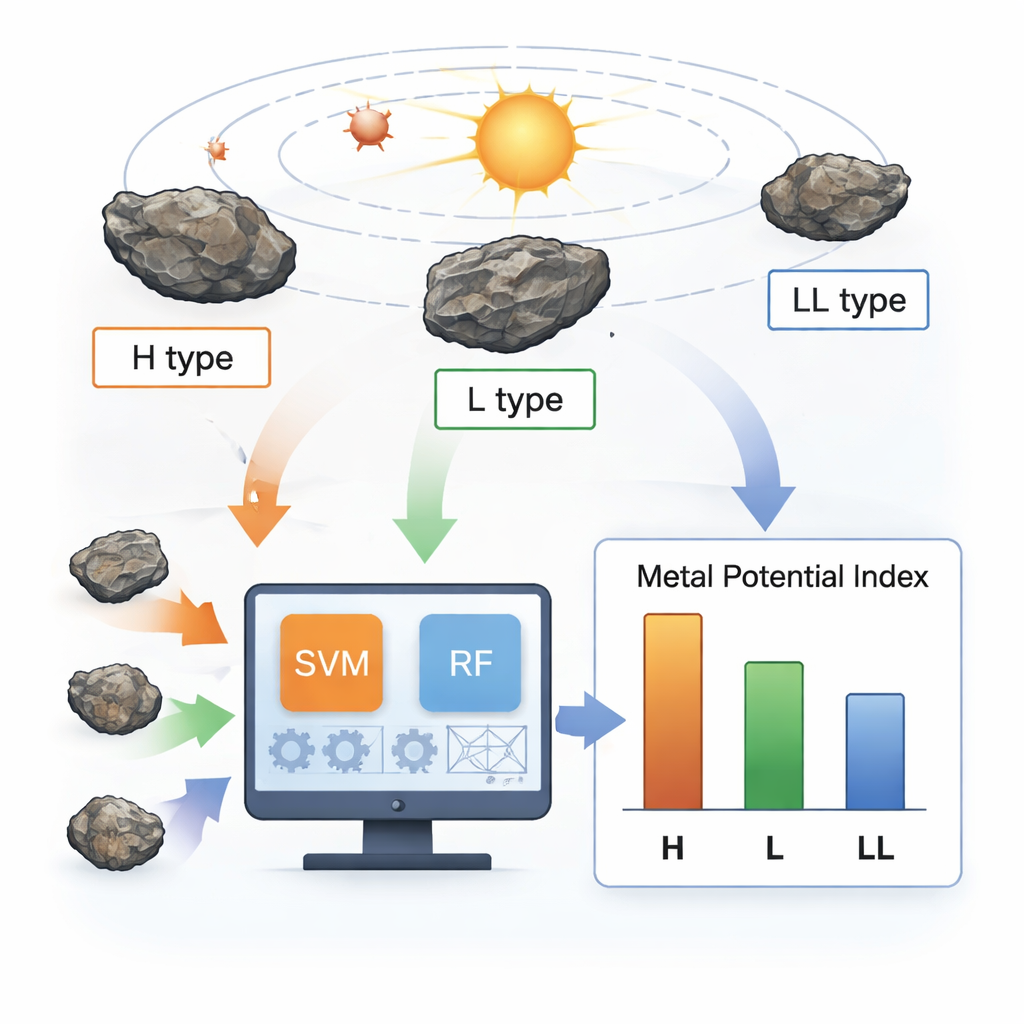
Ordinary chondrites make up about 87% of known meteorite falls and are strongly linked to a common kind of asteroid called S-type, which orbits in the inner main belt. Spacecraft samples, telescope spectra, and orbital dynamics all point to these objects as the main source of ordinary chondrites. Scientists divide them into three chemical groups — H, L, and LL — that differ mainly in how much iron metal and iron-bearing silicate they contain. This grouping helps reconstruct the history of their parent asteroids and is also crucial for judging how much iron–nickel metal a given asteroid might contain for future resource use.
Using Data Science to Classify Space Rocks
Traditional ways of classifying ordinary chondrites rely on detailed mineral or oxygen-isotope measurements, which are not always available, especially for small or weathered specimens. The authors instead compiled about 1,100 bulk chemical analyses from more than 20,000 reported measurements and trained two machine-learning models — support vector machines and random forests — using 13 carefully chosen chemical features. Many of these features are simple ratios to silicon, such as iron-to-silicon (Fe/Si) and nickel-to-silicon (Ni/Si), which capture how metal and rock were separated in the early Solar System. After handling missing data and balancing the numbers of samples in each group, the models were tested using cross-validation to check that their performance was robust, not a fluke of one particular dataset split.
How Well the Models Work
Both machine-learning approaches reached an overall accuracy of about 90% when predicting whether a meteorite belongs to the H, L, or LL group. They were especially good at identifying the metal-rich H and intermediate L types, with precision near or above 90%. The LL group, which is poorer in metal and more affected by later heating and shock, proved harder to distinguish, with precision around 70–80%. By examining which chemical features mattered most to the models, the authors found that Fe/Si and Ni/Si dominate the decision process, while elements like sodium, cobalt, and magnesium play supporting roles. This matches long-standing geochemical ideas that the key difference among these meteorites is how much metal was separated from silicate rock in their birth environment.
From Chemical Patterns to Metal Potential
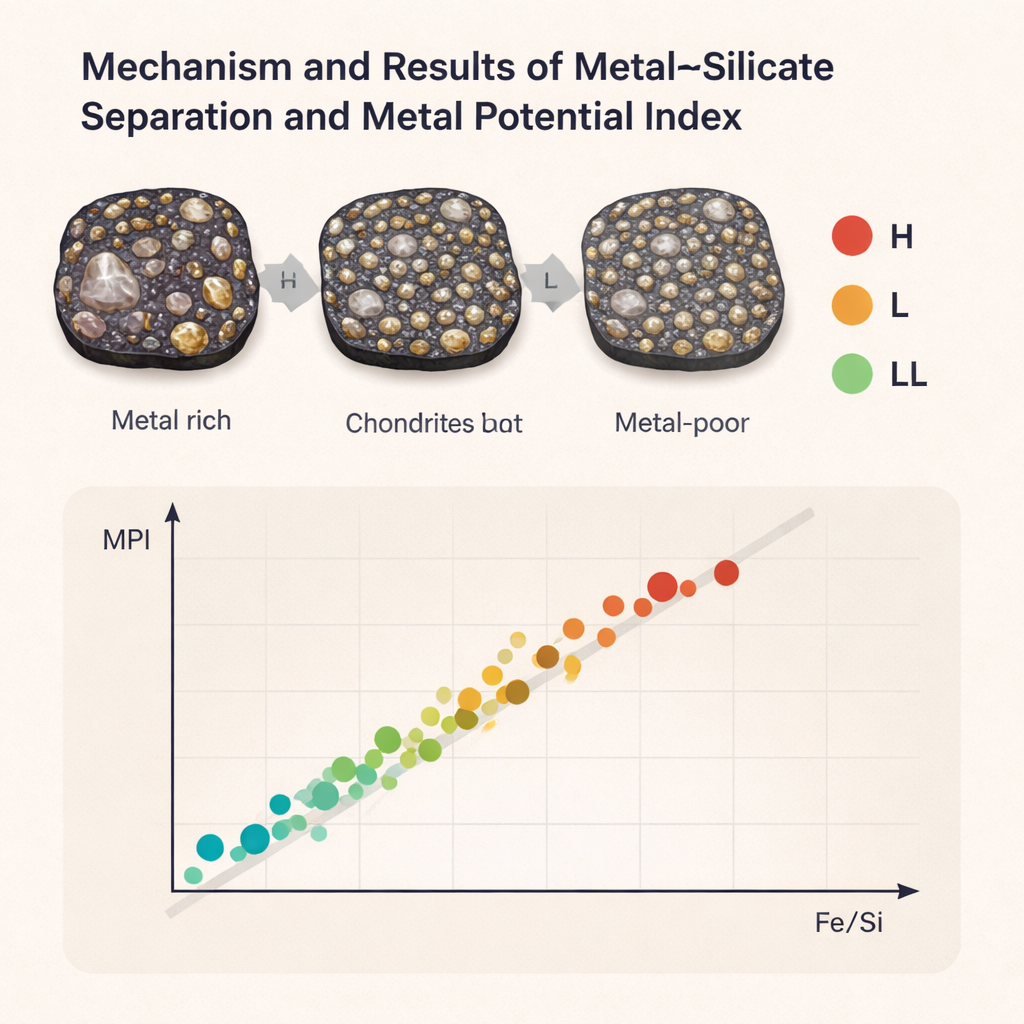
To better visualize the chemistry, the team applied principal component analysis — a statistical method that boils many variables down to just a few combined axes. The first axis cleanly separates metal-rich compositions (high iron and nickel) from silicate-rich ones (high silicon and magnesium), placing H chondrites on one side and L–LL on the other. This pattern suggests that metallic grains of iron–nickel–cobalt are spread fairly evenly within each asteroid-sized parent body, rather than being strongly concentrated in specific layers or regions. Building on this, the authors defined a Metal Potential Index (MPI), which adds together normalized Fe/Si, Ni/Si, and Co/Si values. In this scale, average MPI drops from 1.23 for H chondrites to 0.87 for L and 0.75 for LL, marking a smooth trend from metal-rich to metal-poor sources.
What It Means for Future Exploration
In practical terms, the study offers a way to take a simple bulk chemical analysis of a meteorite — or of material from an asteroid mission — and rapidly answer two questions: which ordinary-chondrite group it belongs to, and how promising its parent body might be as a metal resource. The results point to H-type parent asteroids as the best first targets for in-situ metal extraction, thanks to their consistently higher MPI values and apparently uniform spread of metallic grains. For non-specialists, the takeaway is that by combining large meteorite datasets with modern machine learning, scientists can both sharpen our picture of how the Solar System’s building blocks formed and begin to map where useful metals may lie in near-Earth space.
Citation: Liu, TY., Wei, SJ., Shi, KL. et al. Data-driven classification of ordinary chondrites and asteroidal metal potential evaluation. Sci Rep 16, 5826 (2026). https://doi.org/10.1038/s41598-026-35624-0
Keywords: ordinary chondrites, asteroids, machine learning, meteorite chemistry, space resources