Clear Sky Science · en
The element of surprise distinguishes beauty from pleasure and interest in visuo-tactile perception of art
Why Touching Art Can Change How Beautiful It Feels
Imagine walking through a gallery where you are not scolded for touching the art—you are encouraged to. A vase that looks velvety soft might turn out to be rigid and rough under your fingers; a stone-like sculpture might bounce back like rubber. This study explores how such surprises, when what we feel does not match what we see, shape our sense of beauty, pleasure, and interest in art, and what is happening in the brain when this occurs. 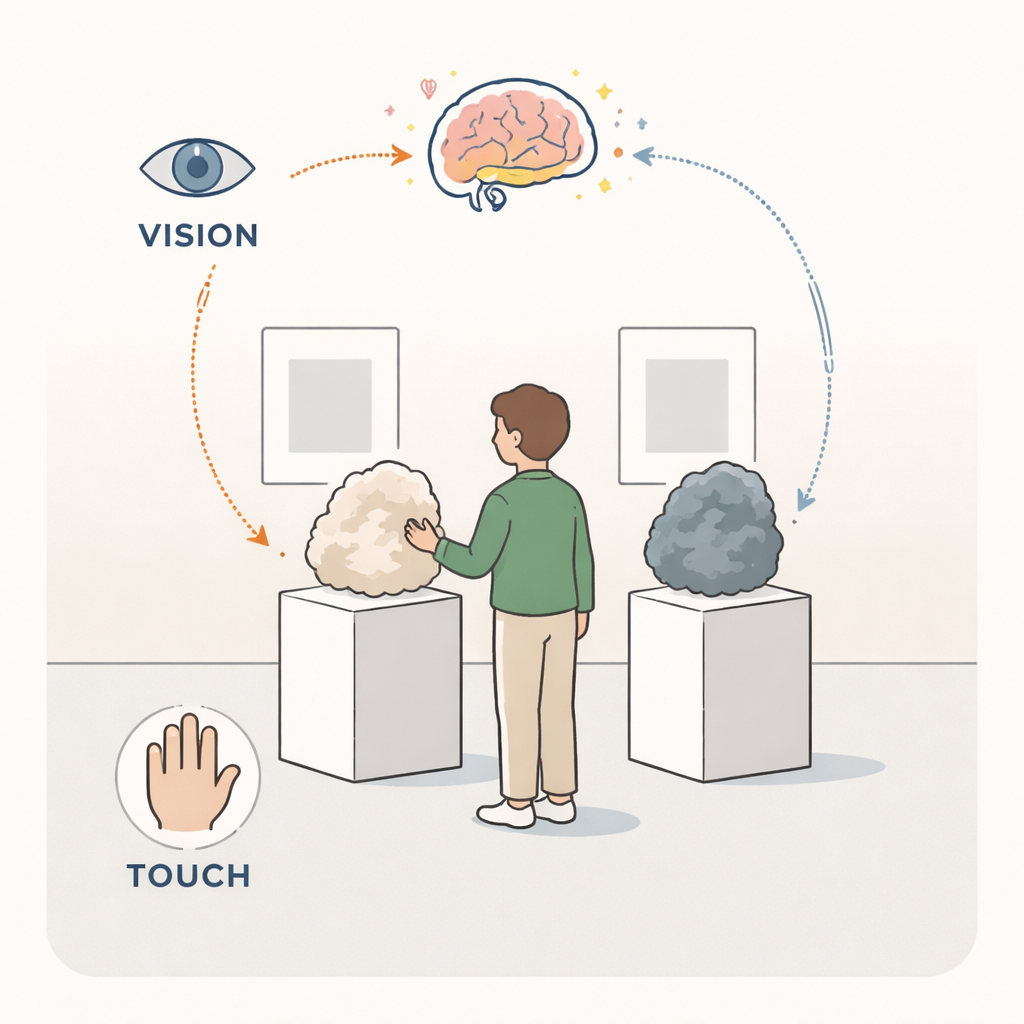
Art You Can See and Feel
The researchers worked with an artist to create eight pairs of sculptures. In each pair, the two pieces looked almost identical but felt different to the touch. One version was "congruent": its feel matched what its appearance suggested—for example, real soft moss that looked soft. The other was "incongruent": its surface was engineered to behave differently from how it looked, such as moss coated in varnish so it became stiff and prickly, or fluffy-looking fabric made hard and scratchy. Sixty-six volunteers explored these sculptures in a gallery-like setting, guided by a tablet, and were explicitly invited to use their hands while their brain activity was recorded.
Judging Beauty, Pleasure, and Interest
After touching each sculpture, participants rated how beautiful, pleasurable, and interesting they found it, along with how connected and engaged they felt, and how aware they were of their own body and movements. Across the board, the visually and tactually matching pieces were judged more beautiful, more pleasurable, and more interesting than the mismatched ones. In other words, sensory harmony—when sight and touch agree—tended to make artworks feel better overall. Yet feelings of intimacy with the art and awareness of one’s own body did not clearly differ between matching and mismatching sculptures; those aspects seemed to depend more on the specific piece than on whether it surprised the hand.
When the Brain Says “Something’s Off”
To peer inside the brain, the team focused on a signal known as mismatch negativity, or MMN, measured with EEG. MMN is a brief electrical response that appears when incoming sensory information violates expectations. Some sculpture pairs, especially those where a surface suddenly felt bouncy instead of hard, or stiff instead of soft, produced a stronger MMN: the brain registered a clearer "that’s not what I predicted" moment. Other pairs, despite being designed to be misleading, evoked little or no such signal, suggesting that not every visual–tactile mismatch is equally surprising at a neural level. 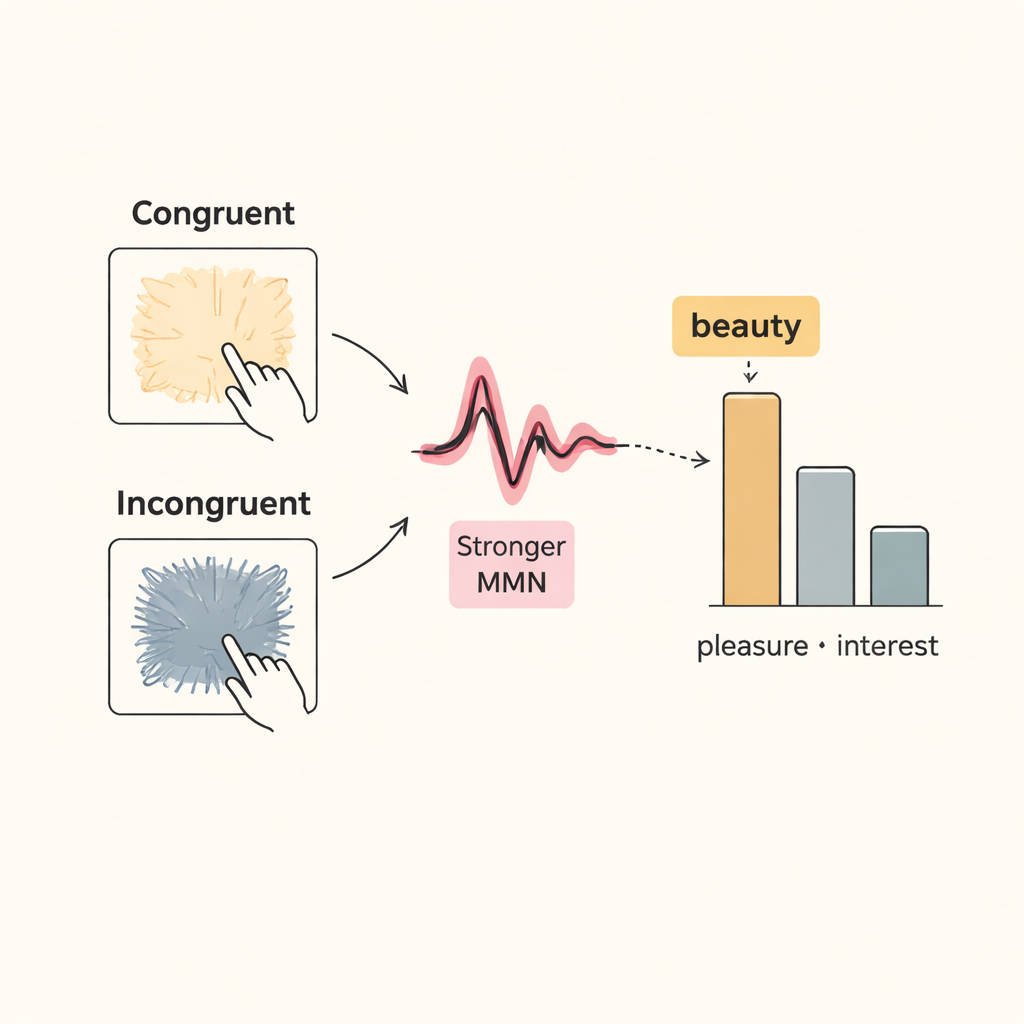
Surprise and the Experience of Beauty
The most intriguing finding emerged when the researchers linked the brain signal to people’s ratings. For artworks that produced a clear MMN, stronger surprise in the brain tended to go hand in hand with higher beauty ratings. This was not true for pleasure or interest alone. Moreover, the link between surprise and beauty was strongest when people reported relatively low pleasure. The authors suggest that beauty may rely on a kind of reflective, “thinking about what I’m feeling” state. When an artwork violates expectations, the brain flags a mismatch; if we stay with that moment of uncertainty instead of just enjoying easy comfort, we may end up finding the piece more profoundly beautiful.
Finding the Sweet Spot Between Comfort and Surprise
In simple terms, this study shows that while we usually like artworks that feel just as they look, an element of surprise can deepen our sense of beauty. Too much unpredictability may be confusing or unpleasant; too little may be dull. Somewhere in between lies a sweet spot where a sculpture’s unexpected feel prompts our brain to reconsider and resolve the mismatch. That extra mental work seems to be part of what turns mere pleasure into a richer experience of beauty, especially in art meant to be explored by touch as well as by sight.
Citation: Pistolas, E., Sayın, E. & Wagemans, J. The element of surprise distinguishes beauty from pleasure and interest in visuo-tactile perception of art. Sci Rep 16, 6258 (2026). https://doi.org/10.1038/s41598-026-35622-2
Keywords: tactile art, multisensory perception, aesthetic experience, prediction error, mismatch negativity