Clear Sky Science · en
Effects of pulsating flow frequency and dimensionless amplitude on the thermal performance of SEGS LS-2 parabolic trough solar collector
Making Solar Heat Work Harder
Parabolic trough solar collectors are a workhorse technology for turning sunlight into heat for electricity and industry. This study asks a simple but powerful question: instead of pushing the heat-carrying oil through these collectors at a steady pace, what if we gently "pulse" the flow? By rhythmically speeding up and slowing down the liquid, the researchers show it is possible to squeeze more useful heat out of the same sunlight, with only a small and inexpensive change to existing systems.
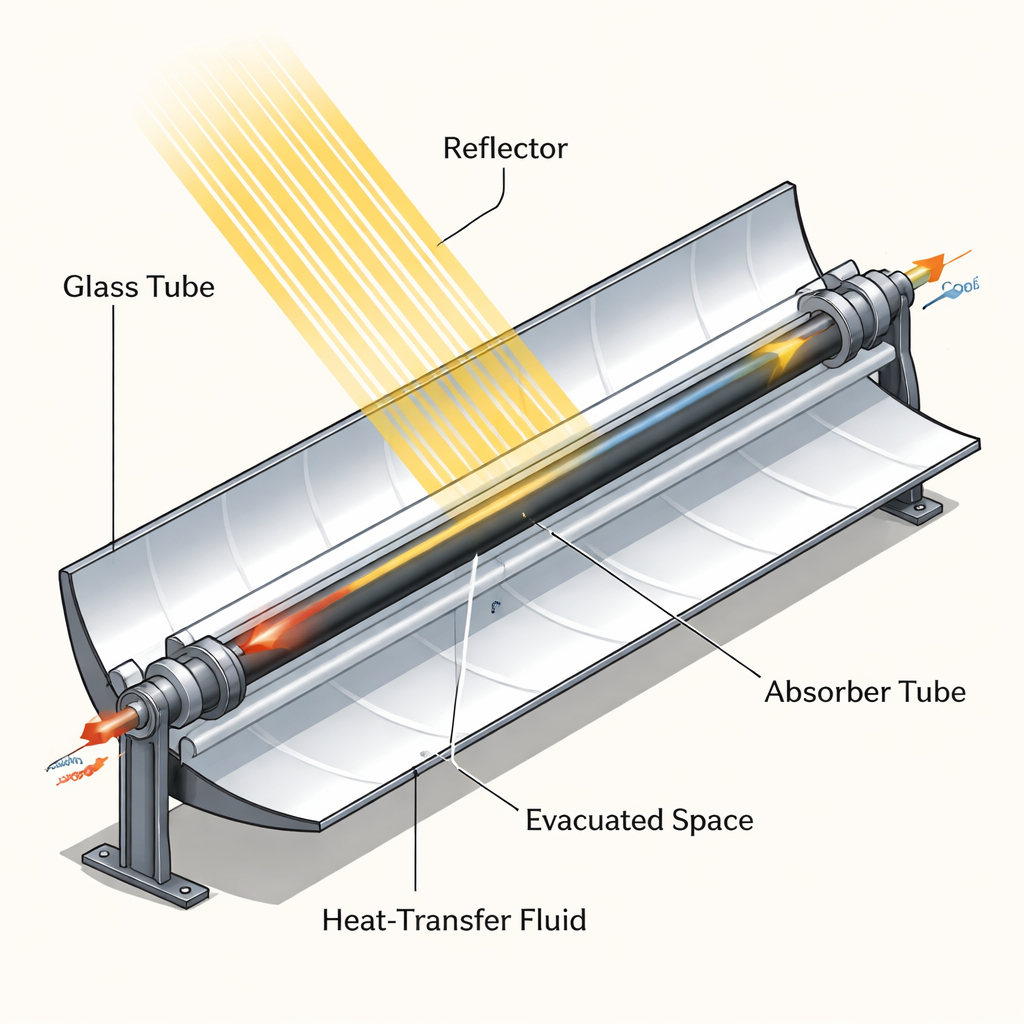
How Curved Mirrors Capture Sunlight
The work focuses on a widely used commercial design called the SEGS LS-2 parabolic trough collector. Long, curved mirrors concentrate sunlight onto a narrow metal tube that runs along the focus of the trough. Inside that tube, a special heat-transfer oil called Syltherm 800 is pumped through, picking up heat that can later drive a power cycle or industrial process. The tube is surrounded by a glass envelope and an evacuated (low-pressure) gap to cut heat losses. Because the mirror does not light the tube evenly around its circumference, some regions of the tube get much hotter than others, which affects how efficiently heat moves into the flowing oil.
Turning Flow Into a Gentle Pulse
Instead of changing the hardware of the collector, such as adding fins or special inserts, the authors change how the fluid moves. They prescribe a smooth, sinusoidal inlet condition: the flow rate oscillates around its normal average value, becoming a bit faster and then a bit slower in a repeating pattern. Two knobs control this motion. The frequency (0.2–6 cycles per second) sets how often the flow speeds up and slows down, and the dimensionless amplitude (0.3–0.9) sets how strong each pulse is relative to the average speed. Using advanced fluid dynamics software, they simulate how these pulsations interact with the thin layer of fluid hugging the inner wall of the tube, where most of the heat transfer happens.
What Happens Inside the Hot Tube
Under steady flow, the fastest-moving oil is near the center of the tube, while the fluid close to the wall is sluggish and dominated by friction. That slow near-wall region limits how quickly heat can move into the bulk flow. The simulations show that at an optimal pulsation—about 5 Hz with a moderate amplitude of 0.5—the pulses shake energy out of the faster central stream and push it into the near-wall layer. This creates more intense small-scale mixing right where the metal tube meets the fluid. As a result, the effective heat transfer rate, captured by a dimensionless measure called the Nusselt number, rises to about 5.1, higher than in the steady case. The outer wall of the tube runs cooler, while the oil leaving the collector becomes slightly hotter overall, showing that more of the incoming solar energy ends up in the fluid.
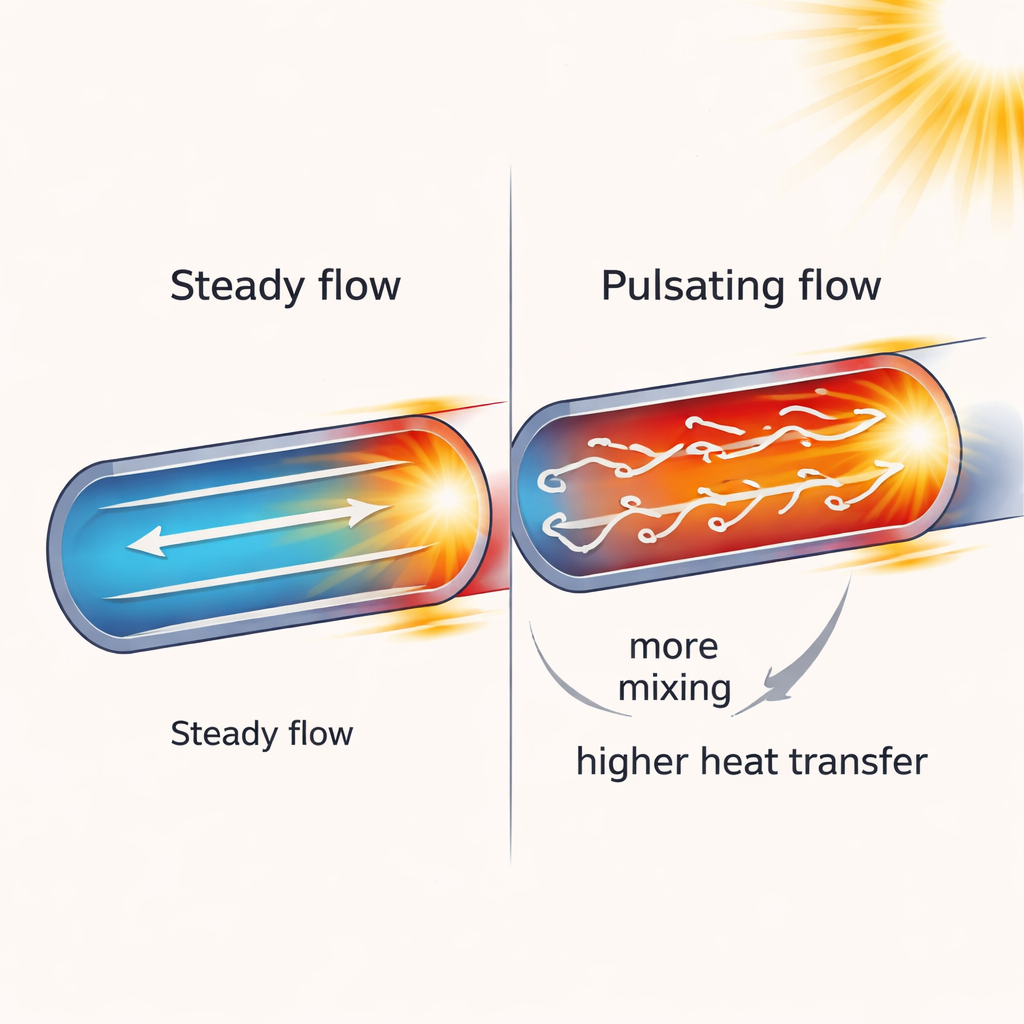
Finding the Sweet Spot and Its Limits
The study explores many combinations of frequency and pulse strength to find the practical sweet spot. At very low frequencies, the flow does not pulse often enough to noticeably disturb the near-wall layer, so performance gains are small. At the optimal 5 Hz and amplitude 0.5, time-averaged thermal efficiency reaches about 77%, compared with roughly 74% reported for conventional steady flow—an improvement of 3–4.5 percentage points. Pushing frequencies even higher, to around 6 Hz, brings diminishing returns: the turbulence pattern effectively "freezes" and stops responding to faster oscillations. Likewise, making the pulses too strong (high amplitude) increases internal heat transfer but actually cools the fluid too much as it races through, reducing overall efficiency.
Low-Cost Upgrade for Sunny Regions
Because the collector geometry and working fluid are unchanged, this approach could be applied to existing solar fields by adding relatively simple flow-control hardware, such as frequency-controlled valves or rotary devices at the inlet. The authors estimate that for a standard LS-2 module, the cost of such a valve is only about 1–2% of the collector price, while it can deliver an efficiency gain of about 3%. In very sunny, hot, and dry regions—where solar input is high and such collectors are already common—this small relative improvement could translate into substantial extra energy over the lifetime of a plant. In plain terms, by learning to "shake" the heat-transfer fluid just right, engineers can get more usable heat out of the same sunlight, without expensive redesigns or exotic new materials.
Citation: Ferdosnia, S., Mirzaee, I., Abbasalizadeh, M. et al. Effects of pulsating flow frequency and dimensionless amplitude on the thermal performance of SEGS LS-2 parabolic trough solar collector. Sci Rep 16, 6105 (2026). https://doi.org/10.1038/s41598-026-35619-x
Keywords: parabolic trough solar collector, pulsating flow, heat transfer enhancement, solar thermal efficiency, frequency-controlled valves