Clear Sky Science · en
Seismic energy from small earthquakes maps fault segmentation in the Southeastern Alps
Why tiny quakes matter for big risks
When we think about dangerous earthquakes, we picture rare, powerful events that shake entire regions. But beneath our feet, thousands of tiny tremors happen quietly every year. This study shows that these small earthquakes, too weak to cause damage on their own, can reveal how and where future larger earthquakes might strike in the Southeastern Alps, one of the most hazardous parts of Central Europe.
Listening to the crust with a dense network
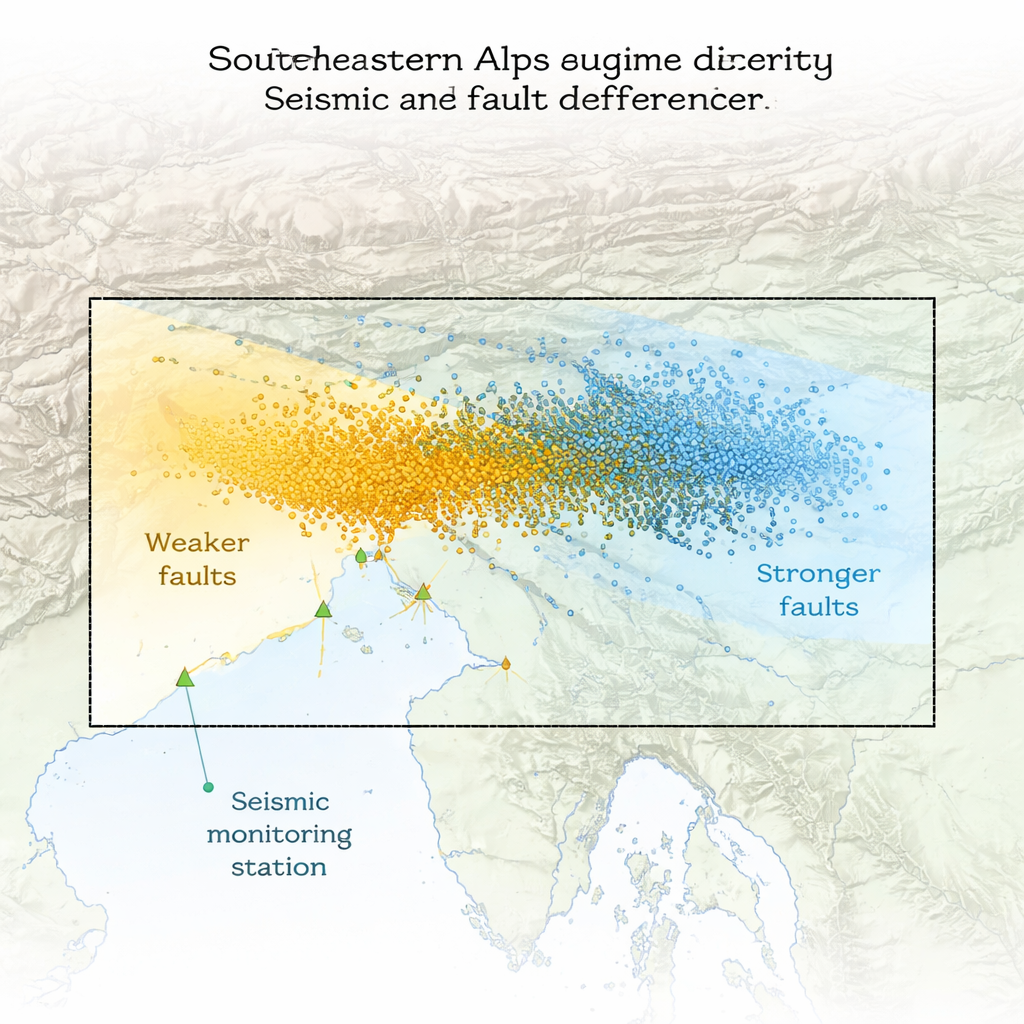
The researchers focused on the border region between Italy, Austria and Slovenia, where the Eurasian plate and the Adriatic microplate slowly collide. This area hosts a tangled system of faults and a long history of damaging earthquakes, such as the 1511 Idrija and 1976 Friuli events. Thanks to a dense web of seismic stations operated by several countries, the team could reprocess records from more than 9,200 earthquakes between 2016 and 2025, most of them so small that only instruments can detect them. Instead of looking only at how big each quake was, they examined how much seismic energy it radiated compared with its size, using a parameter called the Energy Index. This allowed them to infer how efficiently each fault patch released stored stress during rupture.
A new way to read fault strength
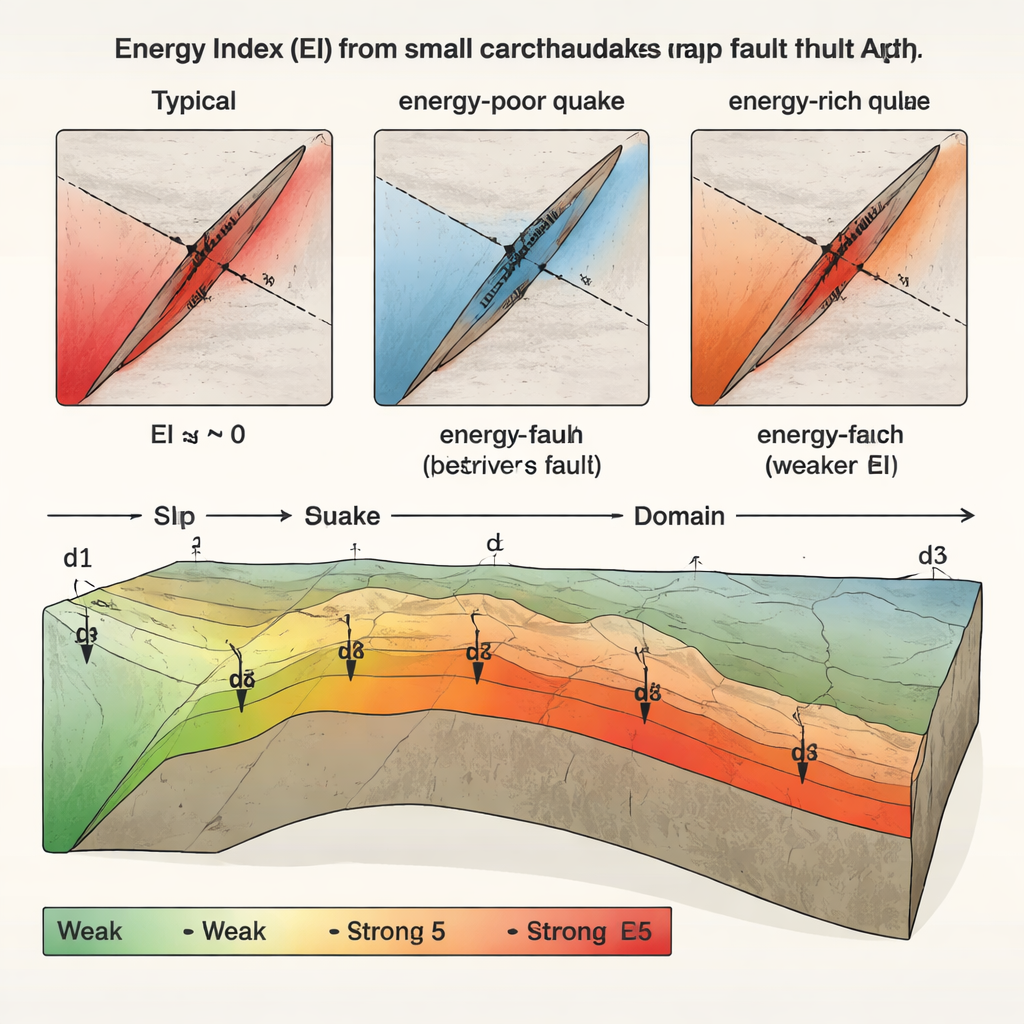
For each event, the scientists estimated two key quantities directly from the seismograms: the seismic moment, which reflects how much the fault slipped over how large an area, and the radiated energy, which reflects how intense the shaking was. They then built a reference relationship between these two measures for the region and defined the Energy Index as the difference between what the energy should be, on average, and what was actually observed. Earthquakes with a positive Energy Index radiate more shaking than typical events of the same size and are interpreted as happening on mechanically weaker fault patches. Negative values suggest energy-poor ruptures on stronger, more resistant fault sections. By mapping these values in three dimensions, the team created an image of how fault strength varies across the Southeastern Alps.
East–west contrasts in hidden fault behavior
The resulting picture shows a clear contrast from west to east. West of about 12° longitude, small earthquakes tend to have higher Energy Index values, indicating weaker faults that let ruptures run more efficiently once they start. In the eastern sector, by contrast, most small quakes radiate less energy than average, pointing to stronger, more segmented fault zones that resist sliding and require more stress to break. The team grouped the region into five domains, each with its own mix of seismic energy release, long-term strain rate, and history of large earthquakes. In some domains, faults seem to be mechanically weak and well lubricated, possibly by fluids within fractured rocks. In others, reduced day‑to‑day seismicity and lower energy release hint at locked segments that may be quietly storing elastic strain.
Connecting small quakes, rock properties and hazards
These patterns do not stand alone. They line up with independent images of the crust obtained from seismic wave speeds and attenuation, as well as with geodetic measurements of how the ground is deforming. Regions where small quakes look energetic also tend to show signs of damaged, permeable rock and fluid-rich zones, which weaken faults and allow stress to be relieved through frequent smaller events. Areas that look stronger in the Energy Index maps often coincide with stiffer rocks, lower levels of everyday seismicity, and in several cases with the sites of past moderate to large earthquakes. Together, these findings suggest that fault strength, rock type, fluids and long-term deformation are all tightly linked in shaping when and how earthquakes occur.
From research tool to real-time monitoring
The study demonstrates that carefully analyzing thousands of minor earthquakes can map the mechanical segmentation of complex fault systems at a level of detail not achievable with rare large events alone. By extending a monitoring framework first developed for central Italy, the authors show that the Energy Index can be computed in a way similar to standard magnitudes, making it suitable for routine use. In the future, tracking changes in this index over time could help identify evolving stress conditions and the early stages of preparation for larger earthquakes. For people living in and around the Southeastern Alps, this does not mean that small earthquakes can be used to predict specific events, but it does mean that continuous “listening” to tiny tremors can sharpen seismic hazard models and guide targeted monitoring where the crust is most primed to fail.
Citation: Picozzi, M., Cataldi, L., Viganò, A. et al. Seismic energy from small earthquakes maps fault segmentation in the Southeastern Alps. Sci Rep 16, 5731 (2026). https://doi.org/10.1038/s41598-026-35618-y
Keywords: earthquakes, fault strength, Southeastern Alps, seismic hazard, microseismicity