Clear Sky Science · en
Echocardiographic investigation of maternal cardiac physiological adaptations in Chinese pregnancies
Why the Heart Matters in Pregnancy
Pregnancy is often described as a workout that lasts for months, not minutes. To nourish both mother and baby, a woman’s heart and blood vessels undergo remarkable, carefully tuned changes. This study followed hundreds of healthy Chinese women through pregnancy using ultrasound scans of the heart to see exactly how the heart’s size, pumping strength, and filling patterns shift from trimester to trimester. Understanding what “normal” looks like for this population can help doctors spot early signs of trouble and protect mothers from serious heart problems.
A Growing Heart for a Growing Baby
As pregnancy progresses, a woman’s blood volume increases dramatically to supply the uterus and placenta. The researchers used echocardiography—an ultrasound of the heart—to track how the heart’s main pumping chamber, the left ventricle, responds to this extra load. They found that the cavity of the left ventricle gradually becomes larger from early to late pregnancy, while the muscle walls stay about the same thickness. This pattern, called volume or “eccentric” enlargement, allows the heart to hold and eject more blood with each beat without becoming abnormally thick or stiff. The heart’s upper chambers and the ring-like openings of its valves also expand modestly, reflecting an overall stretching that remains within healthy limits. 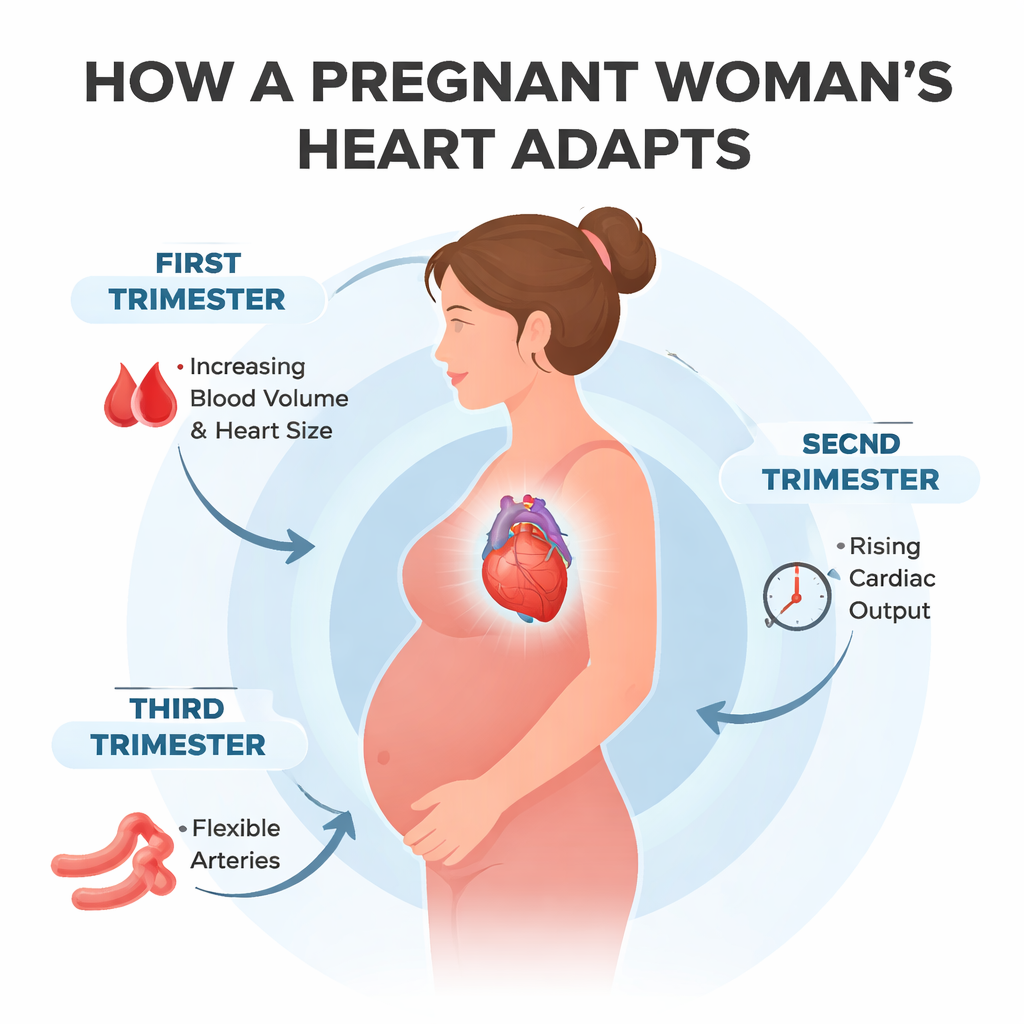
More Blood Pumped, Strength Preserved
One of the clearest signs of adaptation in this study was the steady rise in stroke volume—the amount of blood pumped out with each heartbeat—and cardiac output, the total blood the heart pumps per minute. By the third trimester, both measures were significantly higher than in early pregnancy, showing that the heart is working harder but efficiently to support the mother and the growing fetus. At the same time, a standard measure of pumping strength, the ejection fraction, stayed in the normal range, declining only slightly. This suggests that although the heart is under extra demand, its core strength and performance remain intact in healthy pregnancies.
Subtle Shifts in How the Heart Fills
The team also examined how the heart relaxes and fills with blood between beats, a phase known as diastole. They measured blood flow across the mitral valve and tiny movements of the heart muscle itself. Over the course of pregnancy, some values that reflect early, passive filling of the heart decreased, while those related to the later, active squeeze from the upper chamber increased. Ratios combining these signals shifted modestly in a way that would look worrisome in someone with heart disease. However, in these healthy pregnant women, all values stayed within normal ranges and matched what is expected when the heart is coping with higher blood volume. In other words, these changes likely represent a normal fine-tuning of the heart’s relaxation rather than early damage.
Blood Vessels Keeping Pace
Beyond the heart itself, the researchers looked at how blood flows through the main artery to the body and the main artery to the lungs. Flow speeds and pressure differences across these vessels rose slightly with advancing pregnancy but remained well within healthy boundaries. These mild increases fit with higher blood flow overall and the natural softening and widening of blood vessels seen in pregnancy. Together, the heart and great arteries appear to adjust in a coordinated fashion so that circulation remains smooth and balanced despite the added demands of the uterus and placenta. 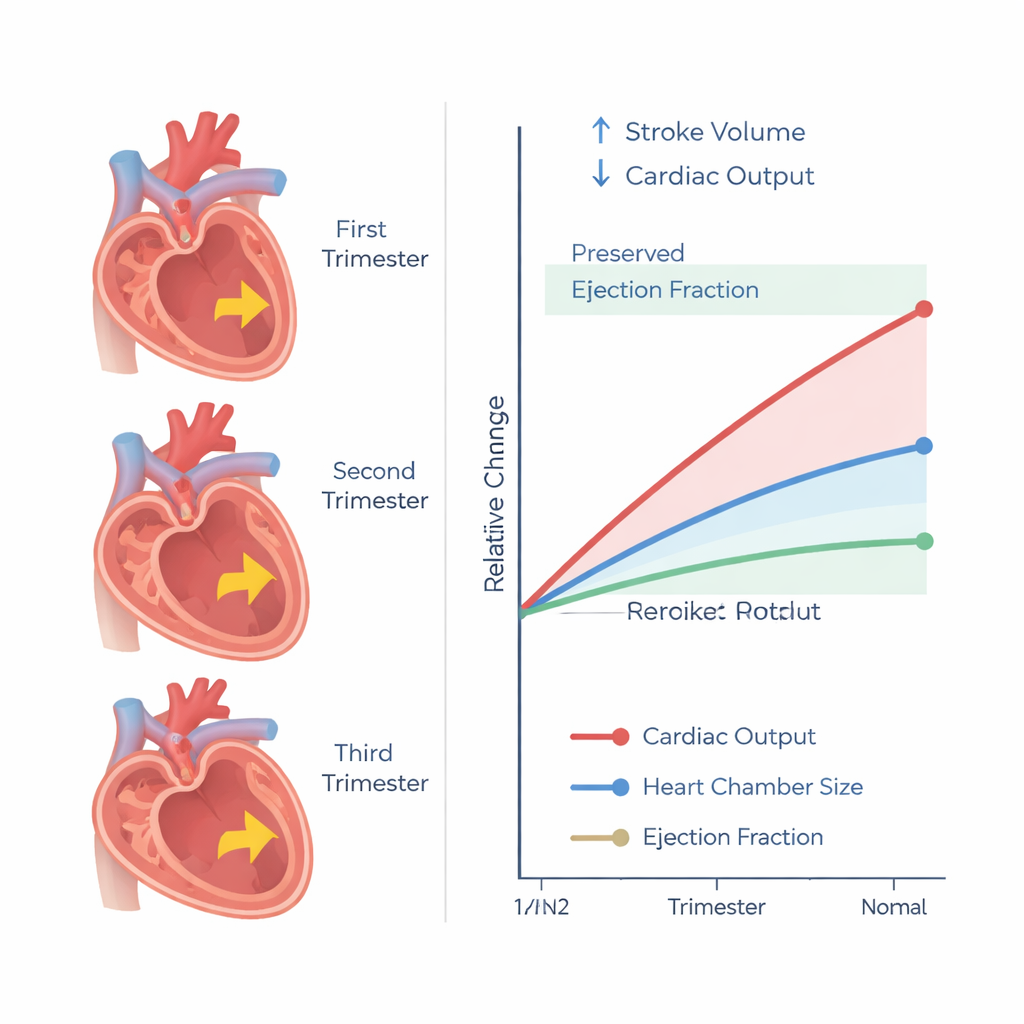
What This Means for Mothers and Clinicians
Heart-related complications are now a leading cause of maternal death worldwide, and many can be prevented if early warning signs are recognized. This large study provides trimester-specific reference values for heart structure and function in healthy Chinese women. These tailored benchmarks can help doctors distinguish between normal pregnancy changes—like a slightly larger heart or altered filling patterns—and the early stages of heart strain or disease. For expectant mothers, the findings are reassuring: in uncomplicated pregnancies, the heart typically grows, pumps more, and relaxes a bit differently, but it does so in a flexible, reversible way that safely supports both mother and baby.
Citation: Chen, ZH., Chiu, WH., Chao, SS. et al. Echocardiographic investigation of maternal cardiac physiological adaptations in Chinese pregnancies. Sci Rep 16, 4956 (2026). https://doi.org/10.1038/s41598-026-35615-1
Keywords: pregnancy heart changes, maternal cardiovascular adaptation, echocardiography in pregnancy, Chinese pregnant women, cardiac output during pregnancy