Clear Sky Science · en
Trajectory of stratum radiatum, lacunosum and moleculare integrity in Alzheimer’s disease continuum
Why this matters for memory and aging
As people live longer, many worry about whether normal forgetfulness could be an early sign of Alzheimer’s disease. Doctors can scan the brain for shrinkage in memory centers, but today’s tools often miss the very first changes, when treatment and planning might help most. This study looks at a thin, signal-carrying layer inside the brain’s memory hub—the hippocampus—to see whether its appearance on MRI might reveal Alzheimer’s disease earlier and predict who is likely to decline faster.
A closer look at the brain’s memory hub
The hippocampus is a seahorse-shaped structure deep in the brain that is crucial for forming new memories. Inside it lies a delicate band of wiring called the stratum radiatum, lacunosum, and moleculare, or SRLM. This layer carries messages into a key hippocampal region and is one of the first places affected by the abnormal proteins that build up in Alzheimer’s disease. On certain MRI scans, the SRLM appears as a thin dark line. Earlier work suggested that this line fades as the tissue becomes damaged, raising the possibility that the clarity of this line could act as a simple visual marker of early disease.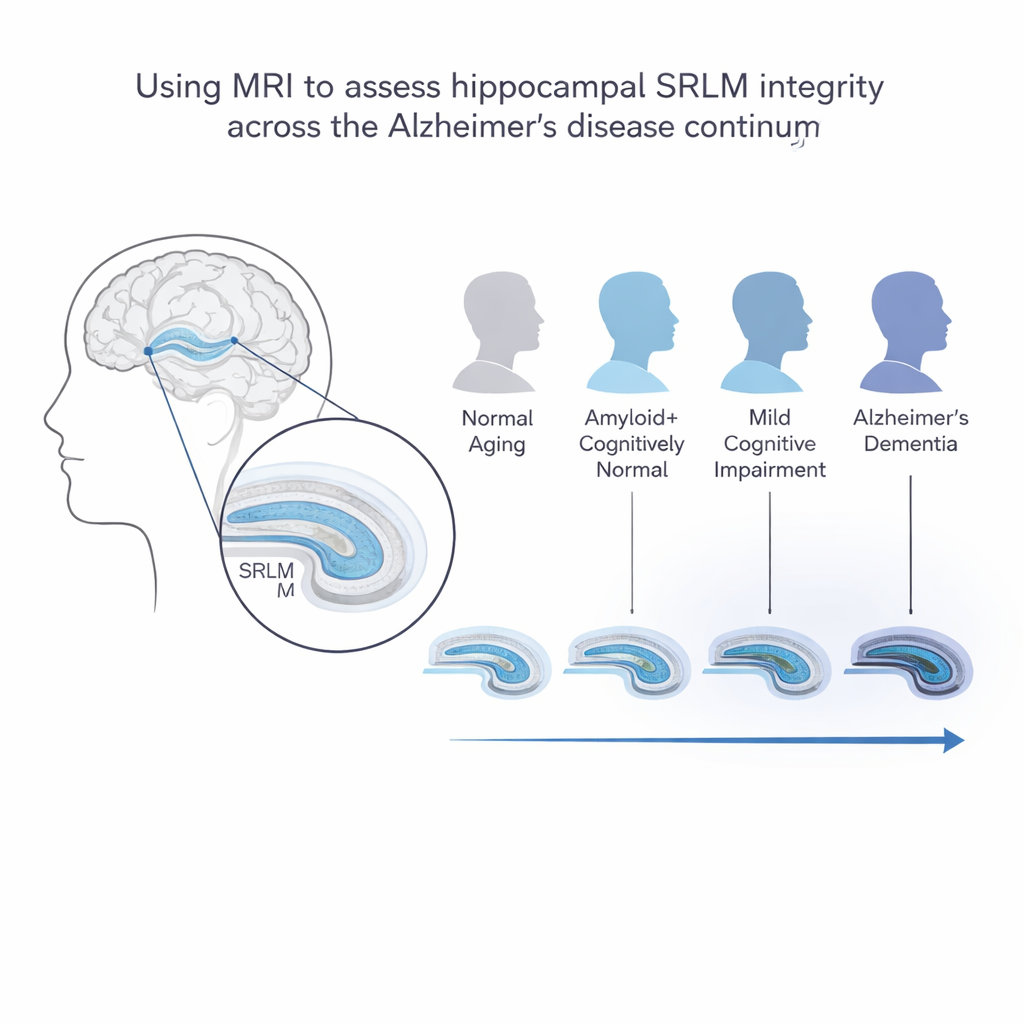
Following people along the Alzheimer’s path
To test this idea, the researchers used data from a large U.S. study of aging and dementia. They grouped 373 older adults into four stages along the Alzheimer’s “continuum” based on brain scans for amyloid, one of the hallmark proteins of the disease. The groups were: people with normal thinking and no amyloid, people with normal thinking but amyloid present, people with mild memory problems plus amyloid, and people with full Alzheimer’s dementia plus amyloid. Everyone had detailed MRI scans, including high‑resolution images focused on the hippocampus, and most had follow‑up memory testing over about two years.
Reading a fading line on MRI
Two trained readers, who did not know the participants’ diagnoses, scored the SRLM on each person’s MRI using a five‑point scale: from a missing or barely visible line to a crisp, continuous one. They also scored overall hippocampal shrinkage using a standard visual rating scale and measured volumes of the hippocampus and neighboring structures with automated software. Compared with the healthy, amyloid‑negative group, people who were amyloid‑positive but still tested normally already showed significantly lower SRLM scores. In contrast, visible hippocampal shrinkage and volume loss were mainly seen later, in those with mild cognitive impairment or dementia, suggesting that SRLM changes appear earlier than traditional measures.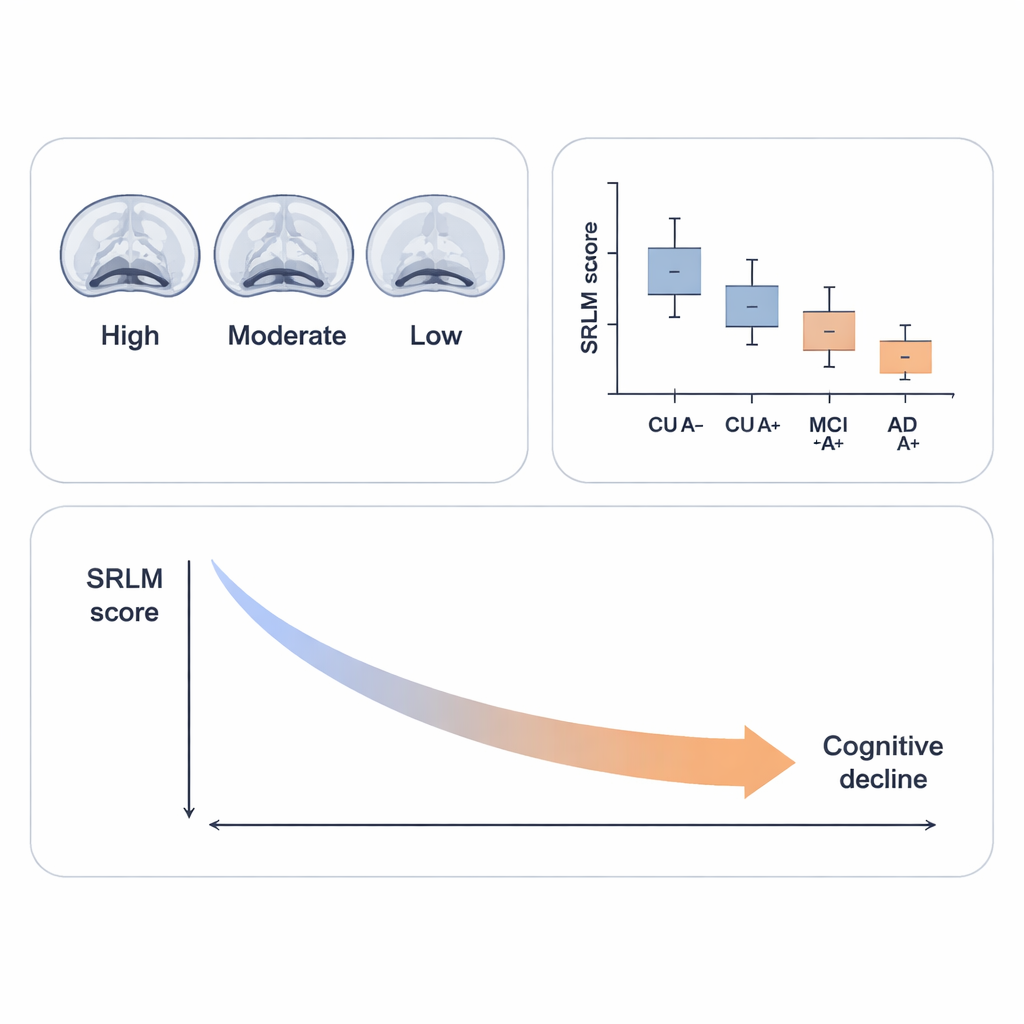
Linking brain changes to thinking and disease proteins
Across all participants, lower SRLM scores, greater hippocampal shrinkage, and smaller hippocampal volume were each tied to higher levels of amyloid and tau (another Alzheimer’s protein) and to worse performance in memory, language, and thinking tests. Among people with amyloid in the brain, these relationships were moderate and consistent. Even in the group without amyloid, subtle links appeared between SRLM scores, tau levels, and certain thinking abilities. Importantly, when the team looked at changes over time, those who started with poorer SRLM integrity were more likely to show faster decline on standard dementia scales, even after accounting for age, sex, and education.
What this could mean for patients and doctors
From a layperson’s perspective, this work suggests that doctors may one day read a single thin line on a routine MRI to spot very early signs of Alzheimer’s‑related damage. Because SRLM changes appear before clear brain shrinkage and predict who is more likely to decline, they could help identify higher‑risk individuals for closer monitoring, lifestyle changes, or participation in clinical trials. The method still relies on expert judgment and high‑quality scanners, and larger studies are needed, but it points toward a future where simple MRI features provide earlier, more precise warnings about memory disorders.
Citation: Wang, K., Shao, B., Zeng, Q. et al. Trajectory of stratum radiatum, lacunosum and moleculare integrity in Alzheimer’s disease continuum. Sci Rep 16, 5796 (2026). https://doi.org/10.1038/s41598-026-35610-6
Keywords: Alzheimer’s disease, hippocampus, brain MRI, early diagnosis, memory loss