Clear Sky Science · en
Non-cohesive jet formation of Zr-based amorphous alloy shaped charge liners: a predictive model
Why breaking a metal jet can be a good thing
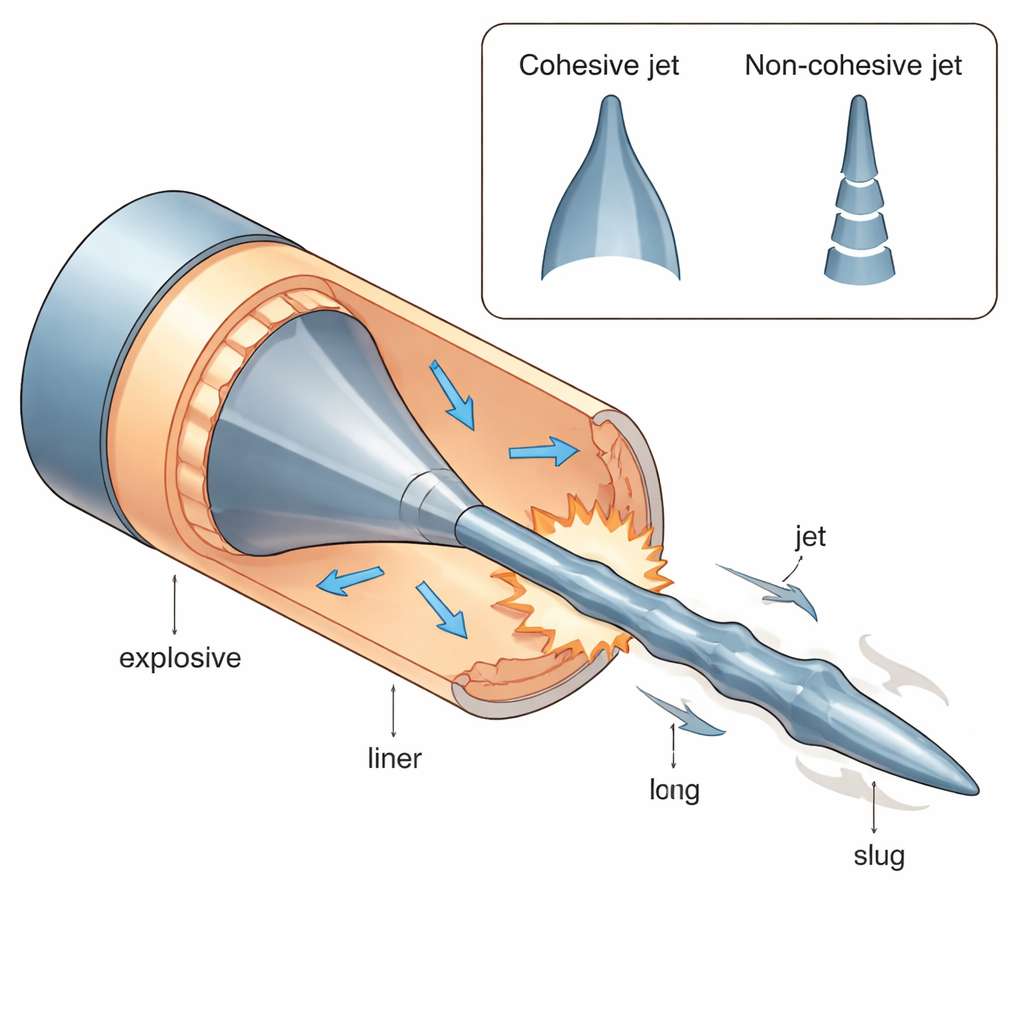
Explosives are often used to punch narrow, deep holes in armor or concrete by squeezing a metal cone into a fast, needle‑like jet. This study looks at a new way to shape those jets using a special zirconium‑based “amorphous” metal. Instead of forming a single smooth spear, this material naturally breaks into a spray of high‑speed fragments. That trade‑off—slightly less depth, but a much wider hole—could be valuable for next‑generation warheads and protective technologies.
A different kind of explosive metal
Traditional shaped charges use ductile metals like copper, which collapse into a long, cohesive jet that burrows deep along a narrow path. Engineers have learned that “non‑cohesive” jets—jets that quickly split into many pieces—can be better when you want to damage a larger area, for example to clear a wide tunnel for a second charge or to disrupt complex structures. Most existing non‑cohesive jets rely on light plastic‑metal mixtures, which do not penetrate very far. Zr‑based amorphous alloys, sometimes called bulk metallic glasses, combine high density with high strength and chemical reactivity, making them promising candidates for powerful but widely spreading jets. Earlier tests showed these alloys produce discrete, particle‑like jets, but until now there was no predictive theory explaining why.
Modeling how the cone collapses
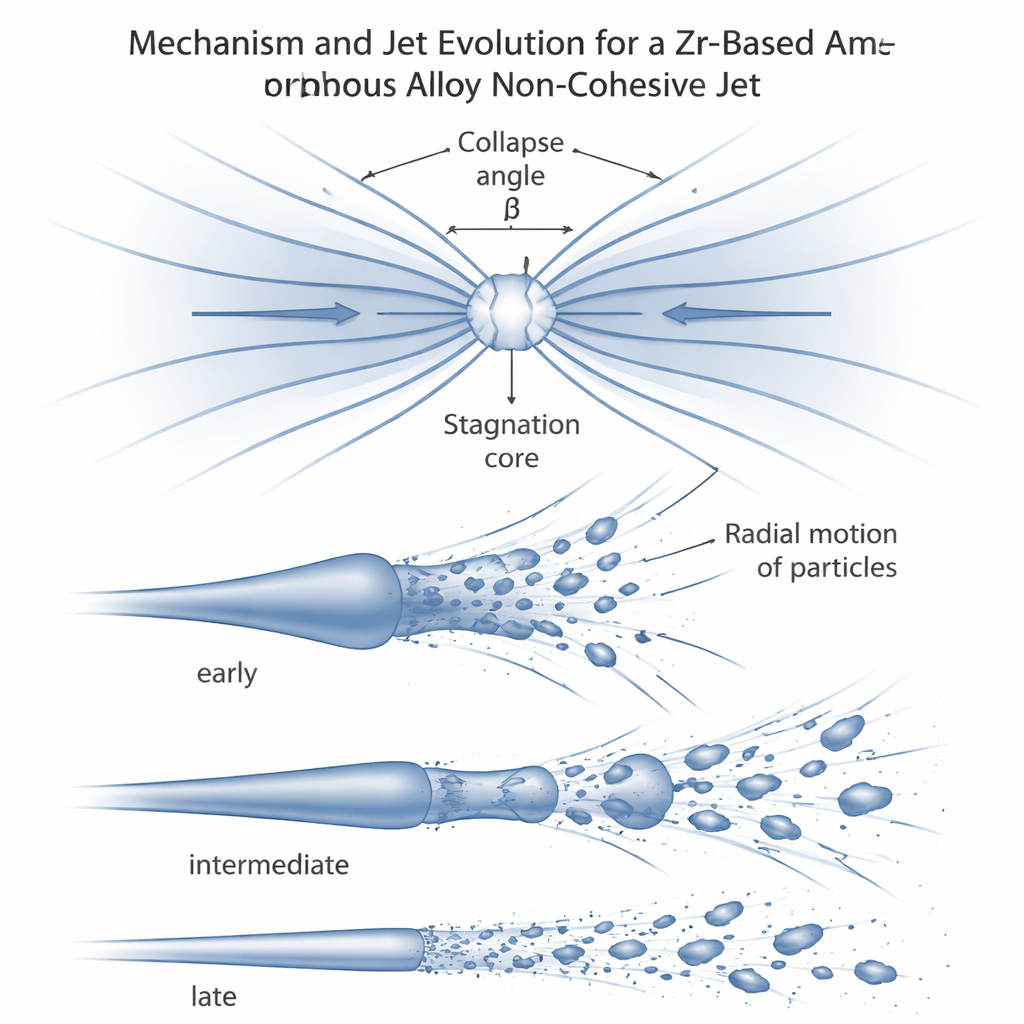
The authors build a mathematical model that zooms in on the tiny region where the metal liner is crushed inward by the explosive. Near the axis, metal flow is diverted around a small “stagnation core,” following curved paths rather than straight lines. The model treats this region as a compressible circular flow and uses a material description tailored to brittle, glass‑like solids (the JH‑2 model). By solving the mass and momentum balance in this curved‑flow zone, and matching it to the rest of the collapsing cone, the model predicts how pressure, density, and flow speed change from the inner to outer streamlines. These predictions are then tied to a key question: at what point do local flow speeds reach or exceed the speed of sound in the material, a condition that tends to destabilize the jet and push particles sideways instead of straight ahead.
A hidden limit: the maximum collapse angle
When the cone collapses, each ring of material closes at a particular angle and speed. The new model shows that for the Zr‑based amorphous alloy there is a maximum collapse angle: beyond this value, the equations describing a steady, well‑behaved flow simply stop having a solution. Physically, this means the metal fragments early, the curved flow region cannot remain stable, and strong sideways (radial) velocities develop. The researchers derive a critical inflow speed for the metal entering this region and show how it depends on the geometry and the material’s sound speed. They also refine a geometric ratio that characterizes the size of the flow region, bringing the model’s numerical predictions into very close agreement (within about half a percent) with their detailed calculations.
Seeing the jet break apart in real time
To check their theory, the team built real shaped charges using a Vit1 amorphous alloy liner and detonated them while recording the jet with high‑energy X‑ray cameras. At about 30 millionths of a second after detonation, the jet looked much like a conventional one: long and nearly continuous, with only a bulb‑shaped thickening at the tip where particles were crowding together. By 60 microseconds, however, the front of the jet had opened into a trumpet‑shaped cavity, and clumps of material were peeling away radially, clear signs of a non‑cohesive jet. Computer simulations using the same material laws reproduced these features—the bulging tip, the growing cavity, and the cloud of fragments—confirming that the model captured the key physics.
From tiny elements to overall jet behavior
Because the model links each small piece of the liner to its eventual motion in the jet, the authors can map which regions of the cone produce cohesive segments and which produce loose particles. They find that material near the cone’s nose and its base tends to stay cohesive, feeding the jet tip and the rear “slug,” while material from the middle region is most likely to become non‑cohesive. This pattern matches the X‑ray images, where the jet body eventually shows strong breakup while the tail remains relatively solid. Importantly, the model explains why this breakup happens even though the collision speeds in the amorphous alloy are still below the traditional sound‑speed threshold that works for copper: the brittle, glass‑like character of the alloy and the existence of the maximum collapse angle together drive the jet to fragment.
What this means in practice
For non‑specialists, the key takeaway is that the way a metal cone fails under explosive loading—whether it flows smoothly or shatters—can be predicted and engineered. This work provides a physics‑based tool that designers can use to choose liner shapes and materials to get either deep, narrow penetration or a wider, more destructive opening, all while maintaining good forward punch. In particular, it shows that Zr‑based amorphous alloys naturally favor controlled jet breakup, offering a path toward compact devices that can carve large passages or produce broad internal damage with a single charge.
Citation: Niu, Y., Ji, L., Jia, X. et al. Non-cohesive jet formation of Zr-based amorphous alloy shaped charge liners: a predictive model. Sci Rep 16, 5647 (2026). https://doi.org/10.1038/s41598-026-35608-0
Keywords: shaped charge jets, amorphous alloys, non-cohesive jets, metallic glass liners, explosive penetration