Clear Sky Science · en
Developing and examining a compact dual band circularly polarized ultra-wideband antenna covering C-band and X-band applications
Smarter antennas for a crowded wireless world
From streaming video on airplanes to guiding self-driving cars and connecting remote sensors, modern life leans heavily on invisible radio waves. But squeezing ever more data into the air without dropped links or bulky hardware demands antennas that are compact, efficient, and tolerant of how devices move and twist. This paper reports a new tiny antenna design that can talk reliably across a very wide range of frequencies while automatically handling changes in orientation, opening doors for cheaper, more flexible gear in radar, satellite links, Wi‑Fi, 5G and beyond.
Why twist in the wave matters
Radio waves do more than just oscillate; they also have a twist, or polarization. Most antennas send waves that swing in a single flat plane, so if a phone or drone turns, that plane can misalign and the signal weakens. In circular polarization, the electric field spins like a corkscrew, so rotation matters far less and reflections from walls or buildings are less damaging. Circularly polarized antennas are therefore prized in satellite navigation, radar, RFID tags, and wireless networks, but making them both compact and able to cover a very broad frequency span has been a long-standing challenge.
A tiny antenna with a big reach
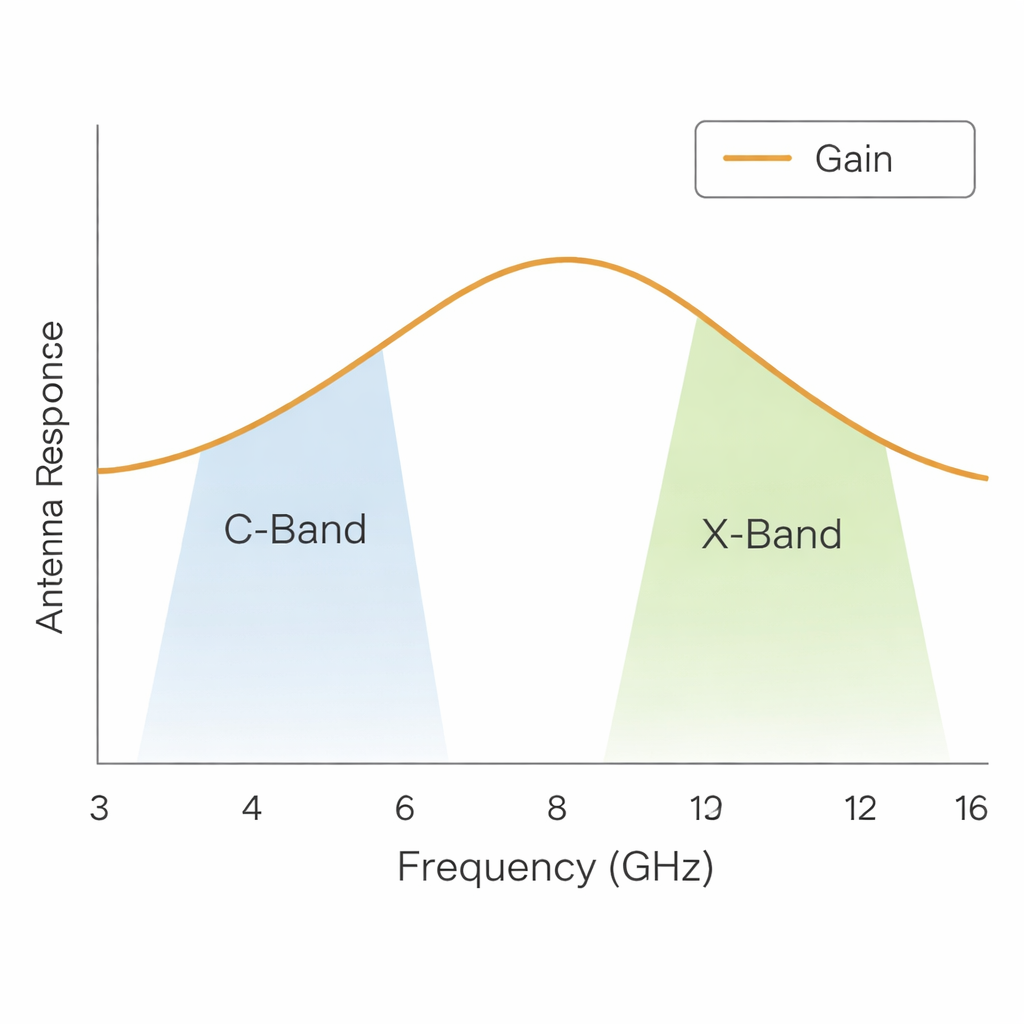
The authors present a microstrip antenna—essentially a thin metal pattern on a circuit board—that manages to be both ultra‑wideband and circularly polarized over two key ranges. Built on inexpensive FR4 circuit material only 1.6 millimeters thick, the finished device is smaller than a postage stamp yet operates from about 3.7 to 15.1 gigahertz. That single design therefore spans most of the so‑called C‑band and X‑band, home to weather radar, high‑resolution imaging, some 5G services, Wi‑Fi 6E, and satellite links. Within this broad sweep, the antenna produces clean circular polarization in two windows, roughly 6.7–8.4 GHz and 8.5–9.5 GHz, while achieving a peak gain of about 2.65 decibels—impressive given the lossy, low‑cost substrate.

Shaping metal to shape waves
To reach this performance, the team did not rely on exotic materials but on careful sculpting of copper. They began with a simple U‑shaped metal trace and partial ground plane that behaved like a basic narrowband antenna. By closing the U into a loop and adding an extra “parasitic” strip of metal near the ground, they broadened the useful frequencies. The final design resembles a square spiral loop with two small internal notches, paired with two extra metal pieces and a ground plane that is deliberately cut short and fitted with two little stubs. These added features subtly steer how electric currents flow across the surface, creating two equal but time‑shifted components of the wave—exactly what is needed for circular polarization—while also stretching the impedance bandwidth so the antenna remains well matched over more than an octave of frequency.
Putting the prototype to the test
After optimizing dimensions in simulation, the researchers fabricated the antenna and measured it in an anechoic (echo‑free) chamber. They compared three versions—the starting U‑shaped patch, an intermediate loop, and the final design—and tracked key metrics: how strongly the antenna reflects power back to the transmitter, how its gain changes with frequency, and how nearly circular its polarization remains. The finished version clearly outperformed its predecessors, showing the deepest signal “dips” (indicating efficient radiation), the broadest usable band, and axial ratio values below 3 decibels across the targeted circularly polarized ranges. Side‑by‑side plots of simulated and measured behavior lined up closely, lending confidence that the concept translates from computer model to real hardware despite FR4’s known high‑frequency losses.
From lab board to real‑world radios
Because it combines wide frequency coverage, dual circularly polarized bands, modest gain, and very compact size on a cheap, standard circuit board, this antenna is well suited to many practical roles. It could serve in compact radar sensors, satellite receivers, and high‑data‑rate wireless links that must remain reliable as devices rotate or flex, such as drones, vehicles, and wearables. In plain terms, the work shows how clever patterning of metal on a small board can coax radio waves into broad, robust coverage without resorting to bulky or expensive structures—an important step toward more versatile and affordable wireless systems.
Citation: Kolusu, D., Nanda, S. Developing and examining a compact dual band circularly polarized ultra-wideband antenna covering C-band and X-band applications. Sci Rep 16, 5283 (2026). https://doi.org/10.1038/s41598-026-35607-1
Keywords: circular polarization, ultra-wideband antenna, C-band, X-band, wireless communication