Clear Sky Science · en
One-year prospective study of a HEMA-based hydrophobic acrylic trifocal IOL (Clareon PanOptix): visual performance, patient-reported outcomes, and optic clarity
Sharper Sight After Cataract Surgery
Cataract surgery is one of the most common operations in the world, and more people now hope to come out of it not only with clear distance vision, but also with freedom from glasses for reading and computer work. This study followed patients for a full year after implantation of a new type of artificial lens, the Clareon PanOptix trifocal lens, to see how well they could see in everyday life and whether the lens stayed optically clear inside the eye.
A New Kind of Artificial Lens
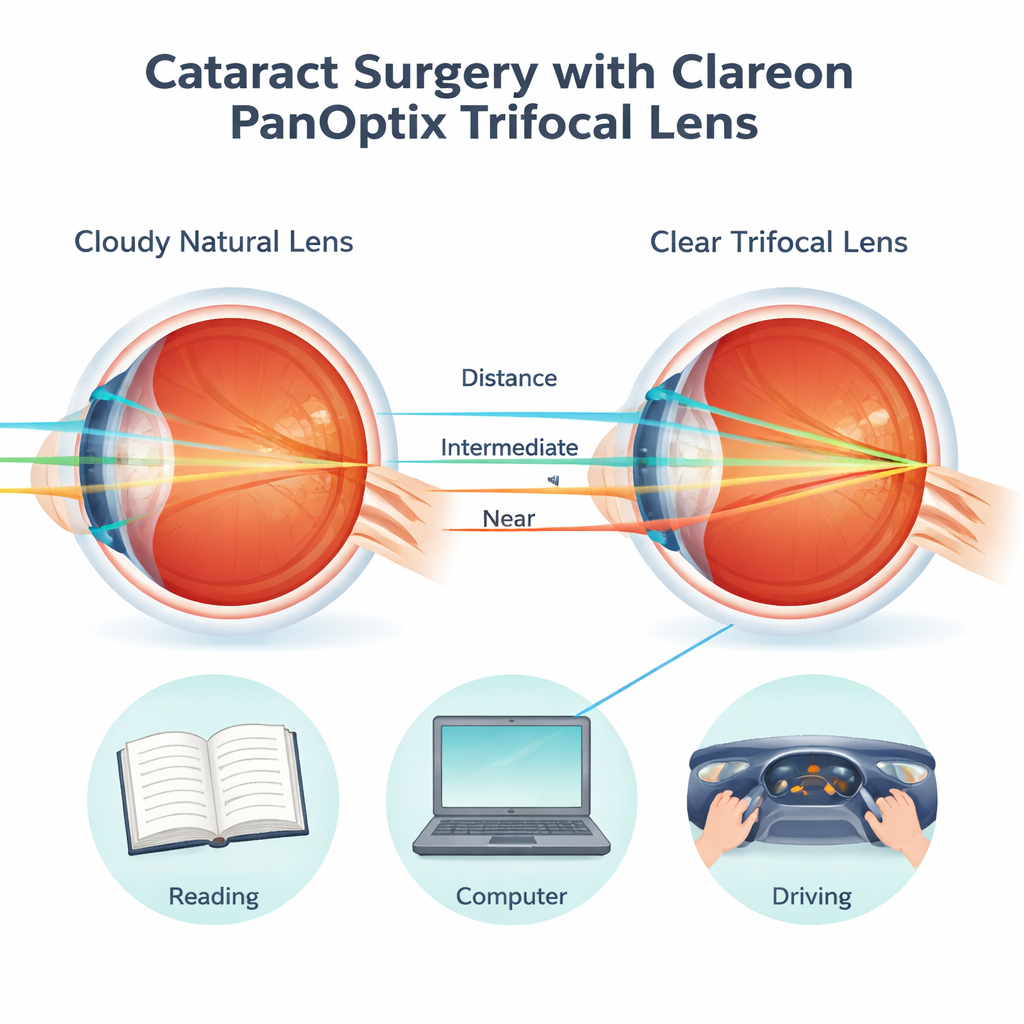
During cataract surgery, a cloudy natural lens is removed and replaced with a clear artificial one, called an intraocular lens. Traditional lenses are monofocal: they are set for one main distance, usually far away, so patients still need glasses for reading. The PanOptix lens is trifocal, designed to focus light for far distance (such as road signs), intermediate distance (such as a computer screen), and near tasks (like reading a book). The Clareon version of PanOptix uses a refined acrylic material that holds a bit more water and is manufactured under stricter conditions. It was created to avoid two long-recognized problems with older acrylic lenses: tiny internal bubbles called “glistenings” and surface light scattering, both of which can scatter light and cause glare or hazy vision years after surgery.
How the Study Was Done
Researchers at three eye clinics in Japan enrolled 39 adults with age-related cataracts who were scheduled for lens replacement in both eyes, giving a total of 78 eyes. None had other eye diseases that could distort the results. Surgeons used standard small-incision cataract techniques and implanted either a regular or astigmatism-correcting version of the Clareon PanOptix lens. After surgery, patients returned at 1, 6, and 12 months for detailed testing. The team measured vision at far (5 meters), intermediate (60 centimeters), and near (40 centimeters) distances with and without glasses. They also examined the lenses under a slit-lamp microscope to look for glistenings and surface haze, tracked any complications, and asked patients to rate how easy it was to perform everyday visual tasks and to drive during the day and at night.
What Patients Could See
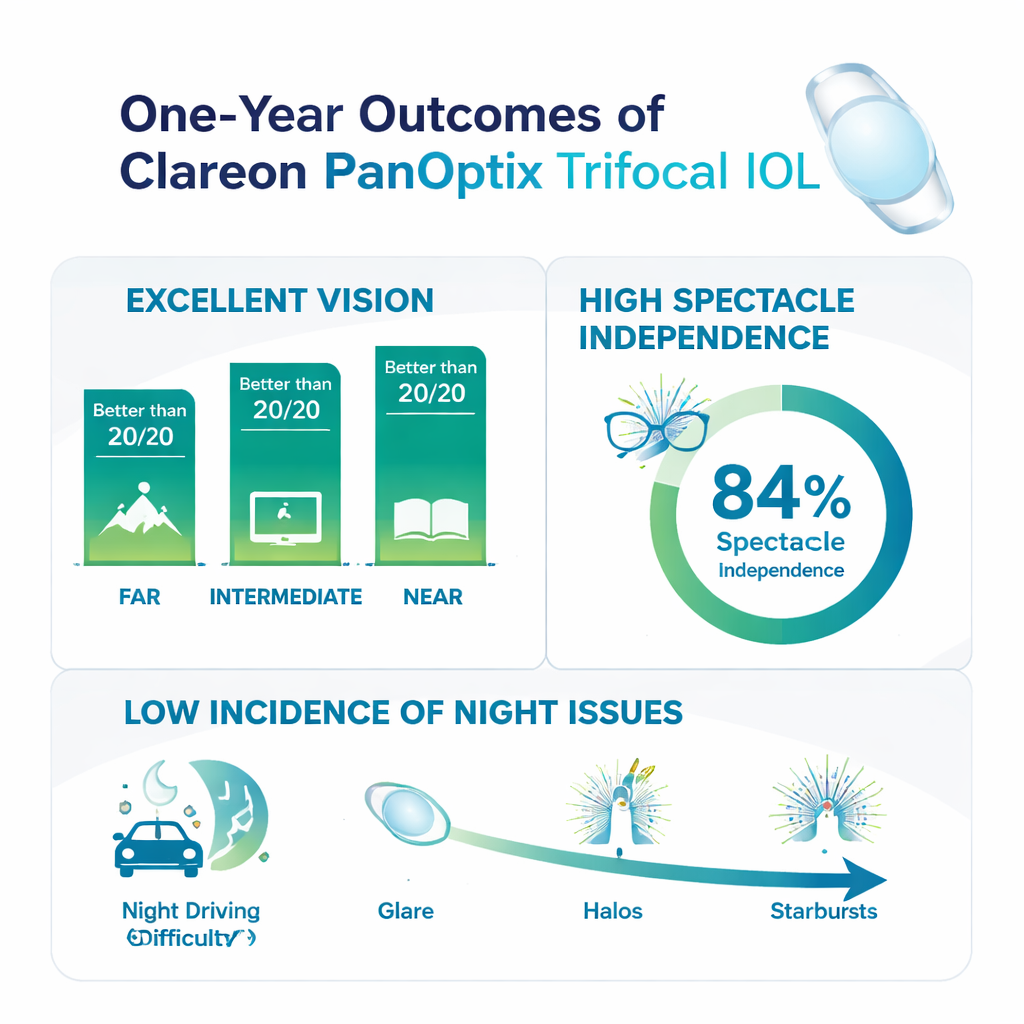
By one year after surgery, binocular vision — that is, using both eyes together — was better than the 20/20 standard at all three distances, even without glasses. The same was true when patients were tested with their best distance prescription in place. This means the lens reliably provided sharp distance, computer, and reading vision across the group. Most patients no longer needed glasses at all: 84.2 percent reported that they were completely spectacles-free, while the remaining few needed reading glasses only for fine print. No one required glasses for distance vision.
Clarity Inside the Eye and Everyday Experience
An important question was whether the new material actually stayed clear. Over the entire year, every implanted Clareon PanOptix lens was graded as having zero glistenings, and none developed surface light scattering. A small fraction of eyes (about 7 percent) developed a common after-effect of cataract surgery called posterior capsule opacification, a thin cloudy film behind the lens, which was treated with a brief laser procedure. Patients were generally very satisfied with their sight in daily life. Most found reading, cooking, watching television, computer use, and personal grooming to be “not difficult.” Daytime driving was also rated highly. Night driving, however, remained more challenging: about half of the participants reported at least occasional difficulty. Light-related side effects such as glare, halos, and starbursts around lights were fairly common in the first month but tended to fade in intensity by one year, and no patient described them as severe at that time.
What This Means for People With Cataracts
For patients considering cataract surgery who hope to minimize their dependence on glasses, this one-year study suggests that the Clareon PanOptix trifocal lens can provide sharp vision at multiple distances with high satisfaction. The lens material appeared to remain crystal clear over the first year, without the microscopic clouding and light scatter that have troubled some older designs, although longer follow-up is still needed. The trade-off, as with many multifocal lenses, is that some people may notice more visual disturbances around lights at night, which can make night driving harder, even if those effects lessen over time. Overall, the findings support this lens as a strong option for active people who value seeing well across their whole visual range after cataract surgery.
Citation: Fujita, Y., Nomura, Y., Sugita, T. et al. One-year prospective study of a HEMA-based hydrophobic acrylic trifocal IOL (Clareon PanOptix): visual performance, patient-reported outcomes, and optic clarity. Sci Rep 16, 6643 (2026). https://doi.org/10.1038/s41598-026-35603-5
Keywords: cataract surgery, trifocal intraocular lens, Clareon PanOptix, spectacle independence, night driving vision