Clear Sky Science · en
Ecological analysis of mosquito larval communities in Burkina Faso to inform environmental monitoring of genetic control programs
Why mosquito ponds matter to everyone
Across much of Africa, a tiny, buzzing insect still claims hundreds of thousands of lives every year: the malaria mosquito. New genetic tools promise to dramatically shrink mosquito populations, but they also raise a big question—what happens to the rest of the ecosystem if we deliberately reduce one species? This study from Burkina Faso takes a close look at the watery nurseries where mosquito larvae grow, to understand which other creatures share those habitats and how they might be affected if a key malaria vector is pushed to near extinction.
Looking into the mosquito nursery
The researchers focused on Anopheles coluzzii, one of the main malaria-carrying mosquitoes in western Burkina Faso and a leading candidate for future gene drive control programs. They surveyed 138 small water bodies around three communities that span irrigated rice fields, rural villages, and fast-growing peri-urban areas. These breeding sites included puddles, ponds, streams, rice paddies, tire tracks, and other man-made pools. At each spot, the team collected mosquito larvae and other aquatic invertebrates, while also measuring basic water conditions such as temperature, acidity (pH), cloudiness (turbidity), and salt content (conductivity). 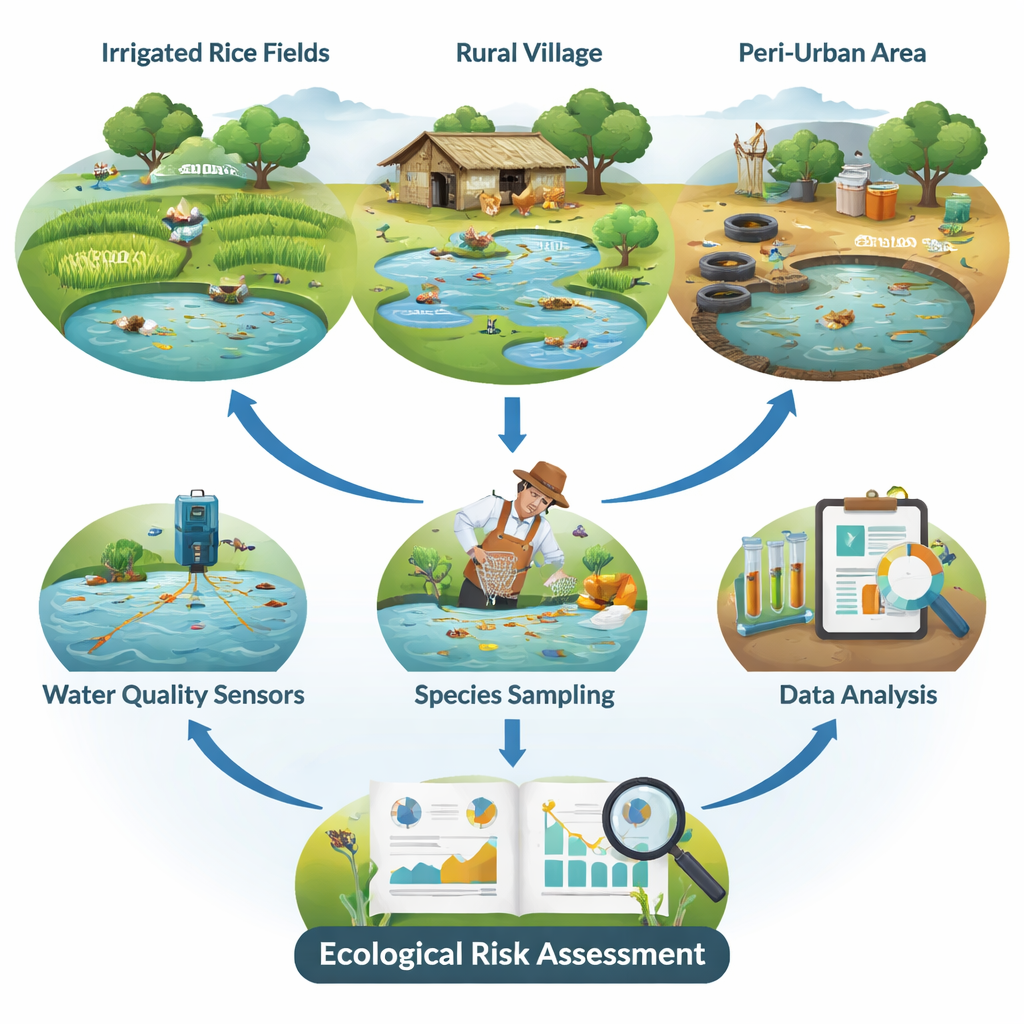
Who shares space with whom?
From these sites, the scientists collected nearly 8,000 mosquito larvae from three main groups: Anopheles, Culex, and Aedes. Anopheles dominated overall, especially in two of the villages, but the exact mix of species varied a lot from place to place. Using genetic tools, they showed that An. coluzzii, An. gambiae sensu stricto, and An. arabiensis all occurred, sometimes together, and even found a small number of natural hybrids between An. coluzzii and An. gambiae. Other insects, including aquatic beetles, water boatmen (Corixidae), and dragonfly relatives, also shared these habitats, typically in lower numbers. The team found that Anopheles larvae preferred natural or semi-natural sites—puddles, ponds, streams, rice fields, and tire tracks—rather than purely artificial containers. Different species within the Anopheles group tended to favor slightly different types of water, hinting at subtle ways they avoid competing too directly.
Measuring ecological crowding
To move beyond simple presence or absence, the authors borrowed tools from community ecology that quantify how much species overlap in their use of space and resources. They used two indices: one that compares how similarly species use habitats ("niche overlap") and another that tracks how often they are actually found at the same sites ("co-occurrence"). Combining these with direct field observations, they created an "exposure score" between 0 and 1 for each non-target organism. A higher score means a species shares more of its world with An. coluzzii and could be more affected if that mosquito is strongly suppressed. 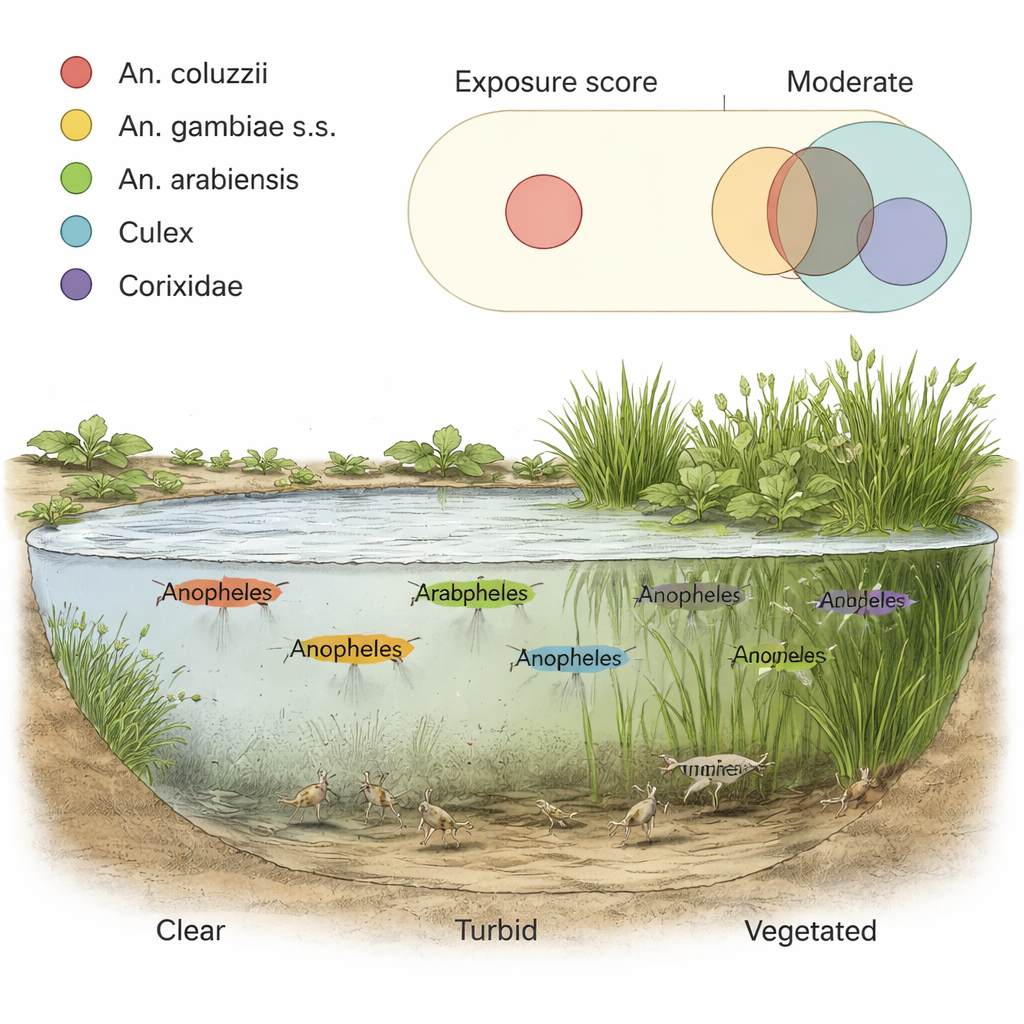
Who is most at risk if we remove a mosquito?
The results show that not all neighbors of An. coluzzii are equally exposed. Close relatives such as An. gambiae s.s. and An. arabiensis, along with Culex mosquitoes, received moderate exposure scores. They often use similar breeding sites and therefore might shift in abundance if An. coluzzii disappears, potentially stepping into its ecological shoes and even taking over its role as a disease vector. In contrast, predators like Corixidae and Baetidae had low exposure scores: they use some of the same habitats but are rarely found in exactly the same micro-sites at the same time, probably because larvae avoid them or are quickly eaten. Water conditions also mattered. An. coluzzii, for example, was more common in warmer and cloudier pools, where murky water may hide larvae from visual predators, while other species responded differently to factors such as acidity and electrical conductivity.
Turning ecology into a safety checklist
This work does not claim to predict precisely what will happen after a gene drive is released. Instead, it offers a practical checklist for what to watch. By ranking non-target species according to how much of their lives intersect with An. coluzzii, the exposure score highlights which mosquitoes and aquatic insects deserve special attention in environmental monitoring. The study suggests that closely related mosquitoes are the most likely to respond strongly to the removal of An. coluzzii—either through changes in competition or through gene flow via hybrids—while predators may be less tightly bound to this particular prey. For policymakers and communities considering genetic mosquito control, this framework provides an evidence-based way to focus monitoring efforts and to spot unintended ecological shifts early, helping to balance the urgent need to reduce malaria with care for the surrounding ecosystem.
Citation: Toé, I., Kientega, M., Lingani, A.J. et al. Ecological analysis of mosquito larval communities in Burkina Faso to inform environmental monitoring of genetic control programs. Sci Rep 16, 5091 (2026). https://doi.org/10.1038/s41598-026-35602-6
Keywords: malaria mosquitoes, gene drive, aquatic ecosystems, non-target species, environmental monitoring