Clear Sky Science · en
Synergistic activity of sunlight protectants on some biocontrol agents as a new approach to control the cotton leaf worm, Spodoptera littoralis (Boisduval)
Protecting Crops with Sun-Friendly Pest Control
Farmers worldwide are looking for ways to protect crops from insects without relying so heavily on conventional chemical sprays. This study explores how to make “green” insect killers—bioinsecticides—last longer in the sun so they can better protect cotton from a major pest, the Egyptian cotton leaf worm. By pairing these natural products with ingredients similar to sunscreen, the researchers show a practical route to more durable, eco-friendly pest control.
A Hungry Caterpillar with a Big Economic Bite
The cotton leaf worm, Spodoptera littoralis, is a caterpillar that feeds on many crops, especially cotton, destroying both leaves and developing bolls. To keep it in check, growers often turn to broad-spectrum chemical insecticides. Over time, however, these chemicals can pollute the environment, kill helpful insects, and push pests to evolve resistance. Bioinsecticides—products based on naturally occurring bacteria or fermentation products—offer a cleaner alternative. In this work, the team focused on three widely used bioinsecticides: a bacterium-derived product (Dipel, based on Bacillus thuringiensis), a fermentation product called Spinosad (Tracer), and a nerve-targeting compound, Emamectin benzoate (Diacox).
Why Sunlight Is the Enemy of “Green” Sprays
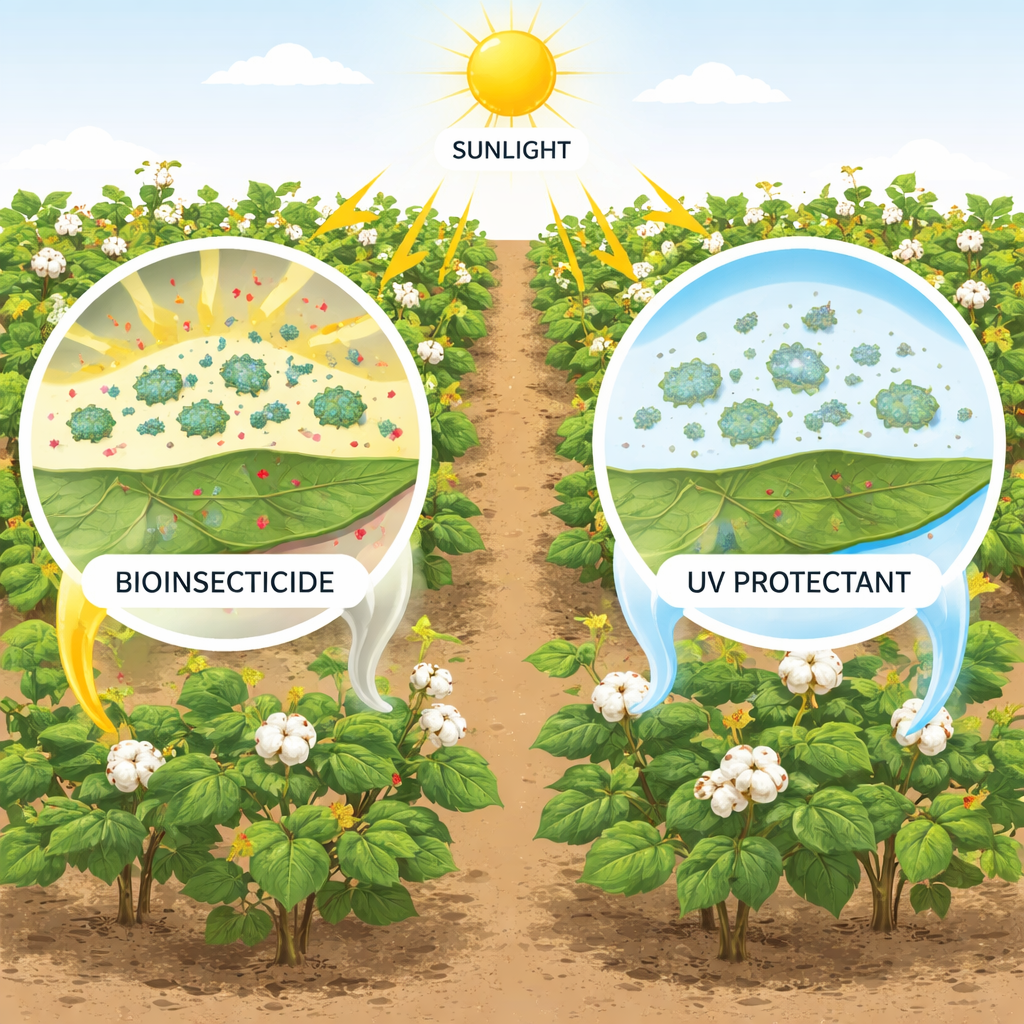
Although bioinsecticides are gentle on the environment, they have a major weakness: they break down quickly under sunlight, especially under ultraviolet (UV) rays. That means their power to kill pests fades within days, forcing farmers to spray more often. To tackle this, the researchers borrowed an idea from human skincare. They tested three UV-protecting additives—Octyl palmitate, Tinuvin P, and UV-P—that are commonly used to shield materials or cosmetics from sun damage. These protectants either absorb or scatter UV light, potentially acting as a protective umbrella over the bioinsecticides once they are sprayed on cotton leaves.
Field Trials: Sunscreen for Bioinsecticides
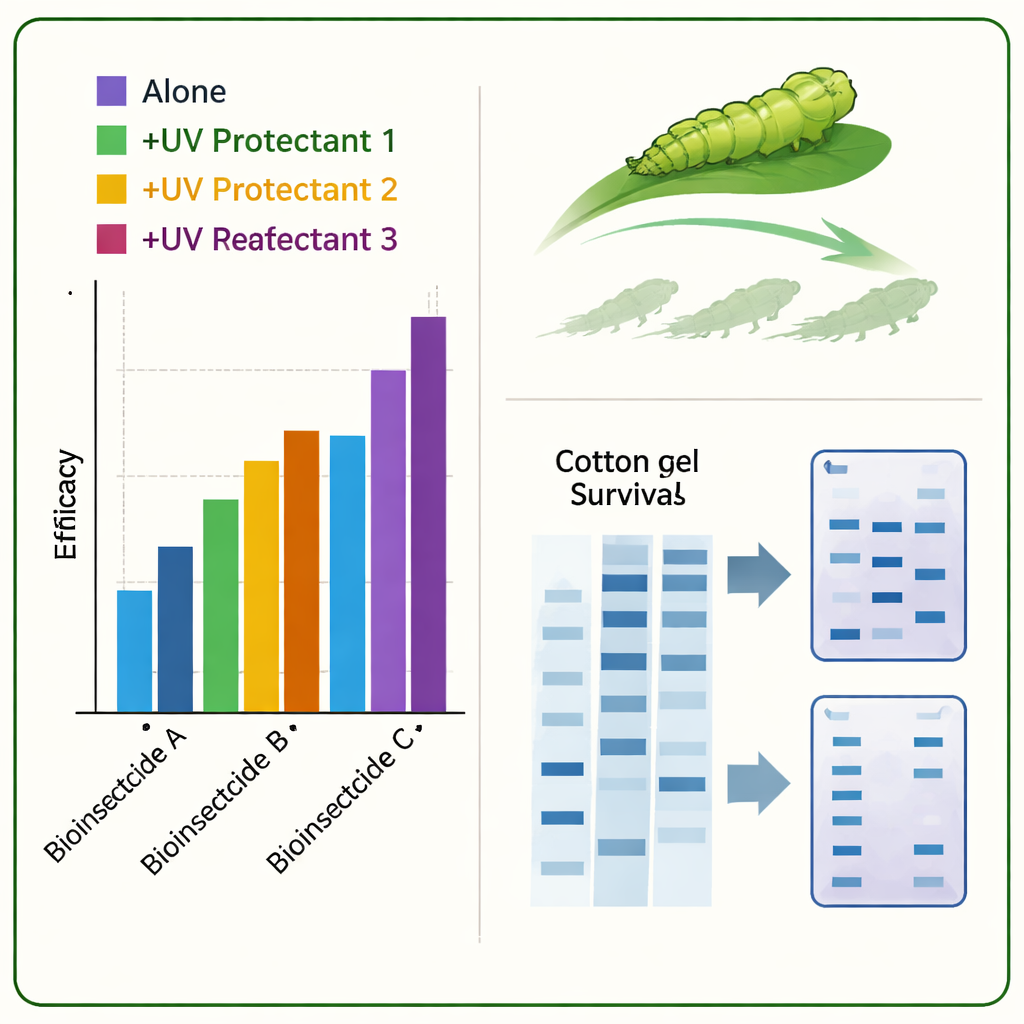
In field plots of cotton, the scientists sprayed leaves with each bioinsecticide alone and with each of the three UV protectants. At different times after spraying—up to 15 days—they collected leaves and fed them to fourth-stage cotton leaf worm larvae in the laboratory, then measured how many larvae died. All treatments showed strong initial killing power, but without UV protection their effectiveness dropped sharply over time, with some combinations losing all impact by day 12. When UV protectants were added, the story changed: the bioinsecticides stayed potent for longer, and larvae mortality remained higher across the 15-day test period. Among all treatments, Diacox combined with UV protectants stood out. Even after 15 days, Diacox mixed with Octyl palmitate, Tinuvin P, or UV-P still killed 27%, 32%, and 12% of the larvae, respectively, whereas most other treatments had essentially stopped working.
Looking Inside the Insects
To understand whether these treatments were truly stressing the insects and altering their biology, the researchers examined the total proteins in treated and untreated larvae using a lab technique that separates proteins into bands, much like a barcode. After 15 days of exposure to treated leaves, larvae showed clear changes in their protein patterns: new bands appeared and some normal bands disappeared. These shifts were seen with bioinsecticides alone and were often more pronounced when UV protectants were added. The altered protein profiles suggest that the combined treatments triggered physiological stress and changes in metabolic pathways within the insects, consistent with stronger or more persistent toxic effects.
What This Means for Farmers and the Environment
By showing that simple UV-protecting ingredients can significantly extend the working life of bioinsecticides on crop leaves, this study points to a practical way to make biological pest control more reliable in sunny fields. In plain terms, giving bioinsecticides a “sunscreen coat” helps them keep killing cotton leaf worms for longer, with Diacox plus UV protectants emerging as particularly durable. If carefully evaluated for safety and compatibility with beneficial organisms, such combinations could reduce the number of spray applications, cut back on conventional chemical insecticides, and support more sustainable cotton production.
Citation: Attia, R.G., Khidr, A.E.A.A., Al-Ashry, H.A.A. et al. Synergistic activity of sunlight protectants on some biocontrol agents as a new approach to control the cotton leaf worm, Spodoptera littoralis (Boisduval). Sci Rep 16, 4809 (2026). https://doi.org/10.1038/s41598-026-35601-7
Keywords: bioinsecticides, cotton leafworm, UV protectants, sustainable pest control, Spodoptera littoralis