Clear Sky Science · en
Evaluating the sports performance of badminton players based on grip strength of the real hitting scenario
Why Your Racket Grip Might Matter More Than Your Muscles
Anyone who has played badminton knows the feel of a well-timed shot: the shuttle leaves the racket cleanly, almost effortlessly. This study asks a deceptively simple question behind that feeling: how much does the way you grip the racket actually shape performance? Using ultra-thin pressure sensors hidden under the grip, researchers compared beginners and trained athletes to see how differences in hand force relate to accuracy, power, and control in realistic hitting drills.
Measuring the Invisible Forces in Your Hand
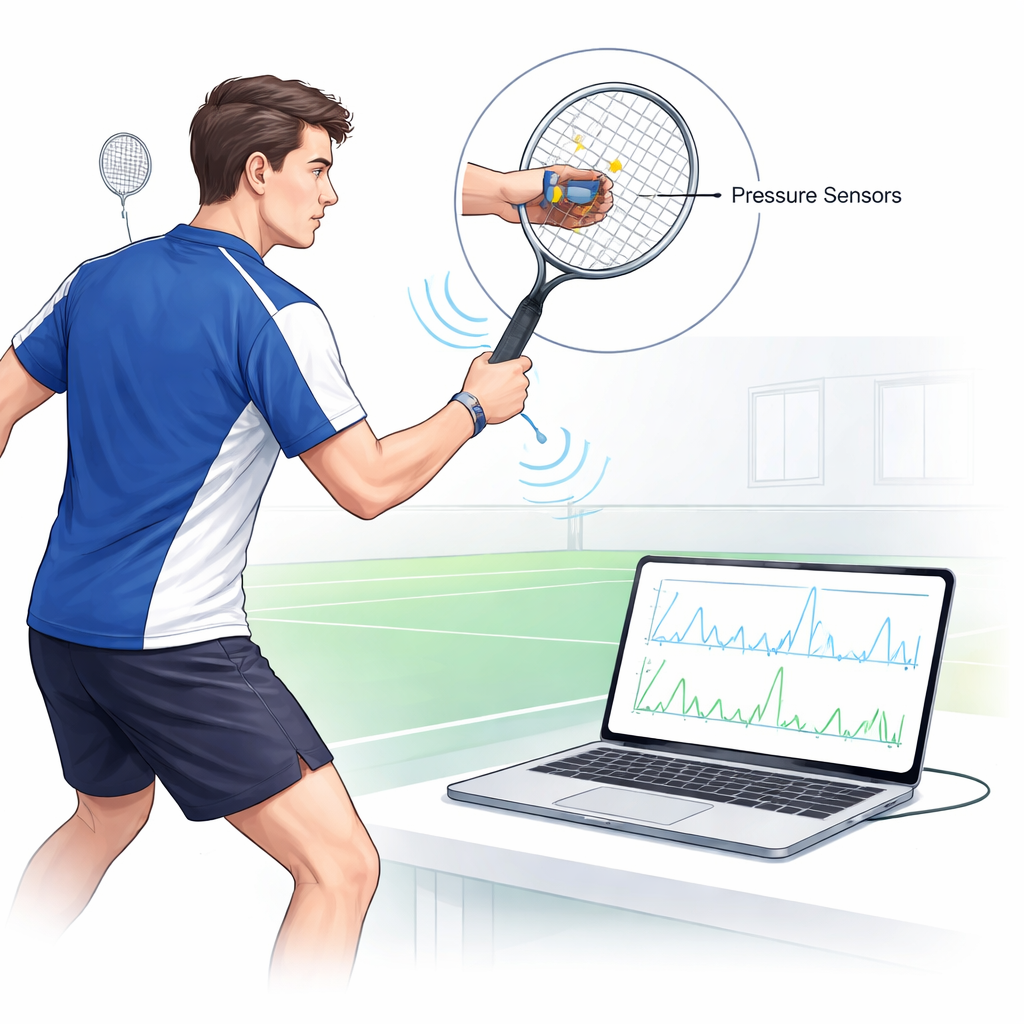
Instead of studying players only in a lab full of cameras and wires, the team built a small, flexible pressure-sensing system that could be used on a normal court. Two tiny sensors were placed where the racket handle presses against the base of the index finger and the fleshy part of the thumb. As players hit, the sensors turned changes in grip pressure into electrical signals. These signals were sent wirelessly to a computer, which recorded three key numbers for every stroke: how strong the tightest squeeze was, how long the squeeze lasted, and the average force during a test. At the same time, trained judges scored each shot based on where the shuttle landed.
Putting Beginners and Athletes Through Real Game Skills
Thirty right-handed male players took part: fifteen with about a year of experience and fifteen national second-level athletes with nearly a decade of training. They completed three stages of tests that became progressively more like real match play. First came simple, stationary drills using single techniques such as soft net shots and powerful smashes. Next were stationary combinations that chained several strokes together. Finally, the hardest stage added full footwork, asking players to move across the court while mixing control shots and attacking shots. Between tests, players rested briefly to keep fatigue from distorting the results.
What the Grip Signals Revealed
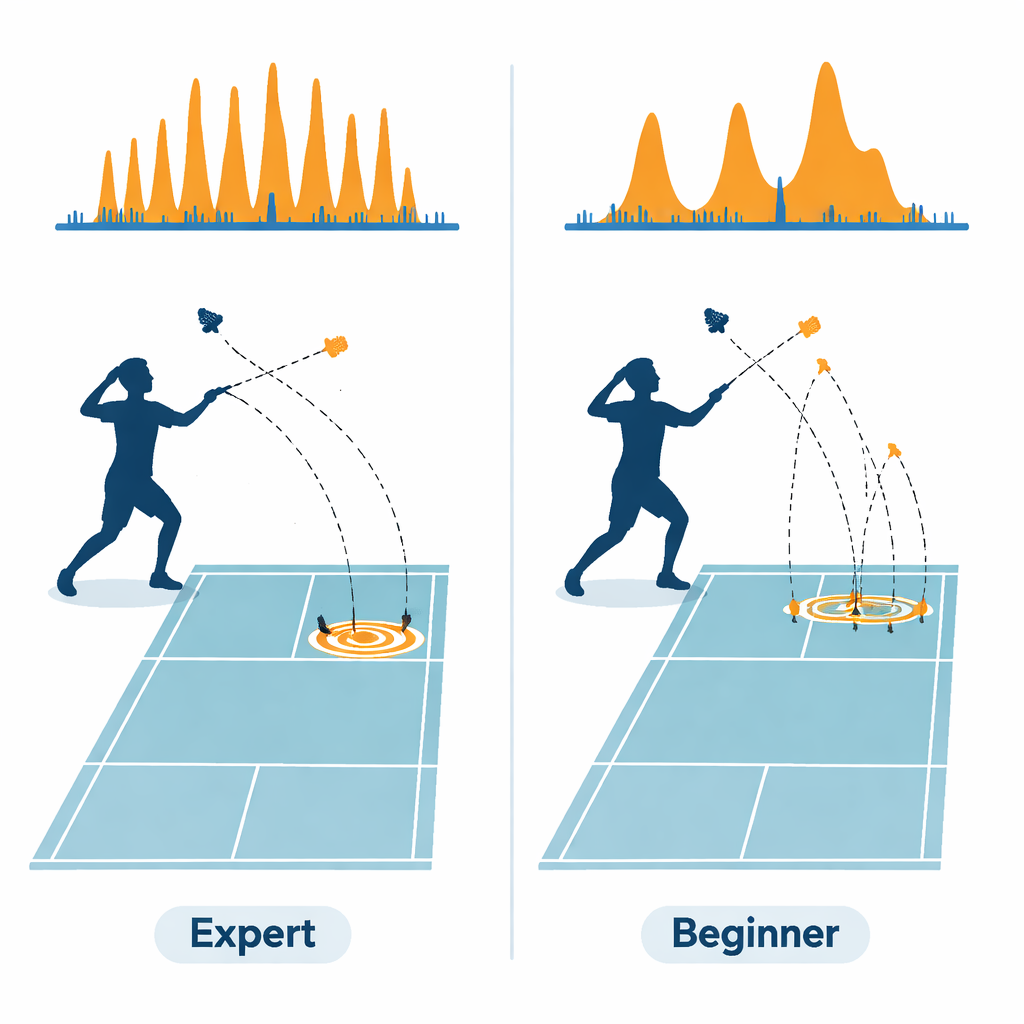
The pressure traces from the sensors looked very different for the two groups. Skilled athletes produced short, sharp bursts of force that rose and fell quickly, with clear rhythms and tidy peaks. Their grip was firm only at the crucial moment of impact and relaxed in between. Beginners, in contrast, tended to squeeze harder, hold that squeeze longer, and show more irregular curves. This pattern was especially clear in “touch” skills like net drops and cross-court flicks, where fine control of the shuttle’s landing is vital. Across almost all tests, athletes scored higher, used less peak force during delicate shots, and kept their grip active for a much shorter time than beginners.
Control Beats Raw Strength for Precision Shots
When the researchers compared grip numbers with shot scores, a clear pattern emerged for control-based techniques. Among the experienced athletes, better performance in net and drop shots was linked to lower peak grip force and shorter squeezing time: in other words, the softer and more precisely timed the grip, the higher the score. For power-based techniques like smashes and lifts, the relationship was more mixed. Both groups needed substantial force to drive the shuttle deep, and differences in grip strength alone could not fully explain who scored better. For beginners overall, grip measures were only weakly related to performance, suggesting that many aspects of their technique—body position, timing, and footwork—still need to come together.
What This Means for Players and Coaches
To a non-specialist, the message is straightforward: in badminton, how you squeeze the racket may matter more than how hard you can squeeze it. High-level players do not simply grip tighter; they grip smarter, turning the hand into a finely tuned “force gate” that controls how power from the whole body finally reaches the shuttle. The flexible sensors used in this study show that such control can be measured in detail without disrupting normal play. This approach could help coaches diagnose subtle problems in an athlete’s technique and give beginners concrete feedback on developing a relaxed, well-timed grip rather than just swinging harder.
Citation: Liu, D., Che, L., Qi, F. et al. Evaluating the sports performance of badminton players based on grip strength of the real hitting scenario. Sci Rep 16, 5055 (2026). https://doi.org/10.1038/s41598-026-35596-1
Keywords: badminton performance, grip strength, wearable sensors, racket sports, motor control