Clear Sky Science · en
Growth of microorganisms in a Martian regolith simulant at reduced water activity
Why dry Mars dirt might still host life
When we picture life on Mars, we often imagine flowing rivers or buried oceans. But today’s Red Planet is bone-dry at the surface, with liquid water mostly impossible. This study asks a deceptively simple question with big implications: could hardy microbes still slowly grow in Mars-like soil using nothing more than moisture from the air? By testing Earth desert microbes in a realistic Martian soil mimic, the researchers probe just how little water life might need to hang on—and what that means for finding life on Mars and protecting it from our own contamination.
Testing life in fake Martian dirt
To explore this, the team used a commercially available soil called Mojave Mars Simulant 2 (MMS-2). It is made from crushed basaltic rock mixed with small amounts of calcium sulfate and other oxides to resemble Martian regolith. This simulant already contains a natural community of desert microbes. The researchers first heated the soil to remove detectable DNA and to push most cells into survival mode, much like what might happen in harsh planetary environments. They then placed 1 gram of this soil into a special two-compartment Petri dish: one side held the soil, the other held pure water or salty solutions that controlled how much water vapor filled the sealed air space above. Over weeks, only water vapor—not liquid water—could reach the soil, mimicking how real Martian ground interacts with its thin, dry atmosphere. 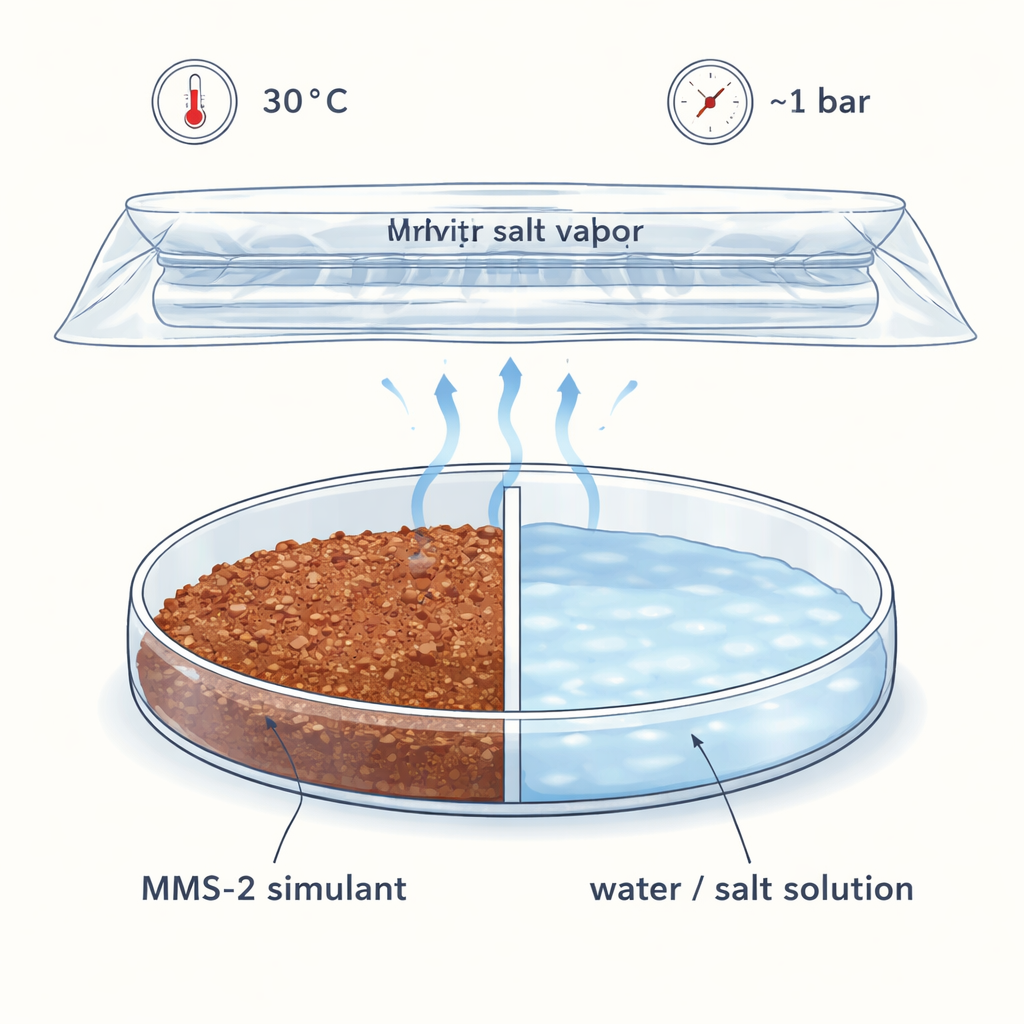
Measuring growth by weighing genetic material
Standard microbiology tools often rely on cloudy liquid cultures or colonies on agar plates, methods that do not work well for opaque rock and soil. Instead, the team tracked growth by directly extracting and measuring the total mass of DNA from the soil at different times. They first validated this approach using the well-known bacterium Bacillus subtilis grown in liquid. DNA measurements closely matched traditional growth curves based on optical density and colony counts, confirming that increasing DNA mass can reliably stand in for microbial replication. With that confidence, they turned back to the Mars-like soil and followed how DNA levels changed over time under different degrees of dryness, known as water activity.
Pushing microbes toward the dry limit
Water activity (aw) describes how much “free” water is available for life, on a scale from 0 (bone-dry) to 1 (pure liquid water). Most Earth microbes stop replicating well above aw 0.9, and the lowest confirmed limit for life in special sugary liquids is around 0.585. In this study, the researchers incubated the Martian simulant at aw values of 1.0, 0.75, 0.65, 0.34, and an extremely dry 0.12, all at 30 °C and Earth-like pressure. At higher water activities, DNA in the soil increased quickly, peaking within 15–20 days and then declining as nutrients ran out or cells died. As conditions grew drier, growth slowed dramatically: at aw 0.34 it took about 30 days to reach a much smaller DNA peak, roughly three times lower than at aw 1.0. At aw 0.12, DNA never rose above detectable levels over 60 days. Statistical tests confirmed that the modest DNA increase at aw 0.34 was real and not just experimental noise.
Salts, soaked soil, and tiny, stressed cells
The team also explored what happens when they add magnesium sulfate, a salt known to strongly attract water, to the simulant. With just 5% of this salt by weight, the soil absorbed up to half its own weight in water from the air and stayed visibly damp, stabilizing around aw 0.96. Surprisingly, even in this wetter setting, it took roughly 40–45 days before DNA levels peaked, and the total DNA was lower than in plain simulant at aw 1.0. Microscopy images of stained cells revealed that as water activity decreased, cells became fewer and often smaller, especially at aw 0.34 and in the magnesium sulfate–rich soil. This suggests that not only the amount of water, but also the specific salts and soil chemistry, strongly influence how well microbes can survive and divide in such harsh, salty, alkaline environments. 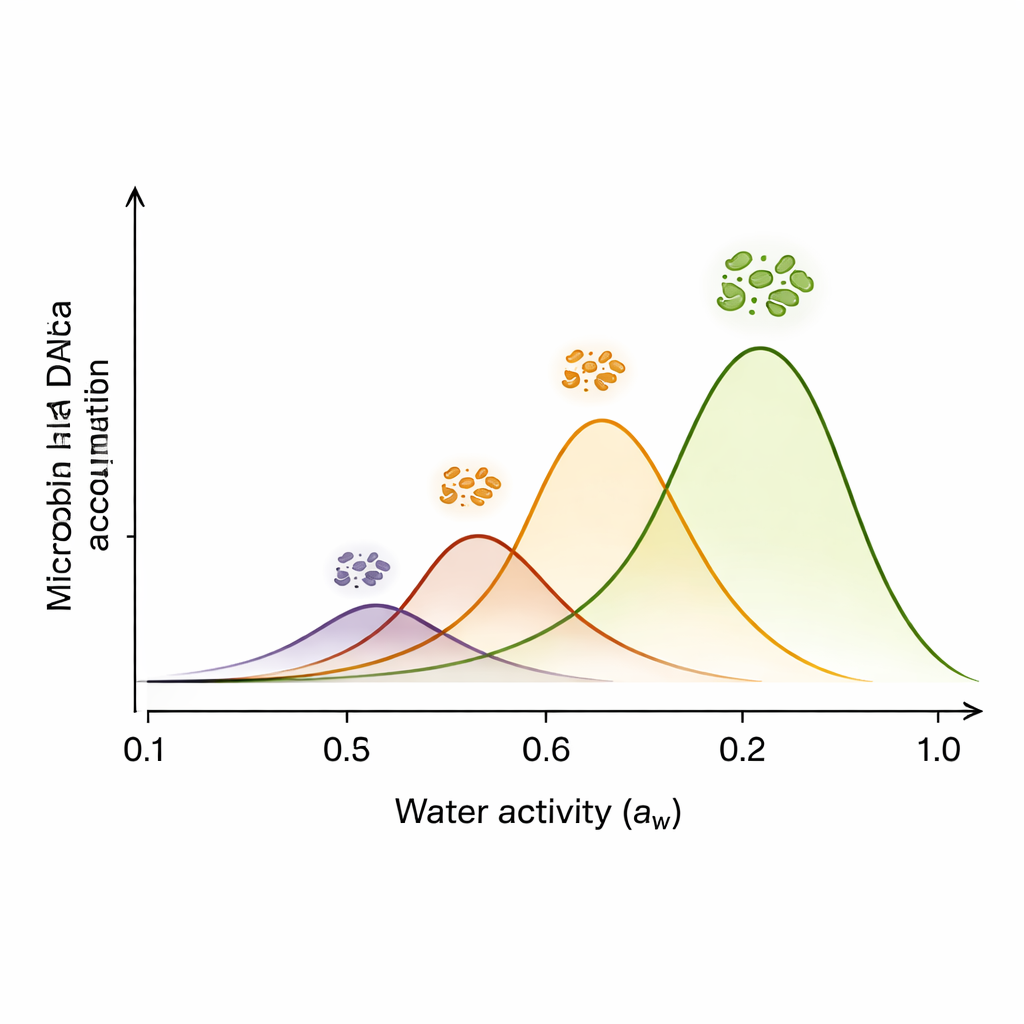
What this means for Mars and for us
The study shows that naturally occurring desert microbes living inside rock-like soil can slowly accumulate DNA, consistent with limited growth, even at water activities as low as about 0.34—much drier than the classic limits established in simple laboratory liquids. While the experiments were done under comfortable Earth temperatures and pressures, they hint that rock-hosted life on Mars could potentially tap transient atmospheric moisture to persist in tiny protected niches. For planetary scientists, this broadens the range of conditions considered “habitable” in dry worlds, and it strengthens the case for careful planetary protection. If our own microbes can endure and occasionally reproduce under such parched, Mars-like humidity, then future missions must be designed to avoid accidentally seeding other planets with Earth life before we have the chance to discover whether alien life already exists there.
Citation: Raghavendra, J.B., Zorzano, M. & Martin‑Torres, J. Growth of microorganisms in a Martian regolith simulant at reduced water activity. Sci Rep 16, 7499 (2026). https://doi.org/10.1038/s41598-026-35595-2
Keywords: Mars habitability, water activity, Martian regolith simulant, desert microbiomes, astrobiology