Clear Sky Science · en
Integrating transparency and privacy in grievance redressal through Hyperledger Fabric with multi-organization support
Why student complaints need a tech upgrade
When students file complaints about unfair grades, harassment, or broken hostel facilities, they expect a fair, timely, and private response. Yet many colleges still rely on paper forms or basic web portals that can lose data, hide what is really happening, or even be tampered with. This article explores how a modern twist on record-keeping—blockchain technology—can make grievance handling in universities both more transparent and more protective of students’ privacy.
From fragile records to tamper‑proof logs
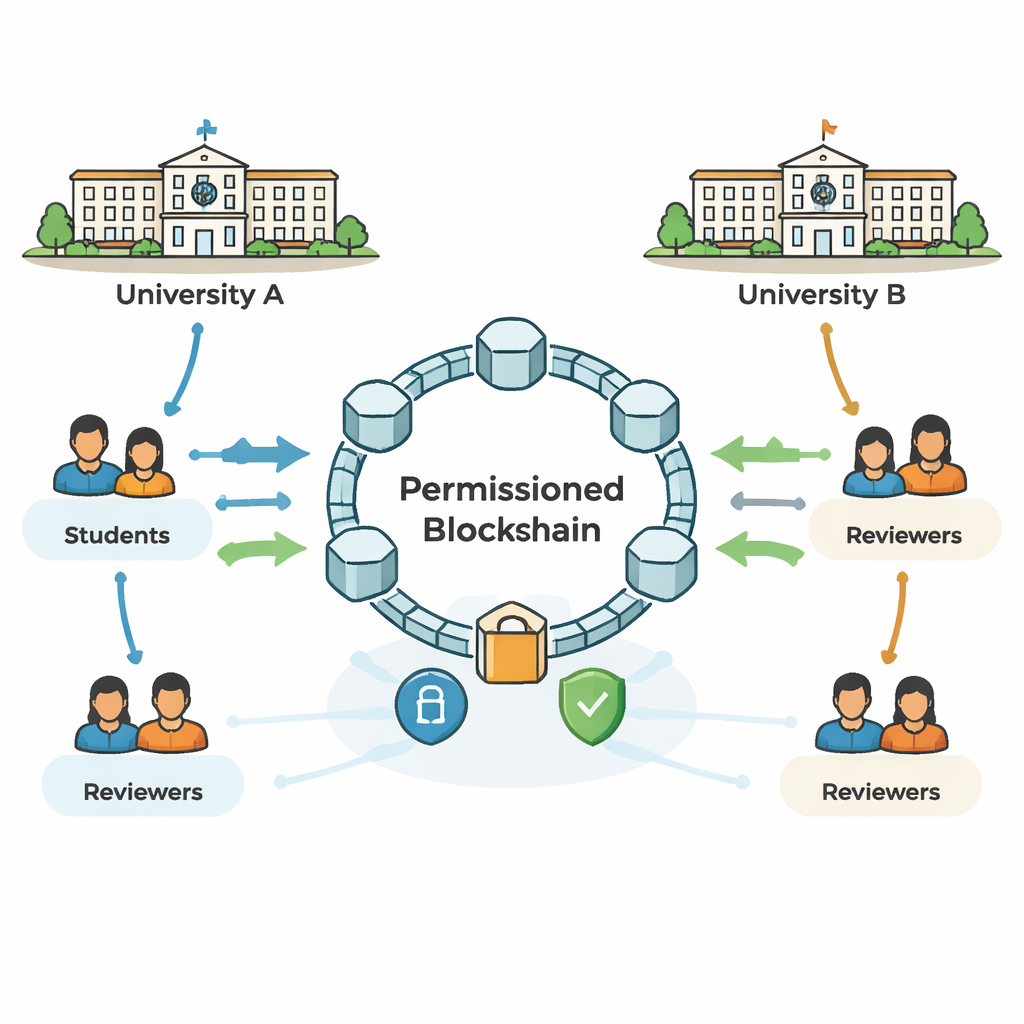
Traditional grievance systems, whether manual or online, suffer from familiar weaknesses: a single central database that can fail, be hacked, or be quietly edited; limited visibility into how a complaint moves through the system; and poor safeguards for sensitive details. The authors propose replacing this fragile backbone with a permissioned blockchain network called Hyperledger Fabric. Instead of one office owning all the data, several institutions share a common, tamper‑resistant ledger. Every complaint, update, and resolution is written as a permanent record that all authorized parties can verify but none can alter in secret. This shift aims to restore trust for students who worry their voices might otherwise be ignored or silenced.
Many campuses, one shared backbone
The system is designed for real academic environments where multiple universities or campuses operate side by side. Each institution runs its own nodes and certificate authority, giving it control over who participates and which data it stores locally, yet they all connect to a shared channel for complaint verification. Access is tightly controlled: students can only see their own cases, and reviewers only see the complaints assigned to them. Sensitive identifiers are protected with strong cryptographic hashing, while role‑based rules ensure that private details are revealed only to those who truly need to know. This multi‑organization setup avoids putting absolute power in the hands of a single authority, making data manipulation far harder.
Smart rules that share the workload fairly
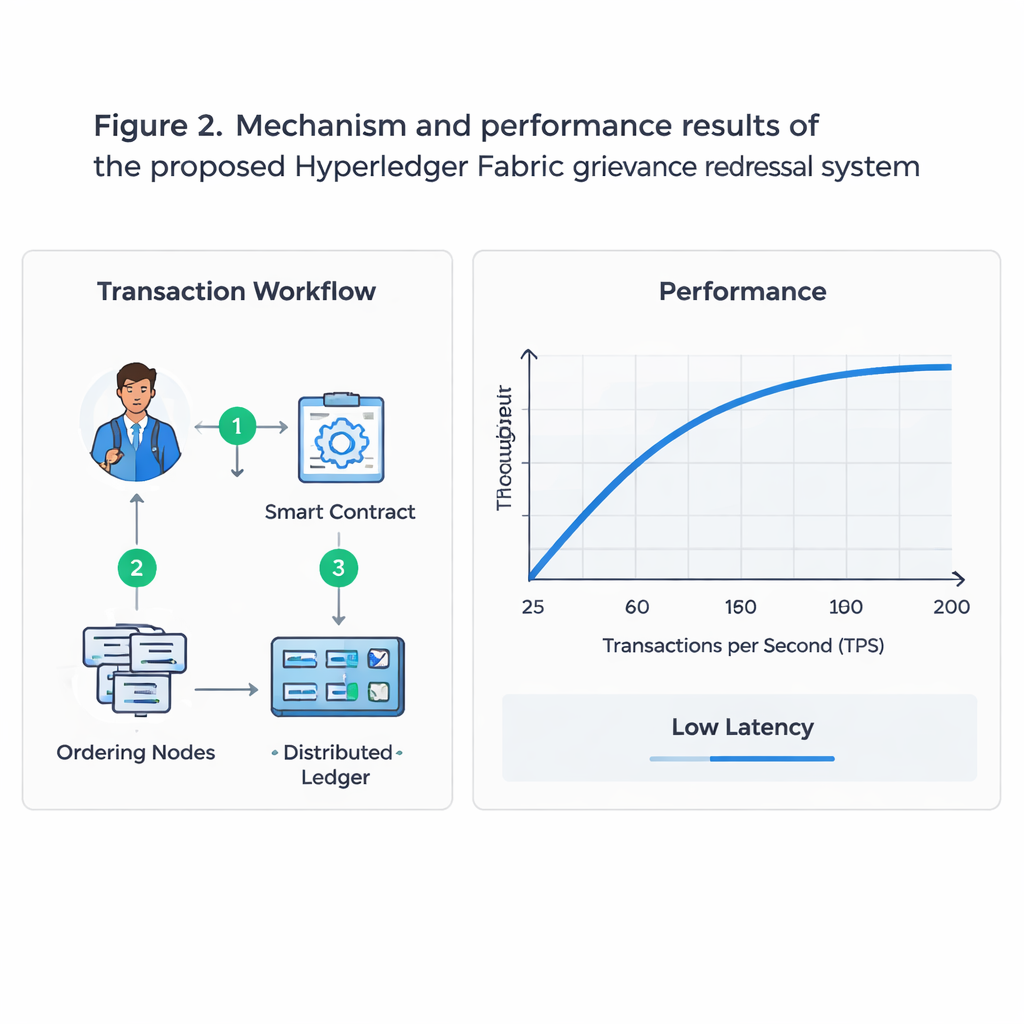
At the heart of the system are smart contracts—small programs that automatically enforce agreed‑upon rules. These contracts handle student and reviewer registration, complaint filing, assignment, resolution, and even reopening of a case if a student is dissatisfied. When a new complaint arrives, the software looks at all eligible reviewers within the same campus and automatically sends the case to the person with the lightest load, promoting a fair distribution of work. Complaints tagged as highly sensitive, such as harassment, receive tighter deadlines and priority handling. Every step—from assignment to resolution—is logged on the shared ledger, creating an auditable trail that reduces the scope for bias or quiet interference.
Built for heavy traffic without slowing down
To see if this approach can handle the real‑world volume of student complaints, the researchers stress‑tested their network using a benchmarking tool called Hyperledger Caliper. They fired batches of 500 to 1500 transactions at increasing speeds, from 25 up to 200 complaint actions per second. Across all tests, the system committed 100% of transactions—no losses or silent failures. Throughput climbed steadily and peaked at about 117 transactions per second at a send rate of 175, while the time to confirm each action stayed well under a second for most settings and only about two seconds at the highest load. Compared with similar blockchain setups reported in earlier studies, this design delivered higher speed and lower delay, suggesting it can support busy academic environments without grinding to a halt.
Safer complaint handling for everyday campus life
In simple terms, the article shows that it is possible to build a complaint system where students can speak up without fearing that their words will vanish, be leaked, or be quietly rewritten. By blending shared but permissioned record‑keeping, automatic rule enforcement, and careful performance tuning, the proposed Hyperledger Fabric solution gives universities a way to be both more transparent and more protective of privacy. While future work may add tools like artificial intelligence to help spot the most urgent cases or extend the system across many more institutions, this study already demonstrates that blockchain can make grievance redressal fairer, more accountable, and reliable at scale.
Citation: Kumar, H., Kaushal, R.K., Kumar, N. et al. Integrating transparency and privacy in grievance redressal through Hyperledger Fabric with multi-organization support. Sci Rep 16, 5574 (2026). https://doi.org/10.1038/s41598-026-35594-3
Keywords: student grievances, blockchain in education, Hyperledger Fabric, complaint management, data transparency