Clear Sky Science · en
Phytochemical characterisation and antifungal activities of five botanicals used by subsistence farmers to manage plant diseases
Fighting Crop Diseases with Everyday Plants
Many small-scale farmers struggle to protect their crops from fungal diseases that rot roots, stems, and fruits, threatening both income and local food supplies. This study explores a simple but powerful idea: can familiar plants like aloe, onions, chilies, marigolds and wild garlic be turned into natural sprays that protect crops from destructive fungi, reducing reliance on synthetic chemicals? 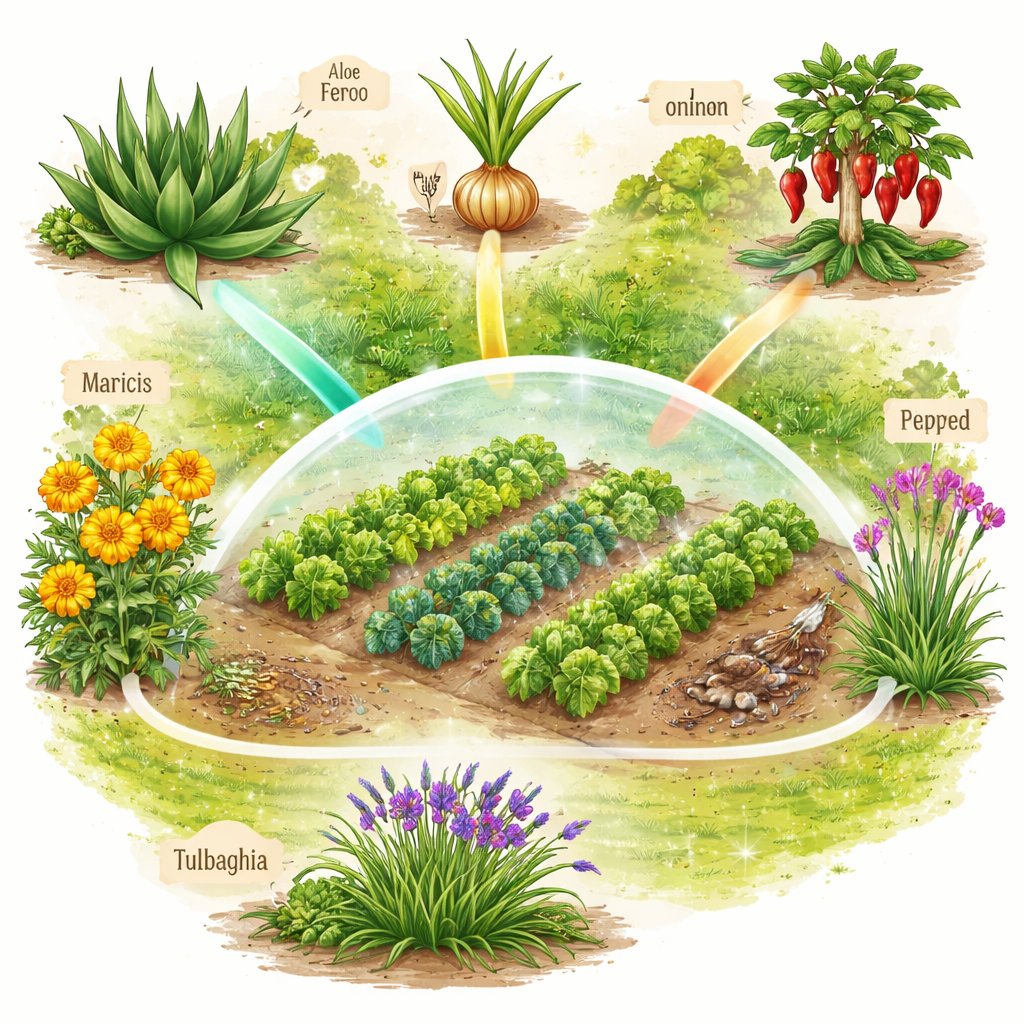
Why Fungal Diseases Matter for Food Security
Two fungal pathogens, Pythium ultimum and Botrytis cinerea, are notorious troublemakers in vegetable fields and fruit orchards. They cause damping-off in seedlings, root and tuber rots, and the grey mould often seen on fruits. Farmers usually fight these diseases with commercial fungicides. While effective, these chemicals can harm the environment, leave residues on food, and drive the evolution of resistant fungal strains. For subsistence farmers with limited resources, there is a pressing need for affordable, safer options that fit into sustainable farming.
Five Traditional Helper Plants Put to the Test
Building on an earlier survey of smallholder farmers in South Africa, the researchers chose five plants that local growers already use informally against plant diseases: Aloe ferox (bitter aloe), Allium cepa (onion), Capsicum annuum (chili pepper), Tagetes minuta (a marigold species), and Tulbaghia violacea (wild garlic). They dried and ground the plant parts farmers typically use and extracted their chemical contents with two common solvents, acetone and methanol. The team then measured how rich each extract was in broad groups of protective plant chemicals—phenolics and flavonoids—and mapped the detailed “chemical fingerprints” using high‑resolution liquid chromatography–mass spectrometry.
Hidden Chemistry Behind Natural Protection
The five botanicals turned out to be chemical powerhouses. Across all plants, the scientists tentatively identified 106 compounds, including at least 13 flavonoids plus a variety of alkaloids, saponins, sterols, and organic acids. Some, such as quinic acid, 3,4/4,5‑di‑caffeoylquinic acid, and 1‑O‑feruloylglucose, are known for strong antioxidant and antimicrobial effects. The marigold (Tagetes minuta) and wild garlic (Tulbaghia violacea) stood out: marigold’s acetone extract had by far the highest levels of both total phenolics and flavonoids, while wild garlic’s methanol extract also ranked very high. These same plants performed especially well in antioxidant tests that measure how effectively an extract can neutralize reactive molecules, which are involved in plant stress and disease.
From Lab Bench to Fungus-Fighting Power
To see whether the chemistry translated into real protection, the team challenged the two problem fungi with the plant extracts under controlled lab conditions. Using an agar well method, they showed that marigold’s acetone extract produced the largest clear zone around Pythium ultimum, meaning strong growth suppression, while onion and wild garlic methanol extracts also performed well. In a second test where the fungus grew on food mixed with plant extracts, wild garlic’s methanol extract inhibited the grey mould fungus Botrytis cinerea by more than 60% at the highest dose, with marigold not far behind. When the researchers combined antioxidant performance and antifungal strength into an overall ranking, wild garlic came out as the most promising plant, followed closely by marigold. 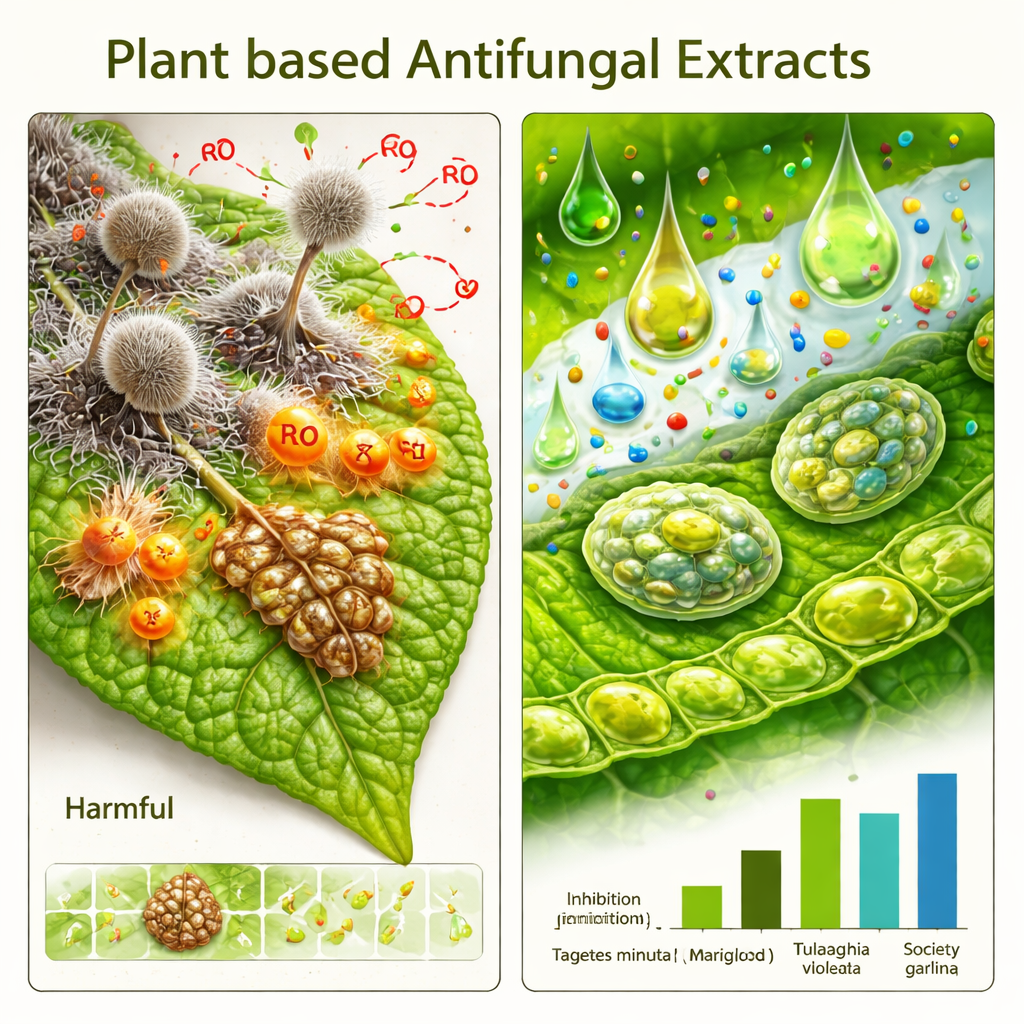
What This Means for Farmers and the Environment
For non-specialists, the message is straightforward: certain plants already familiar in fields, gardens, and kitchens can provide the chemical ingredients for effective, plant-based fungicides. In this study, wild garlic and marigold showed the strongest potential to protect crops from two serious fungal pathogens, helped by their rich mix of natural defensive compounds. While these findings come from laboratory work rather than real farms, they support the idea that low-cost, locally available botanicals might one day help farmers reduce their dependence on synthetic fungicides, improving food safety and environmental health. The authors stress that the next crucial step is to test these extracts and their key compounds in living plants under field-like conditions to see how well they work outside the lab and how they can be turned into practical, farmer-friendly products.
Citation: Mwinga, J.L., Otang-Mbeng, W., Kubheka, B.P. et al. Phytochemical characterisation and antifungal activities of five botanicals used by subsistence farmers to manage plant diseases. Sci Rep 16, 6103 (2026). https://doi.org/10.1038/s41598-026-35591-6
Keywords: botanical fungicides, crop disease, plant extracts, antifungal activity, sustainable agriculture