Clear Sky Science · en
Influence of defect shape on the creep behavior and damage evolution of coal rock using an improved model
Hidden Weak Spots in Underground Rock
Deep underground, the rock that surrounds tunnels and coal mines slowly deforms under immense pressure. Small flaws such as holes and cracks may seem insignificant, but over years they can grow and cause serious cave-ins or roadway failures. This study explores how the simple shape of a hole inside coal-bearing rock can change the way that rock slowly creeps, cracks, and ultimately fails—a question that matters for the long‑term safety of mines, storage caverns, and other subsurface structures.
Why Hole Shape Matters
Engineers have long known that defects weaken rock, but most research has treated rock as either flawless or damaged in a generic way. In reality, coal and surrounding rock contain a variety of cavities created by natural processes or excavation, from sharp‑cornered slots to smooth, rounded openings. The authors realized that these shapes could focus stress and guide crack growth quite differently over time, especially under the slow, steady loading known as creep. To capture this behavior in detail, they combined laboratory data with advanced computer simulations that track how tiny bonds between rock grains break and slip as the rock deforms.
Building a Better Digital Rock
Instead of modeling the rock as a uniform block, the researchers represented coal rock as an assembly of small particles bonded together. They used a “parallel bond” framework to mimic how grains of rock share forces and resist bending, and then coupled it with a Kelvin–Voigt viscoelastic model—essentially, springs and dashpots that represent time‑dependent, creeping deformation. These elements were tuned by trial and error until the simulated strain‑time curves matched real biaxial creep tests on coal specimens. Once calibrated, the model could reproduce not only how the rock deformed under stepwise loading, but also where and when cracks appeared and how they linked up into major fractures.
Putting Different Cavities to the Test
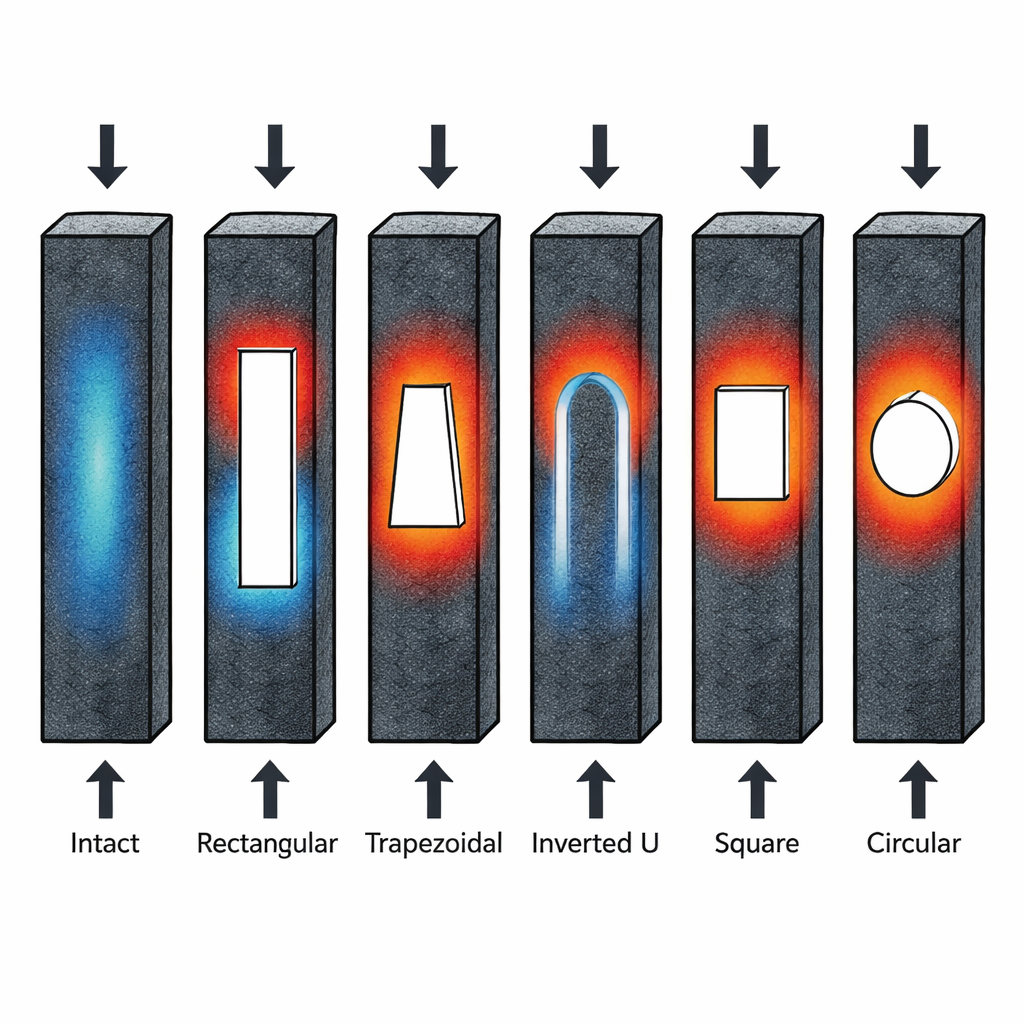
With the digital material in place, the team created six virtual coal samples: one intact and five with cavities of nearly identical area but different shapes—rectangular, trapezoidal, inverted U‑shaped, square, and circular. Each specimen was 50 mm wide and 100 mm high, and was loaded in stages up to 15 megapascals while the simulations recorded stress, strain, and the number of emerging cracks. All defects weakened the rock compared with the intact case, but not equally. Rectangular holes caused the largest drop in failure stress, while square holes led to the greatest reduction in how much the rock could strain before failing. Inverted U‑shaped holes most strongly reduced the effective stiffness at failure. Specimens with the widest cavities, such as the rectangular and inverted U shapes, proved most compressible, highlighting that for holes of the same area, width strongly controls how easily the rock is squeezed and damaged.
Stress Patterns and Crack Pathways
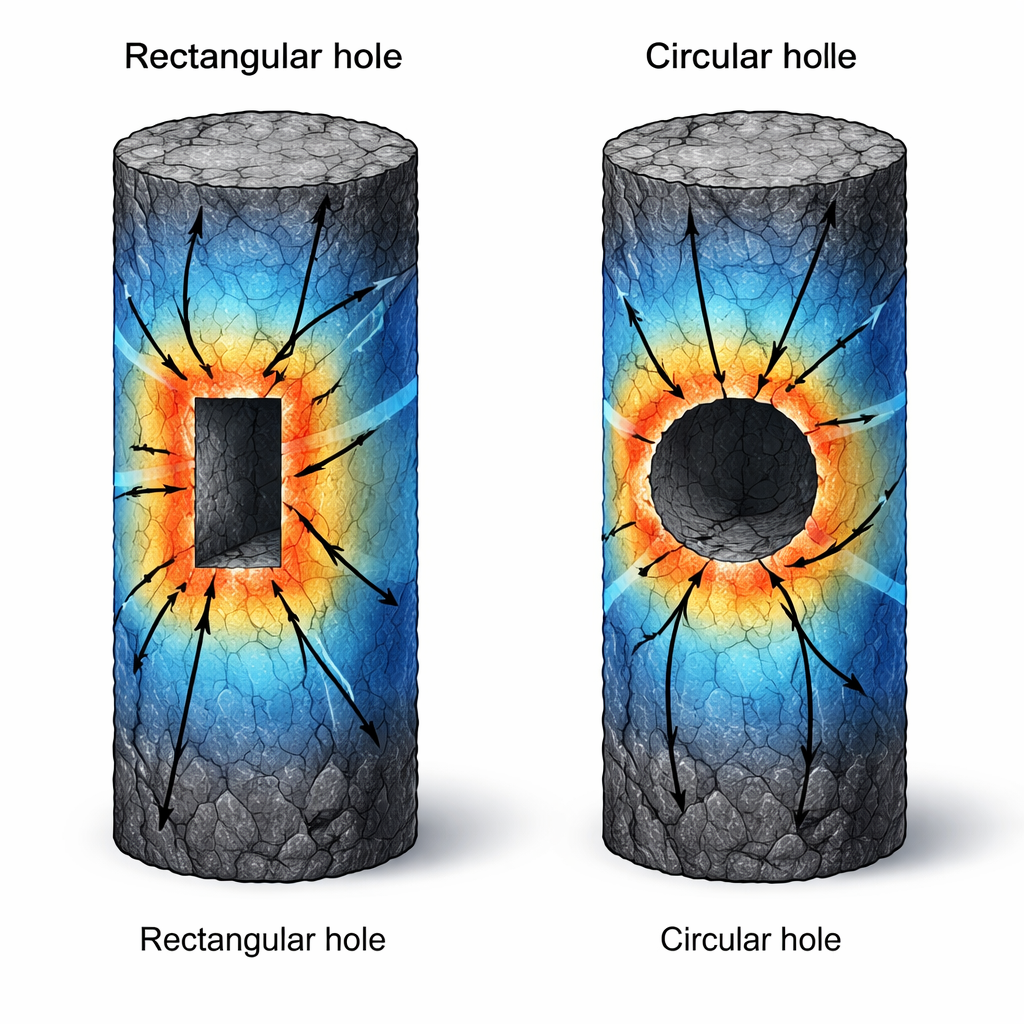
The simulations also revealed how stress fields form and cracks propagate around each type of cavity. In samples with rectangular, trapezoidal, inverted U, and square holes, high‑stress zones did not start at the cavity edges. Instead, they first appeared in the surrounding rock and then grew back toward the hole, eventually linking to it and creating complex, lateral bands of high stress. Cracks tended to start in these outer zones, run toward the cavity, then extend to the specimen boundaries and back inward again, forming mixed tension–shear fracture networks. By contrast, the circular cavity produced a symmetric stress pattern, with high‑stress regions developing directly at opposite sides of the hole. Cracks then wrapped around the cavity in a more uniform way, giving rise to a global shear band that sliced through the entire specimen.
What This Means for Underground Safety
For non‑specialists, the key message is that not all holes in rock are created equal. Even when they are the same size, cavities with sharp corners and broad, flat sides—like rectangles and inverted U‑shapes—concentrate stress in ways that promote early, localized shear failure and high compressibility. Smoother, round cavities distribute stress more evenly and tend to fail in a more global shear mode at higher loads. By showing how defect geometry controls creep strength, stiffness loss, and crack evolution, the study offers practical guidance for designing safer coal pillars, roadways, and other deep mining supports: avoid creating wide, sharp‑edged openings, and treat existing ones as high‑risk zones for long‑term deformation and failure.
Citation: Zhao, T., Cao, Y., Wang, T. et al. Influence of defect shape on the creep behavior and damage evolution of coal rock using an improved model. Sci Rep 16, 5781 (2026). https://doi.org/10.1038/s41598-026-35589-0
Keywords: coal rock creep, defect geometry, underground stability, crack evolution, numerical rock modeling