Clear Sky Science · en
Ecological stoichiometry characteristics and influencing factors of the source reservoir in the middle route of the South-to-North Water Diversion Project
Why the Chemistry of a Giant Reservoir Matters
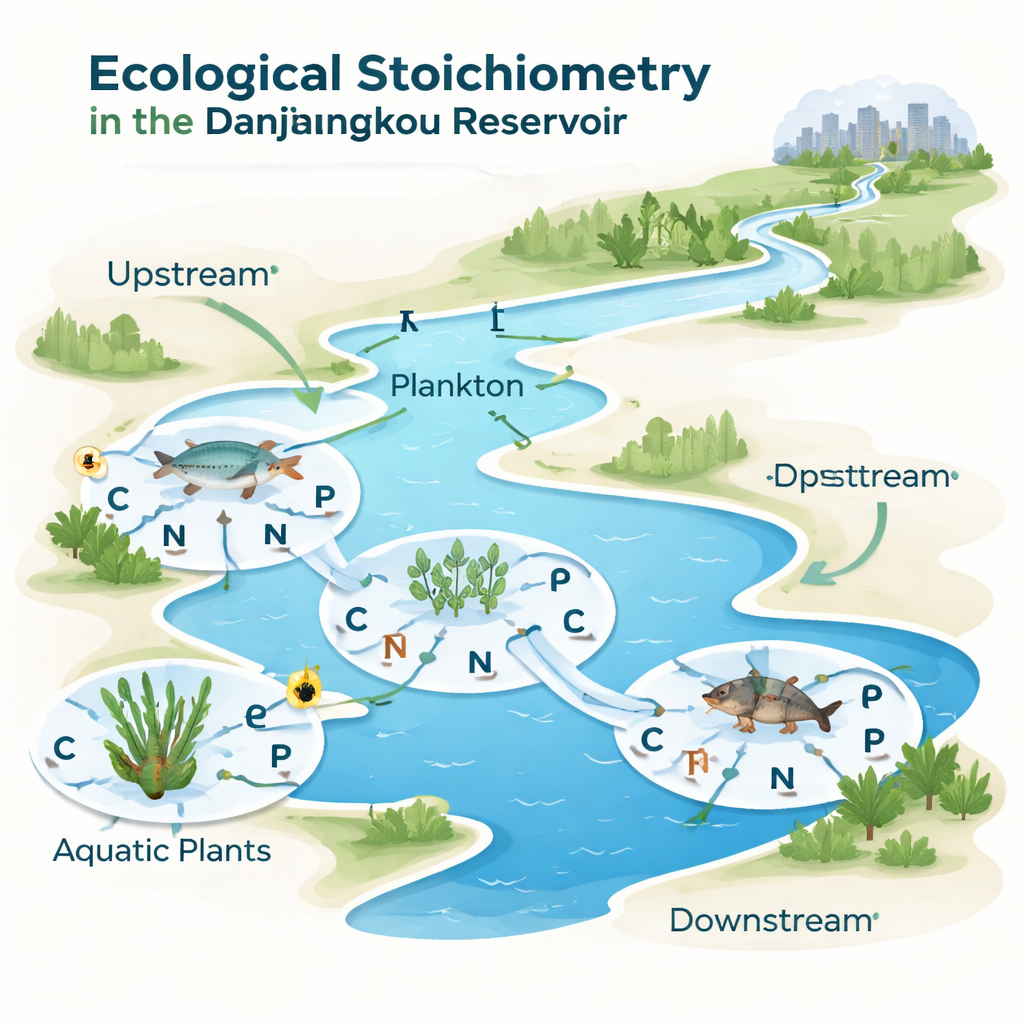
The Danjiangkou Reservoir in central China is the starting point of a massive engineering project that sends drinking water hundreds of kilometers north, including to Beijing. Keeping this water source clean and stable is crucial for millions of people. This study looks at a surprisingly powerful lens on reservoir health: the balance of three basic ingredients of life—carbon, nitrogen, and phosphorus—inside fish, plants, and tiny aquatic creatures. By tracking how these elements move through the food web, the researchers show how the ecosystem stays stable, and where it may be vulnerable to pollution and algal blooms.
Life’s Building Blocks in a Working Reservoir
Every organism needs carbon for energy and structure, nitrogen for proteins, and phosphorus for DNA and bones. But the exact mix of these elements varies between species and environments. In the Danjiangkou Reservoir—China’s second-largest artificial lake and the source of the South-to-North Water Diversion Project—the team measured carbon, nitrogen, and phosphorus in 34 fish species, as well as in plankton, shellfish, shrimps, and aquatic plants. They sampled both upstream and downstream sections of the reservoir in different seasons, and compared these biological measurements with water chemistry, including several forms of dissolved nitrogen and total phosphorus.
Fish Diets Tell a Story About Nutrients
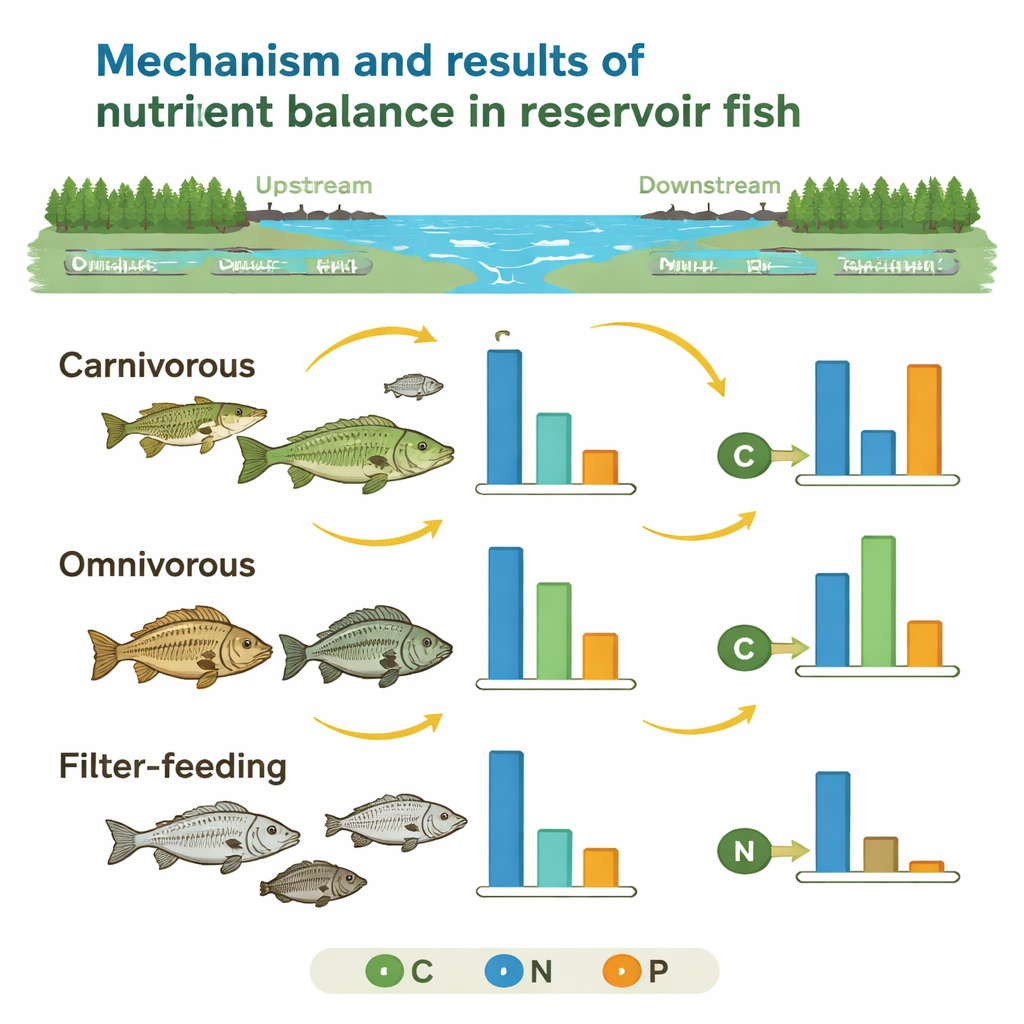
The researchers found that, overall, fish bodies followed a common rule of thumb: carbon made up about half of their mass, nitrogen about one-tenth, and phosphorus only a few percent. Yet which kind of fish you looked at mattered a great deal. Carnivorous species—fish that eat other animals—consistently had higher nitrogen and phosphorus and lower carbon than omnivores and filter feeders, both upstream and downstream. This pattern reflects their bony skeletons and protein-rich diets. In contrast, fish that filter food particles from the water tended to have the lowest nitrogen and the highest carbon. Despite clear differences among species and feeding habits, the same species looked remarkably similar in both parts of the reservoir, revealing a strong tendency to keep their internal chemistry stable even as water conditions change.
Tiny Creatures and Plants Signal Hidden Risks
The study did not stop with fish. Zooplankton—the tiny animals that graze on microscopic algae—showed the highest nitrogen and phosphorus levels of all groups, while aquatic plants had the lowest nitrogen. Compared across the reservoir, zooplankton, snails, clams, and the small shrimp Macrobrachium nipponense showed little difference between upstream and downstream, again hinting at strong internal control of their chemistry. In contrast, phytoplankton and aquatic plants had clearly higher nitrogen levels upstream. Their higher nitrogen-to-phosphorus ratios suggest that upstream waters may be more prone to shifts in algal species and even single-species blooms if conditions change, a warning sign for managers trying to prevent green, soupy water.
Water Quality and the Quiet Work of Homeostasis
Because the reservoir’s water quality is not the same everywhere, the authors tested whether fish chemistry tracked local nutrient levels. Upstream, there was no meaningful link between the nitrogen and phosphorus in the water and the elemental makeup of fish. Downstream, some subtle connections emerged: for example, fish with higher nitrogen-to-phosphorus ratios were found where one reactive form of nitrogen (nitrite) was higher and ammonium was lower, and higher water phosphorus was linked to more carbon stored in fish bodies. These patterns suggest that, especially in the downstream, phosphorus scarcity and shifting nitrogen forms nudge fish to adjust how they store and excrete nutrients—but within narrow limits. Overall, the internal balance of elements in most fish remained tightly controlled, a hallmark of what ecologists call homeostasis.
What This Means for a Major Water Supply
For non-specialists, the main message is reassuring but cautionary. The Danjiangkou Reservoir’s food web shows strong chemical stability: fish and most invertebrates keep their internal nutrient balance steady even when the surrounding water differs from place to place. This stability helps buffer the system and supports reliable water quality. However, the more flexible responses of algae and aquatic plants, especially upstream, reveal pressure points where excess nutrients could trigger algal blooms and reduce biodiversity. The authors argue that managing this source of drinking water should focus on limiting nitrogen inputs from the watershed, tracking key nutrient forms, and protecting submerged vegetation. In doing so, managers can support the natural nutrient-balancing work of fish and other organisms that quietly help keep the taps flowing clear.
Citation: Zhang, Y., Duan, J., Han, X. et al. Ecological stoichiometry characteristics and influencing factors of the source reservoir in the middle route of the South-to-North Water Diversion Project. Sci Rep 16, 4971 (2026). https://doi.org/10.1038/s41598-026-35588-1
Keywords: reservoir ecology, nutrient cycling, fish communities, water quality, algal blooms