Clear Sky Science · en
Enhancing the resolution of microseismicity through dense array monitoring in complex extensional settings
Listening to the Smallest Quakes
Most people only hear about earthquakes when a big one strikes, but the planet is constantly trembling with countless tiny events too small to feel. This study shows how carefully listening to those micro‑earthquakes with a super‑dense network of instruments can reveal the hidden shape and behavior of dangerous faults in southern Italy. By mapping very small quakes in great detail, scientists can better estimate how large future earthquakes might be and where they are most likely to occur. 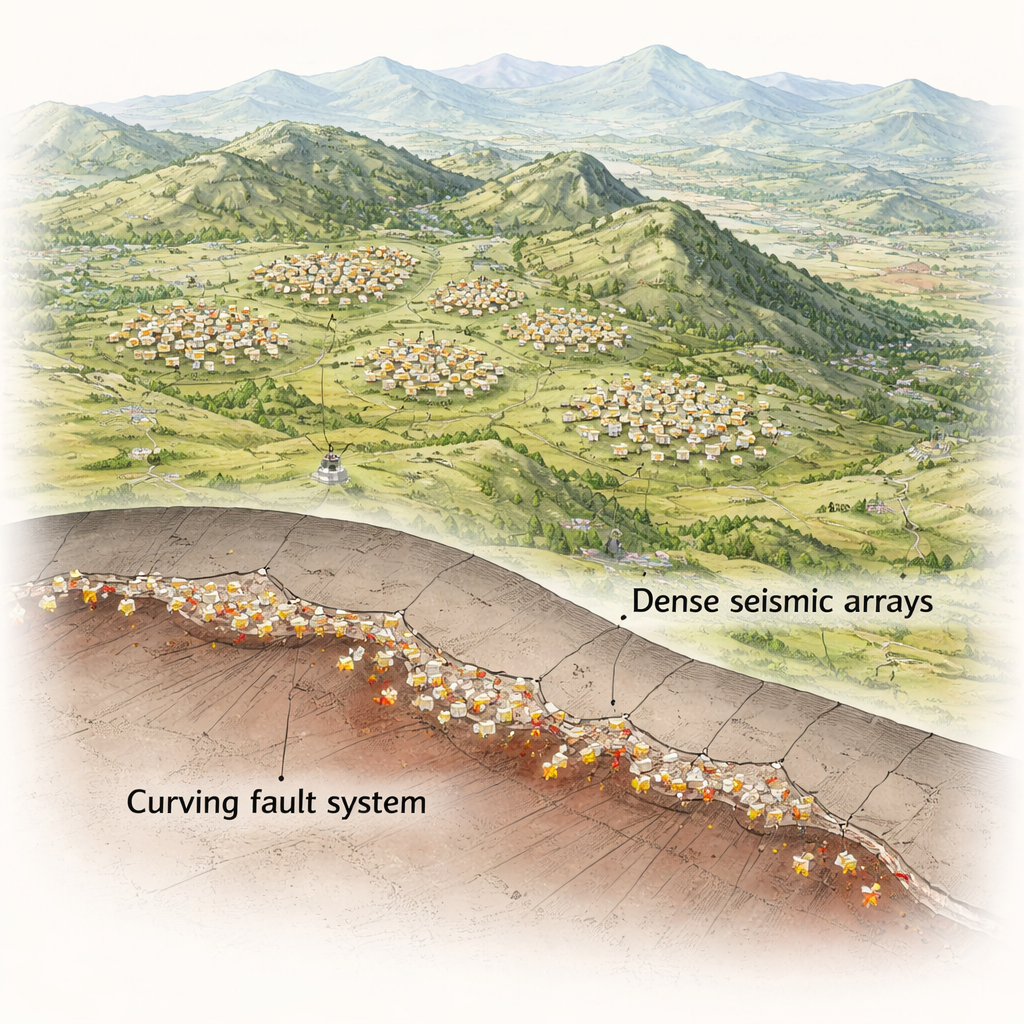
A Natural Lab for Dangerous Earthquakes
The research focuses on the Irpinia region in the Southern Apennines, one of Italy’s highest‑hazard areas. There, a major earthquake in 1980 ruptured several fault segments over tens of kilometers, causing long‑lasting shaking and thousands of deaths. For years, a permanent monitoring system with widely spaced stations has tracked local earthquakes, but the results left open a key question: were the apparently scattered small quakes truly random, or did they simply look messy because the network could not see them clearly enough?
Building a Temporary Super‑Dense Network
To sharpen this blurry picture, scientists deployed a temporary “constellation” of 20 small seismic arrays, each made of 10 instruments, adding 200 sensors on top of the permanent network. These arrays, spaced about 10 kilometers apart but with stations only hundreds of meters from each other inside each cluster, recorded continuous data for 11 months. The team then used modern machine‑learning tools, combined with similarity searches that look for repeating wave patterns, to detect far more tiny earthquakes than a human analyst could find by eye. This approach produced a catalog of about 3,600 events—roughly eight times more quakes than the standard network logged in the same period—and pushed the detection threshold down by more than one full magnitude unit, into the realm of quakes too small for traditional systems to catch. 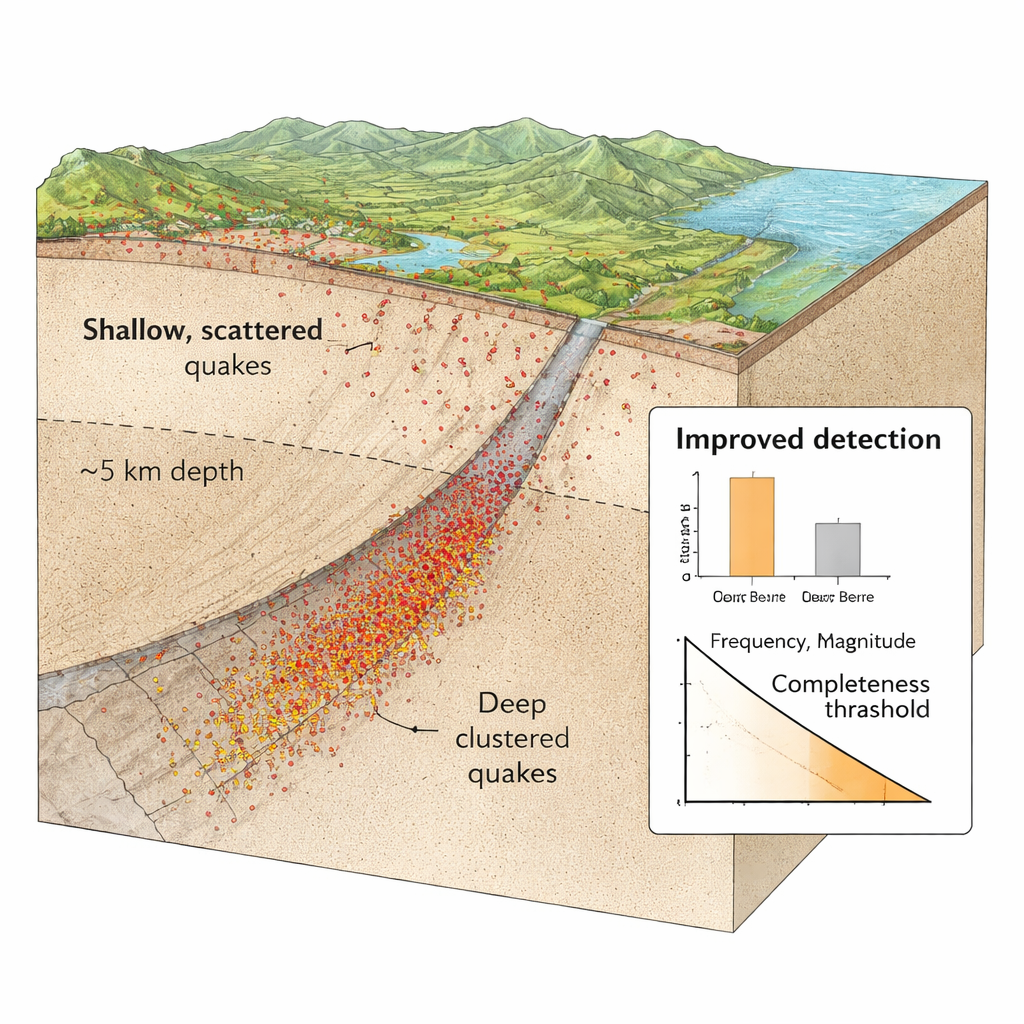
Drawing a Clearer Picture of the Fault
Finding more events is only half the story; knowing exactly where they happen is what reveals the underground structure. Using advanced techniques that compare arrival times of seismic waves between nearby events, the researchers relocated about 65% of the detected earthquakes with typical position uncertainties of only about 100 meters, fine enough to trace the outlines of individual fault patches. They discovered that the new short‑term catalog lines up remarkably well with more than a decade of previous observations: the spatial patterns of activity and the statistical balance between small and larger events are consistent, just extended down to much smaller quakes. This means the tiny events behave like scaled‑down versions of larger ones, offering a new window onto how the fault system slips over time.
Shallow Water Effects and Deep Fault Patches
The high‑resolution locations reveal two distinct depth zones. Above roughly 5 kilometers, earthquakes are sparse and scattered, especially within a zone of fractured rock and karst aquifers between major faults. Previous studies show that changes in groundwater loading there can open and close cracks with the seasons, and the new results support the idea that many shallow quakes are tied to this slow breathing of the crust under changing water pressure. Below 5 kilometers, earthquakes cluster tightly along narrow structures a few hundred meters long. These deeper sequences look more like classic stress‑release on fault patches, with small main shocks and aftershocks breaking highly fractured rock near or along a larger underlying fault.
Hidden Bend, Big Potential
When the relocated earthquakes are viewed together with 3‑D images of seismic wave speeds in the crust, a clearer fault geometry emerges. The micro‑quakes trace out a 50–60‑kilometer‑long curving fault that includes a right‑stepping bend several kilometers wide, consistent with earlier hints from imaging and gravity data. To test what this means for hazard, the team ran computer simulations of earthquake rupture along a segmented fault with this kind of bend. In many realistic stress and friction scenarios, a rupture that starts on one segment can cross the bend and continue along the full length, implying that earthquakes as large as magnitude 7 could occur if the entire system breaks in one event.
What This Means for People at Risk
For non‑specialists, the key message is that very dense, temporary sensor networks combined with artificial intelligence can, in just one year, deliver the kind of detail on fault structure that used to require more than a decade of monitoring. In Irpinia, this technology shows that the same fault system responsible for past deadly earthquakes remains capable of very large events, and that shallow water‑driven cracking and deeper fault slip follow different rules. Such high‑resolution catalogs can help refine earthquake scenarios, improve ground‑shaking forecasts, and guide where to focus mitigation efforts—turning otherwise imperceptible micro‑tremors into valuable clues about future major quakes.
Citation: Scotto di Uccio, F., Muzellec, T., Scala, A. et al. Enhancing the resolution of microseismicity through dense array monitoring in complex extensional settings. Sci Rep 16, 5639 (2026). https://doi.org/10.1038/s41598-026-35586-3
Keywords: microseismicity, dense seismic arrays, Irpinia fault, earthquake monitoring, seismic hazard