Clear Sky Science · en
An approach to modified grinding aid for green cement production: synthesis, characterization, and compatibility with cement
Why better cement matters for everyone
Cement is the glue that holds our buildings, bridges, and roads together—but making it is energy‑hungry and releases large amounts of carbon dioxide. This study looks at a subtle but powerful way to make cement production cleaner and performance better: tweaking the tiny helper chemicals used when grinding cement. By redesigning these helpers, the authors show it is possible to save energy, keep concrete flowing smoothly on site, and still build strong, long‑lasting structures.
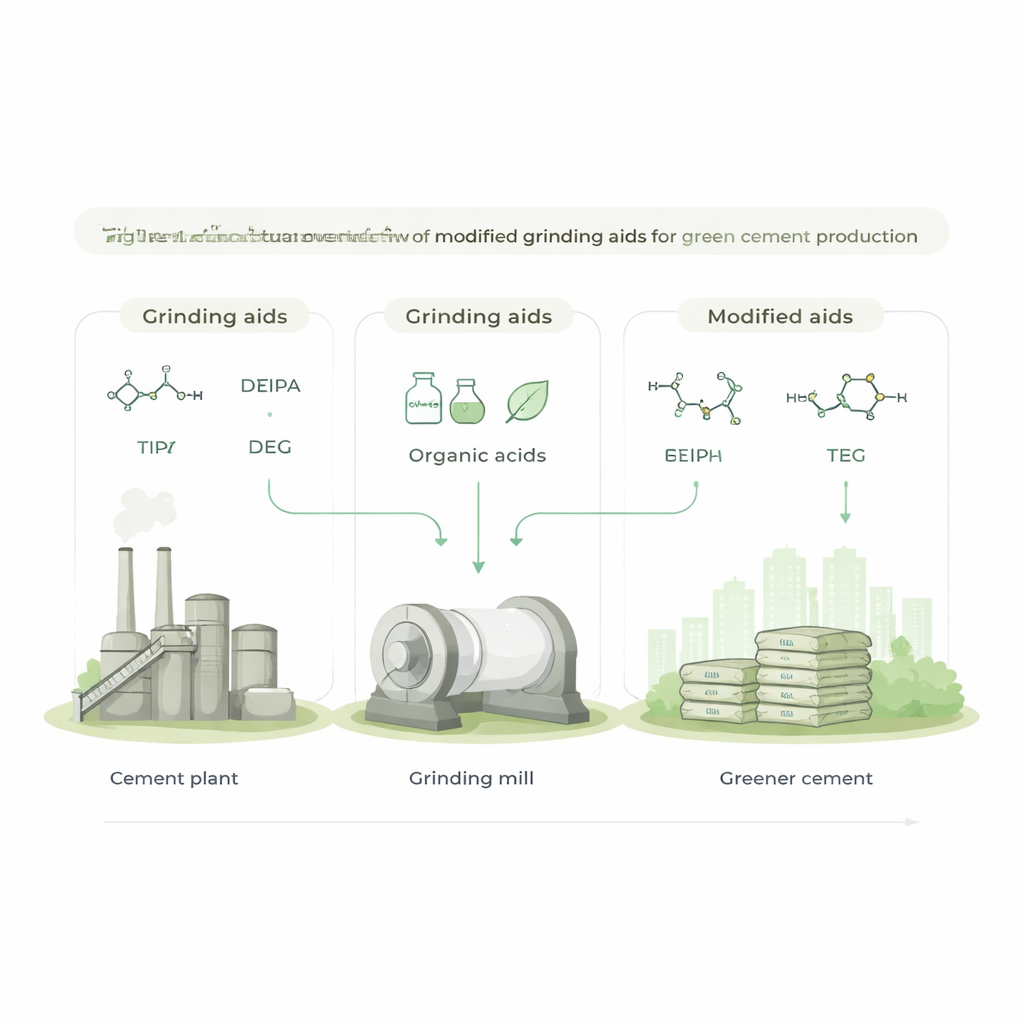
Hidden helpers in the cement mill
Inside a cement plant, hard marble‑like chunks called clinker are ground into the fine powder we recognize as cement. To make this grinding step more efficient, manufacturers add small amounts of “grinding aids”—usually amine or glycol molecules that stick to fresh particle surfaces and stop them from clumping. That means less energy, finer particles, and more consistent material. However, these same additives can clash with modern water‑reducing chemicals, known as polycarboxylate ethers (PCEs), which are crucial for making highly flowable, low‑water concretes used in today’s skyscrapers and infrastructure.
Redesigning the molecules for greener cement
The researchers set out to upgrade three widely used grinding aids: triisopropanolamine (TIPA), diethanol isopropanolamine (DEIPA), and diethylene glycol (DEG). They reacted each of these with small organic acids of different chain lengths—acetic, propanoic, and hexanoic acids—to create “modified” versions with tailor‑made structures. These new molecules were confirmed using infrared spectroscopy, then tested in real cement produced in a laboratory mill. The team measured how particle size changed, how easily cement pastes and mortars flowed, how well they kept that flow over time, and how strong they became after 7 and 28 days.
Making cement finer and easier to handle
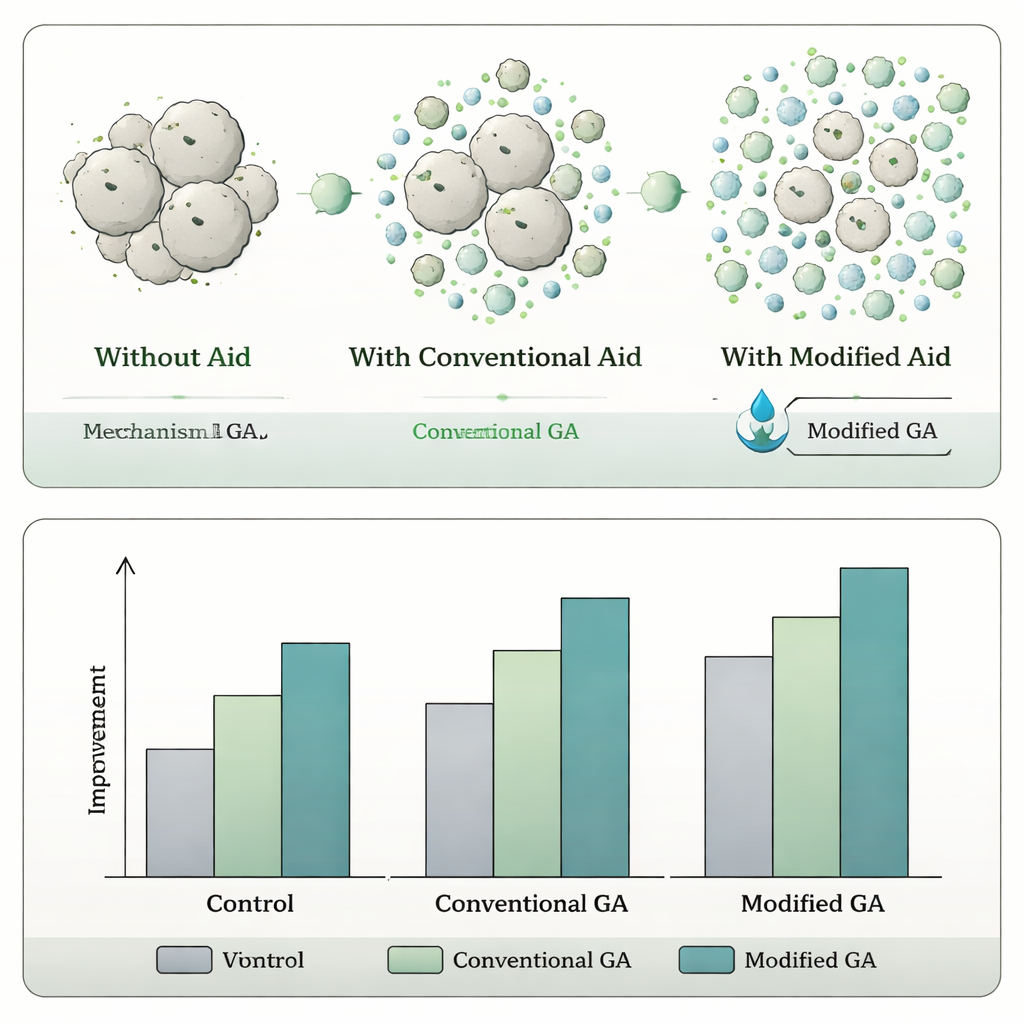
All grinding aids, even the unmodified ones, shifted cement toward finer particles, which generally helps early strength. The modified versions did this even more effectively, especially for formulations based on DEG. Yet the real advance was in how the fresh cement behaved. Some traditional amine aids, particularly TIPA and DEIPA, can interfere with PCE molecules that are added later to improve flow; the result is sticky pastes that resist pumping and placing. In contrast, several of the new modified aids cut the resistance to flow (viscosity) dramatically—by as much as 86% for a TIPA modified with hexanoic acid, and up to 69% for a DEG modified with acetic acid—while still working reasonably well with PCE.
Keeping concrete fluid with less chemical burden
The study also explored how much PCE was needed to reach a standard mortar flow and how well that flow was maintained for an hour, which simulates conditions on a construction site. Conventional TIPA, DEIPA, and DEG often increased the dose of PCE required, and at higher levels they could cause the mix to stiffen more quickly. The modified aids reversed this trend: many of them allowed the same workability with noticeably less PCE and improved flow retention over 60 minutes. Certain combinations—such as TIPA and DEIPA modified with hexanoic acid, and DEG modified with propanoic acid—boosted flow after an hour by up to about 15% compared with their unmodified counterparts, a clear advantage for ready‑mixed and pumped concrete.
Building strength while cutting environmental cost
Crucially, the greener grinding aids did not trade away strength. In most cases, mortars made with the modified additives were stronger than both the control cement and the mixes made with traditional aids. Gains at 28 days commonly ranged from about 10% to over 25%, depending on the specific formulation and dosage. These improvements stem from the combination of finer particle size distributions and subtle changes to how different cement minerals hydrate. Stronger cement at the same clinker content opens the door to replacing part of the clinker with industrial by‑products such as fly ash or natural pozzolans, which lowers both energy use and carbon footprint.
What this means for future construction
For non‑specialists, the key message is that small changes at the molecular level can have outsized benefits in the real world. By smartly redesigning existing grinding chemicals rather than inventing entirely new ones, this work shows a practical route for cement producers to cut energy use, improve the flow of concrete on site, and maintain or even increase strength. In the long run, such advances can help the construction industry use more supplementary materials, reduce emissions, and make “green cement” a mainstream reality without sacrificing safety or performance.
Citation: Kobya, V., Kaya, Y., Kuran, Ö. et al. An approach to modified grinding aid for green cement production: synthesis, characterization, and compatibility with cement. Sci Rep 16, 4901 (2026). https://doi.org/10.1038/s41598-026-35585-4
Keywords: green cement, grinding aids, concrete rheology, superplasticizer compatibility, compressive strength