Clear Sky Science · en
Real-time breath analysis for COPD risk assessment in smokers using a ZnO/SnO₂ heterojunction sensor integrated with support vector machine
Why Your Breath Can Reveal Hidden Lung Trouble
Chronic obstructive pulmonary disease (COPD) is one of the world’s leading killers, yet it often creeps up silently over many years. Today, doctors mostly rely on lung function tests done in clinics to spot it, which means many high‑risk people—especially smokers—are diagnosed late. This study describes a new kind of smart, mask‑based breath analyzer that looks for carbon monoxide in exhaled air as an early warning sign of COPD risk, using advanced materials, miniaturized electronics, and machine learning to turn a simple breath into a powerful health check.
A Growing Lung Crisis That Needs Earlier Answers
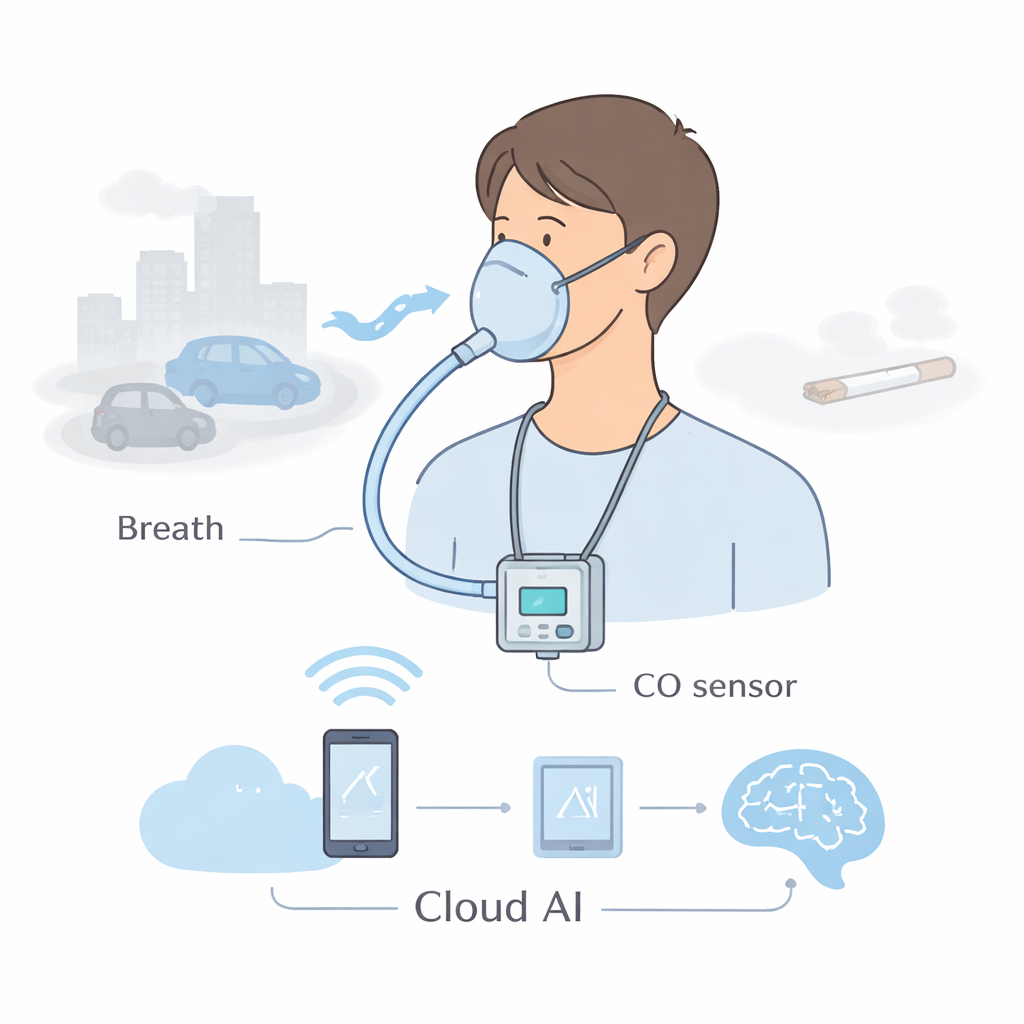
COPD is a long‑term disease that makes it harder to breathe and cannot be fully reversed. It kills millions of people every year and is especially common among older adults and smokers. One major culprit in its development is carbon monoxide (CO), a gas found in cigarette smoke, polluted city air, and smoke from burning fuels. CO sticks to hemoglobin in the blood much more strongly than oxygen does, reducing the body’s oxygen supply and contributing to lung damage and inflammation. Studies show that people with COPD, especially smokers, exhale higher levels of CO than healthy individuals. For example, healthy non‑smokers typically breathe out around 1–4 parts per million (ppm) of CO, while current smokers with COPD can exceed 12 ppm. This makes exhaled CO a promising, painless marker of lung stress that could be tracked in everyday life, not just in hospitals.
Building a Tiny Breath Sensor into a Simple Mask
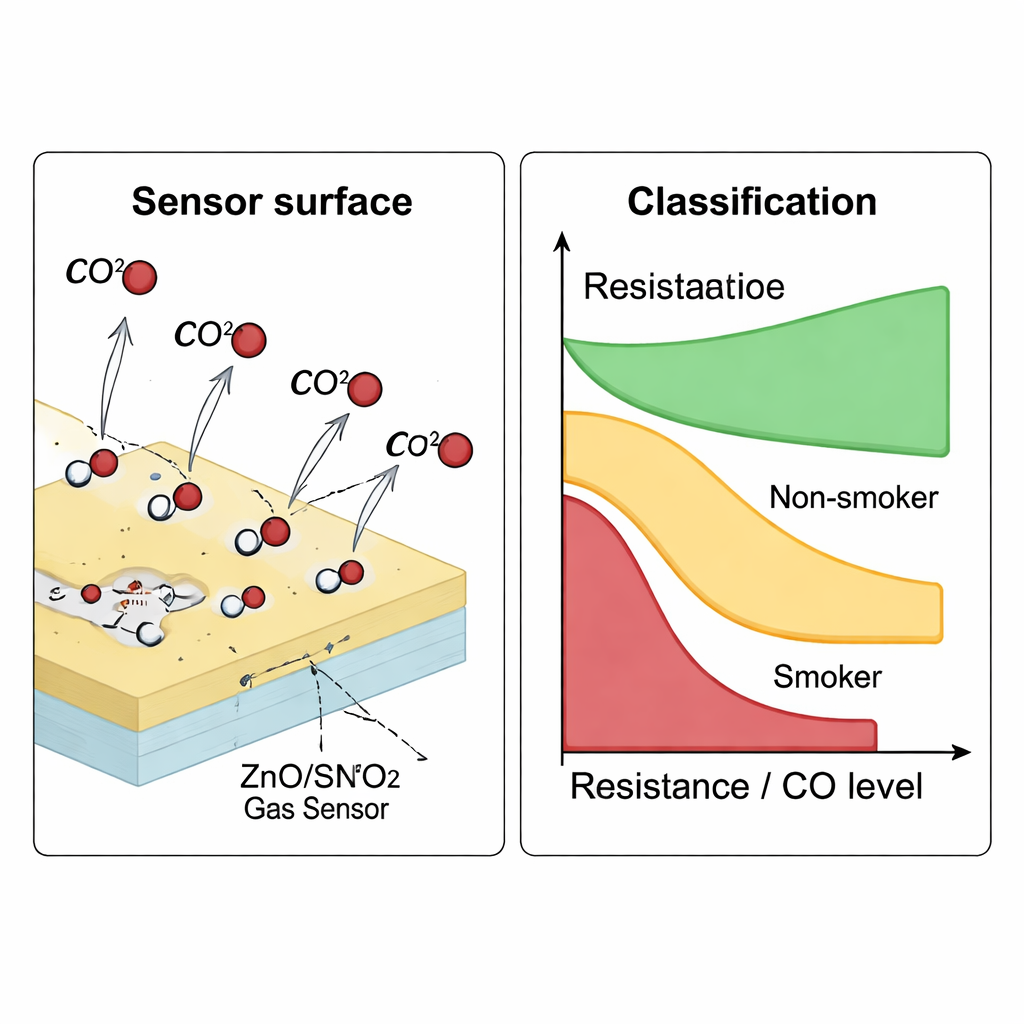
The researchers set out to design a small, low‑cost CO sensor that could work close to body temperature, so it would be comfortable in a mask or wearable device. They combined two metal oxides, zinc oxide (ZnO) and tin dioxide (SnO₂), into a carefully engineered thin film called a heterojunction. This special layered structure, further coated with a conductive polymer (PEDOT:PSS), was deposited on a small glass‑like substrate and wired with silver contacts. When air passes over the film, oxygen from the air sticks to its surface and traps electrons, raising the film’s electrical resistance. When CO molecules arrive in a breath, they react with those oxygen species, release electrons back into the material, and lower the resistance. Because of its structure, the combined ZnO/SnO₂ film showed much stronger and faster changes in resistance than either material alone, reaching high sensitivity at just 37 °C—roughly human body temperature.
From Electrical Signals to Real‑Time Health Readouts
To test this sensor, the team built a controlled gas chamber that mixed precise amounts of CO with nitrogen and kept the temperature at 37 °C. They measured how quickly the sensor reacted when CO was turned on and off, and how strongly its resistance changed with different gas levels. The ZnO/SnO₂ device responded in about 14 seconds and recovered in just 3 seconds, with a sensitivity of more than 260% at 12 ppm CO. The relationship between resistance and CO concentration was very predictable, following a simple mathematical law that allowed the authors to convert raw resistance readings directly into CO levels. They then integrated the sensor into a face mask connected by a tube to a small sealed chamber, read the signal with an Arduino microcontroller, filtered and stored the data, and sent it wirelessly via Wi‑Fi to a cloud platform. This compact setup turned the mask into an Internet‑of‑Things (IoT) device capable of remote breath monitoring.
Letting Machine Learning Sort Smokers, Ex‑Smokers, and Others
Because many factors can affect a single breath reading, the researchers added a machine‑learning layer to interpret patterns over time. They collected exhaled‑breath data from 15 adult volunteers grouped as non‑smokers, current smokers, and ex‑smokers, then trained a support vector machine (SVM) classifier to distinguish between these groups using the sensor’s resistance‑based CO estimates. The model achieved a training accuracy of about 94% and a testing accuracy of nearly 82%, a large jump over earlier approaches. The system could clearly separate the lower CO levels of non‑smokers from the higher levels in ex‑smokers and especially in current smokers, which are closely tied to increased COPD risk. In effect, the device acts like a focused, single‑gas “electronic nose” tuned to CO, but paired with intelligent software that translates breath patterns into meaningful risk categories.
What This Could Mean for Everyday Lung Care
To a layperson, the key message is that this work brings us closer to a future where checking your lungs could be as easy as putting on a mask and breathing normally for a short time. By combining a highly sensitive, low‑power CO sensor with wireless electronics and machine learning, the system can estimate how much harmful CO is in your breath and classify whether your pattern looks like that of a non‑smoker, ex‑smoker, or high‑risk smoker. While it does not replace full medical testing, it could become an affordable, portable screening tool for early COPD risk assessment and ongoing monitoring at home or in primary care, helping people and clinicians act sooner—long before breathlessness becomes impossible to ignore.
Citation: Chellamuthu, P., Savarimuthu, K., Alsath, M.G.N. et al. Real-time breath analysis for COPD risk assessment in smokers using a ZnO/SnO₂ heterojunction sensor integrated with support vector machine. Sci Rep 16, 5100 (2026). https://doi.org/10.1038/s41598-026-35583-6
Keywords: COPD, breath analysis, carbon monoxide, wearable sensors, machine learning