Clear Sky Science · en
Comprehensive assessment of ground motion amplification in stratified soils with different layer configurations and types
Why the Ground Beneath Us Matters in an Earthquake
When an earthquake strikes, two neighboring buildings can experience very different shaking, even if they are the same distance from the fault. The secret often lies not in the buildings themselves, but in the layers of soil beneath them. This study explores how different arrangements of sand and clay in the top 30 meters of the ground can either amplify or damp earthquake motions, offering insights that matter for everything from building codes to where we choose to develop cities.
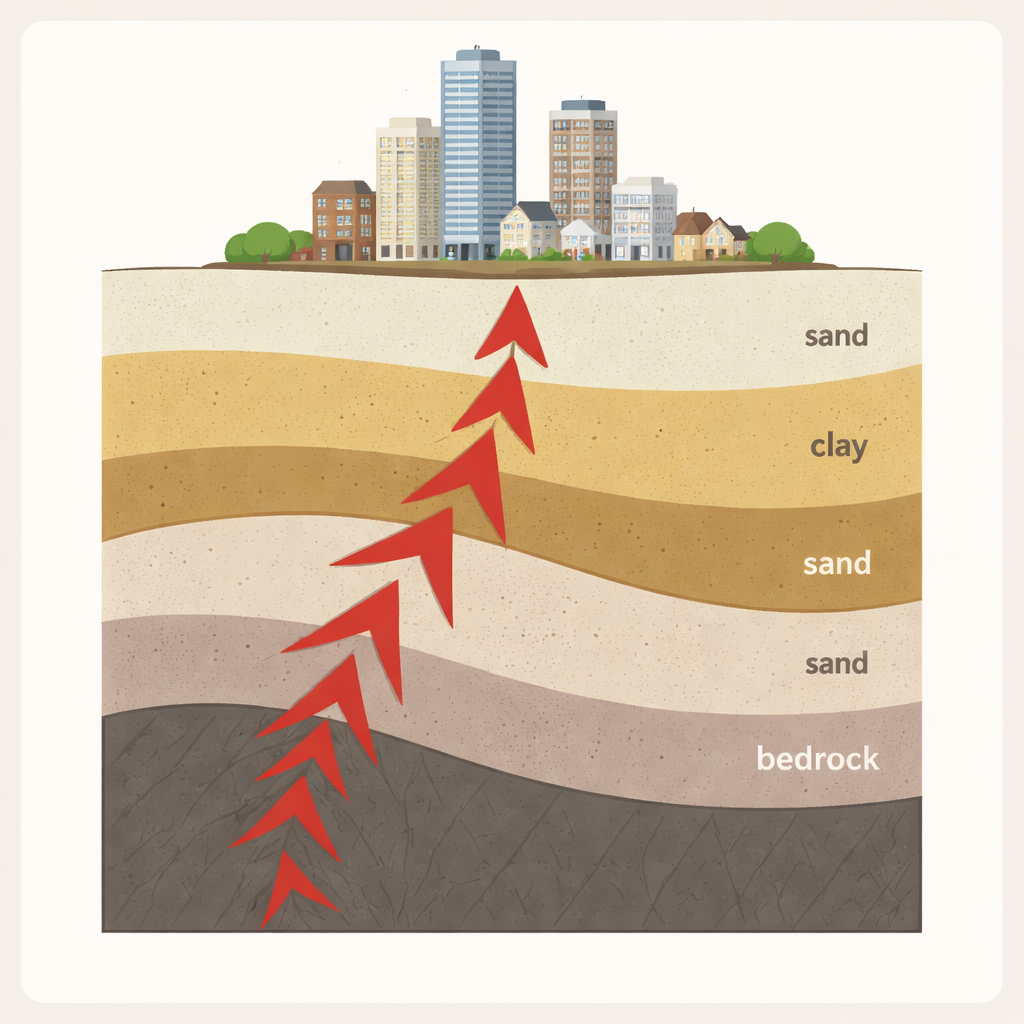
How Earthquake Waves Travel Through Soil
As seismic waves travel upward from solid bedrock, they pass through layers of soil that can be soft or stiff, thick or thin. These layers act a bit like lenses for sound, changing the strength and rhythm of the shaking. Soft soils tend to vibrate more slowly but with larger movements; stiffer soils respond more quickly but usually with smaller motions. When the vibration rhythm of the soil column lines up with that of the incoming earthquake waves, resonance can occur, greatly boosting the shaking felt at the surface. Understanding these interactions is at the heart of modern earthquake engineering.
Eight Ways to Stack Sand and Clay
To untangle the role of soil layering, the researchers built eight simplified ground models, each 30 meters deep. Some were made entirely of sand or entirely of clay. Others mixed the two materials in different proportions and orders: clay over sand, sand over clay, thin soft layers over thick stiff ones, and the reverse. Using a specialized computer program, they simulated how strong earthquake waves, recorded at rock sites around the world, would move through each of these idealized soil columns at three shaking levels: mild (0.10 g), moderate (0.25 g), and strong (0.50 g). For every case, they calculated how much the motion grew or shrank as it traveled from the bedrock to the ground surface.
Which Soil Arrangements Amplify Shaking the Most
The simulations show that what matters most is not just how much sand or clay is present overall, but which material sits near the ground surface and how thick that top layer is. Profiles with clay at the surface consistently produced stronger amplification and longer-period (slower) shaking, because clay is softer and loses stiffness more as it is strained. In contrast, when thick sand layers sat on top, the ground tended to amplify shorter-period (faster) motions but with smaller overall boosts. The most dramatic effect appeared when a relatively thin clay layer lay over a much thicker sand layer. In that arrangement, the shaking at some periods was multiplied by almost six times compared with the input motion at bedrock, far more than in any other profile.
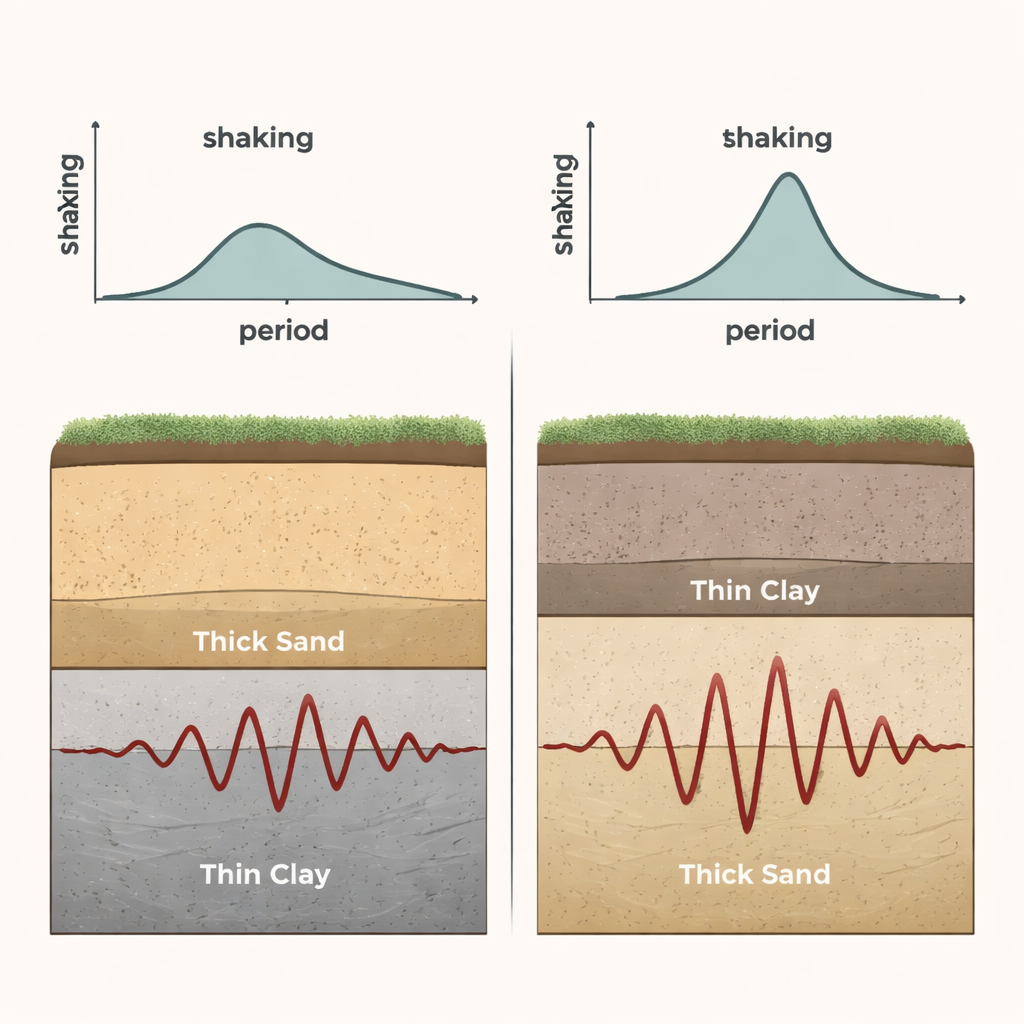
Where the Ground Quietly Calms the Shaking
The study also found that the ground does not always make shaking worse. In certain ranges of vibration period, some soil combinations actually reduced the motion compared with the underlying rock, a behavior known as deamplification. These "quiet zones" depended strongly on how the layers were stacked. Profiles with thick sand on top showed wide bands of reduced motion, while an all-sand profile did not significantly calm the shaking. A thick clay profile, on the other hand, tended to reduce motion over a broad span of shorter periods but still allowed strong amplification at longer periods, which are particularly relevant for taller structures.
What Stronger Shaking Does to the Soil Response
As the intensity of the simulated earthquakes increased from low to high, the soils behaved less like ideal springs and more like real, nonlinear materials. Clay layers, especially those near the surface, softened noticeably under stronger shaking, stretching the soil’s natural vibration period and shifting the peaks in amplification toward slower motions. Stiffer sand layers also showed changes, but mainly through added damping that reduced the highest peaks at strong shaking levels. Overall, many soil profiles amplified motions most at moderate shaking, with some peak factors dropping again at the highest level because of this internal energy loss.
What This Means for Safer Buildings and Cities
For non-specialists, the key takeaway is that the vertical ordering and thickness of soil layers under a site can be more important than broad labels like "soft" or "stiff" ground. A thin soft layer over stiffer material may be especially hazardous, while a thick stiff layer at the surface can help keep amplification in check. The authors conclude that accurate, site-specific investigations of near-surface layering are crucial for realistic earthquake hazard estimates and safe design. Rather than relying on averaged soil descriptions, engineers and planners need to know precisely how sand and clay are stacked beneath their feet if they are to build structures that can better withstand future earthquakes.
Citation: Ziar, A., Basari, E. Comprehensive assessment of ground motion amplification in stratified soils with different layer configurations and types. Sci Rep 16, 5223 (2026). https://doi.org/10.1038/s41598-026-35581-8
Keywords: soil amplification, earthquake shaking, sand and clay layers, site response, seismic hazard