Clear Sky Science · en
Temporal calibration in taste temporal order judgment is associated with empathizing traits
Why the timing of taste matters
When you sip soup or bite into dessert, you probably don’t notice that different flavors reach your brain at slightly different times. Yet salty tastes are detected a fraction of a second faster than sweet ones. This study asks a surprising question: does your style of thinking and feeling about other people—especially how strongly you empathize—change how you experience the timing of salty and sweet flavors when they are mixed together?
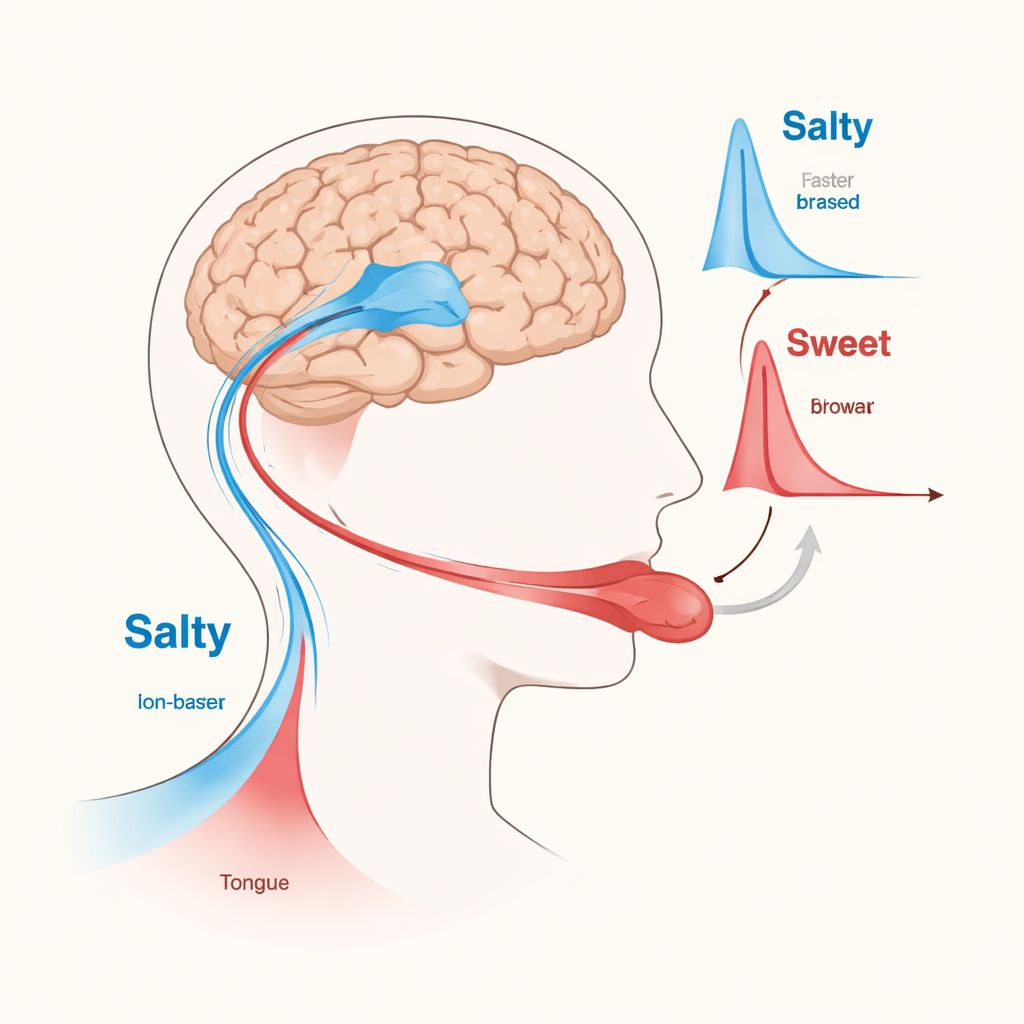
How salty and sweet race to the brain
Our tongues detect basic tastes—salty, sour, sweet, bitter, and umami—using different kinds of microscopic sensors. Salty signals rely on fast, channel-like receptors that open almost instantly when salt is present. Sweet signals mostly use slower, multi-step receptors that trigger an internal chain reaction before sending a message to the brain. Earlier work has shown that salty tastes can be sensed roughly 100–200 milliseconds earlier than sweet tastes. In principle, this means that if salt and sugar hit your tongue at the same moment, the brain should become aware of “salty” first and “sweet” a bit later.
How the brain learns to line up signals
However, our brains do not simply accept raw timing as it comes from the body. For sight and sound, for example, the brain learns during development to treat certain delays as “simultaneous,” even though light and sound travel and are detected at very different speeds. This fine-tuning, often described with ideas from Bayesian statistics, allows us to see a person’s lips move and hear their speech as one event. The authors of this study proposed that a similar kind of lifelong timing adjustment—“temporal calibration”—might also occur within taste itself, aligning the experiences of salty and sweet so they often feel as if they arise together.
A machine that serves tastes in sequence
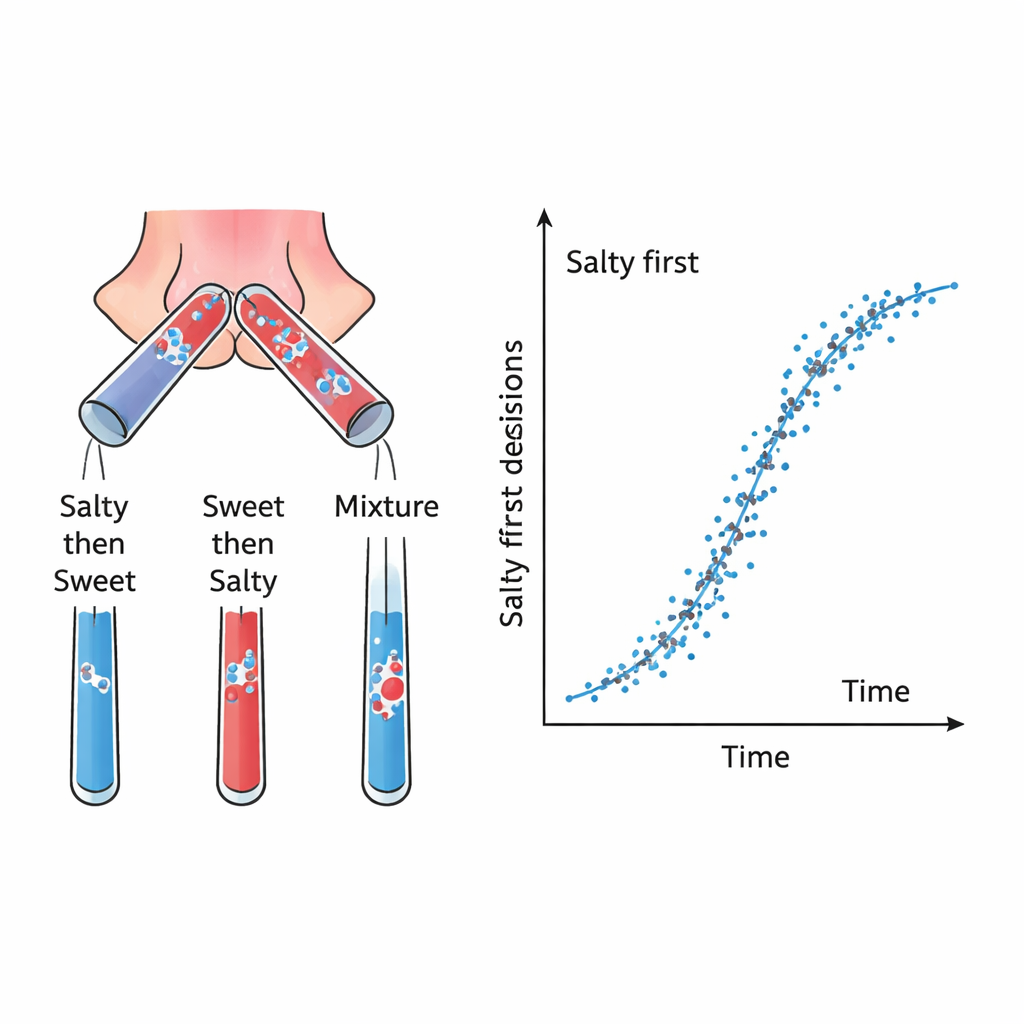
To test this, the researchers built a specialized taste stimulator. Participants rested the tip of their tongue against a small opening while body-warm purified water flowed past. The device could inject short pulses of salty solution, sweet solution, or an exact mixture of the two into this stream, with thin air bubbles in between to keep them separate. In one task, people simply identified whether a single pulse was salty or sweet; salty was detected faster on average, as expected from basic biology. In the key task, the team presented two pulses in quick succession—salt then sweet, sweet then salt, or a carefully prepared mixture designed to arrive as if both tastes started together—and asked participants to report which taste came first.
When feelings about others shape flavor order
When salt and sweet were clearly separated in time, most people correctly reported their order. But when the two were mixed so that, physically, they arrived at the tongue together, responses spread widely. Some people tended to say “salty first,” others “sweet first,” and many hovered near a 50–50 split. Crucially, this pattern was linked to scores on a questionnaire measuring empathizing traits—how readily someone understands and responds to other people’s emotions. Participants with higher empathy scores were more likely to judge the mixed taste as “sweet first,” while those with lower empathy scores leaned toward “salty first,” which mirrors the raw speed difference of the underlying receptors. People who felt that sweetness lingers in the mouth in everyday life also tended to say “sweet first” for the mixtures.
What this reveals about mind and taste
These findings suggest that the brain does more than passively receive flavor signals: it actively adjusts their timing, and the strength of this adjustment differs among individuals. For people with lower empathizing traits, perception appears to follow the hardware of the tongue more closely—salt wins the timing race. For those with higher empathizing traits, the brain seems to perform stronger temporal calibration, sometimes to the point of flipping the experienced order so that sweetness is felt first, perhaps because sweet responses are more spread out in time. Although the study involved only thirty neurotypical adults and used fixed taste strengths, it opens a window onto how subtle differences in social-cognitive style may shape even something as basic as the moment-to-moment unfolding of flavor.
Why this matters in everyday life
To a layperson, the take‑home message is that taste is not just about what molecules touch your tongue; it is also about how your brain, shaped by development and personality, stitches those signals together in time. The same spoonful of salty-sweet food might feel slightly different, and even unfold in a different order, depending on how your brain has learned to align sensory events and how strongly you tend to empathize with others. This work hints that our inner social world and our sensory world are more intertwined than we might expect, extending the reach of empathy all the way to the timing of a taste.
Citation: Wada, M., Takano, K. & Kobayakawa, T. Temporal calibration in taste temporal order judgment is associated with empathizing traits. Sci Rep 16, 5001 (2026). https://doi.org/10.1038/s41598-026-35580-9
Keywords: taste perception, empathy, salty and sweet, sensory timing, autistic traits