Clear Sky Science · en
Strain-dependent modeling of a mechano-electrochemical energy harvester based on carbon nanotube yarn
Turning Motion into Power with Tiny Coils
Imagine if the simple act of walking, bending your elbow, or even the beating of your heart could quietly power small electronics without batteries. This study explores a new kind of energy harvester made from ultra-thin carbon nanotube yarns that twist like springs and generate electricity when stretched. The researchers not only demonstrate how these microscopic coils work in a liquid environment, but also build a practical model that lets engineers predict and optimize their performance in real devices.
From Forests of Nanotubes to Spring-Like Yarns
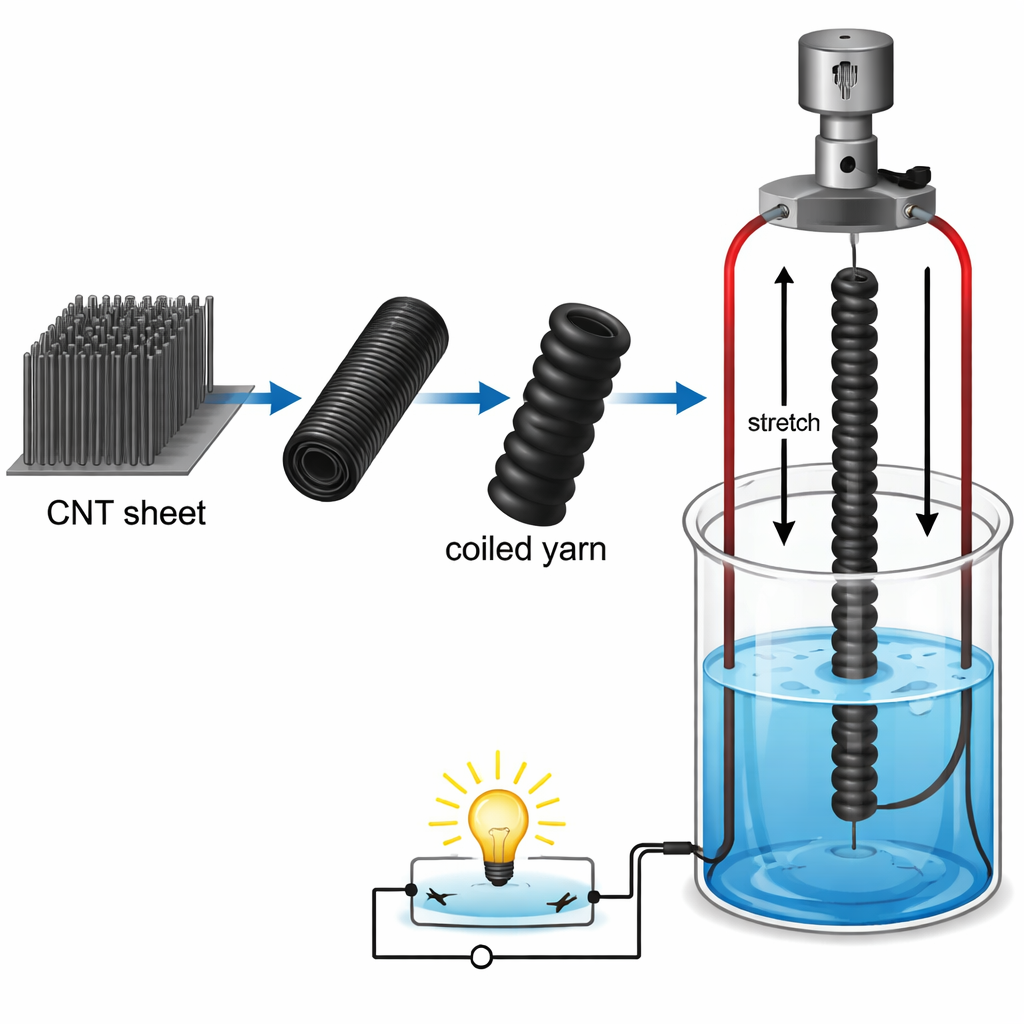
The heart of this work is a special fiber made from carbon nanotubes—cylindrical molecules thousands of times thinner than a human hair. The team begins with a dense “forest” of vertically aligned nanotubes grown on a surface. Thin sheets are pulled from this forest and stacked, then rolled into a cylinder and twisted under tension until they form a tightly coiled yarn, much like a microscopic metal spring. By choosing how many sheets to stack, they can make either a thinner yarn (three-sheet “unit harvester”) or a thicker yarn (six-sheet “scaled-up harvester”), which changes the coil diameter and mass. These yarns are then cut into short lengths and used as electrodes for energy harvesting.
How Stretching Makes Electricity
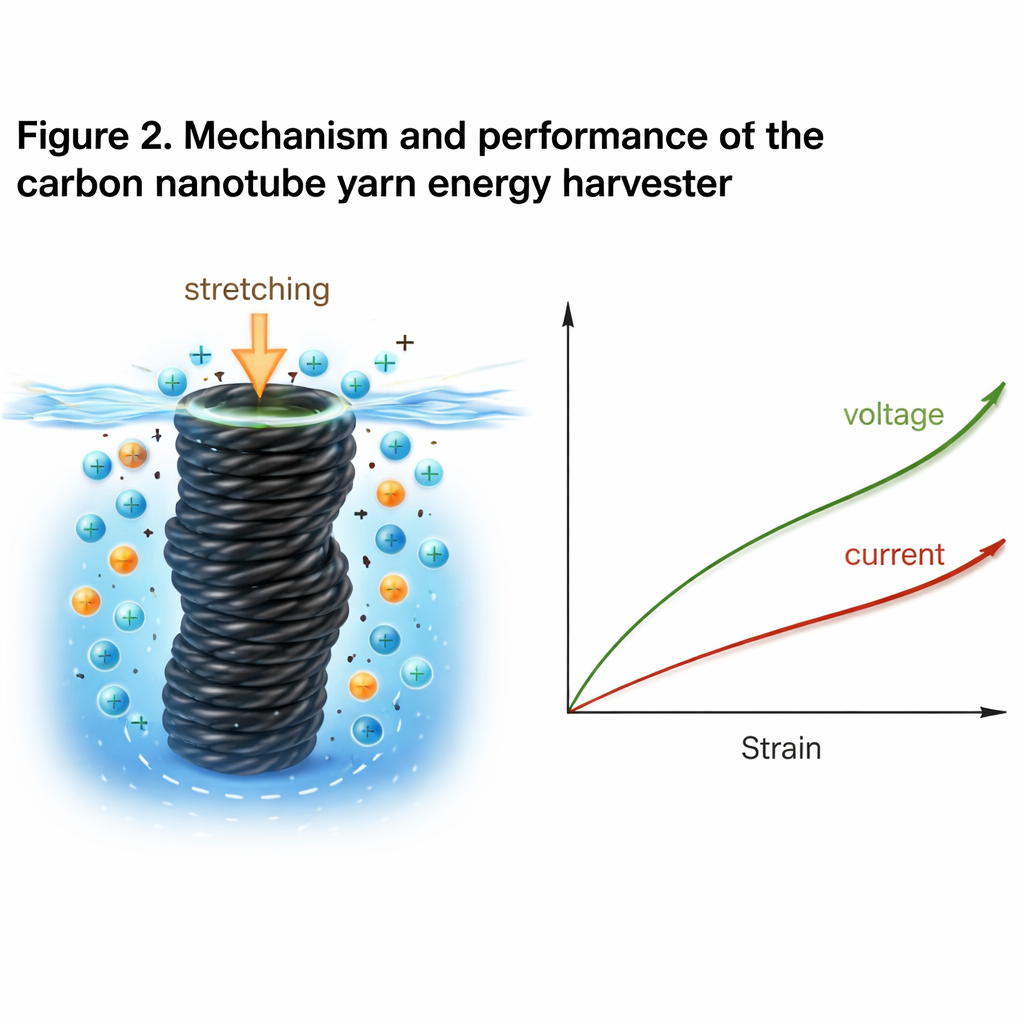
To convert motion into power, the coiled yarn is immersed in an acidic liquid and paired with other electrodes to form an electrochemical cell. When the yarn is stretched and released by a motor, ions in the liquid rearrange at its surface, forming what scientists call an electric double layer—a thin region where charges are separated. This acts like a tiny capacitor whose ability to store charge changes with strain. Because the total charge stays nearly constant during fast stretching, a drop in capacitance forces the voltage to rise, following the simple relation Q = C × V. In other words, pulling on the yarn makes its effective capacitance shrink and its voltage swing up and down, directly turning mechanical motion into electrical energy. Experiments show that as the strain increases, the open-circuit voltage between its peaks grows, while the capacitance falls.
Building a Circuit-Level Picture
To use these yarn harvesters in real electronics, designers need more than raw measurements; they need a circuit model that can be dropped into standard simulation tools. The authors measure how the yarn responds to signals over a wide range of frequencies using electrochemical impedance spectroscopy, which reveals how resistance, capacitance, and ion diffusion contribute to the overall behavior. They then represent the yarn with a modified version of a standard battery model known as the Randles circuit. In this picture, the harvester is described by a series resistance from the liquid, a charge-transfer resistance for surface reactions, a diffusion element describing how ions move through pores, and—crucially—a capacitance that explicitly depends on mechanical strain. By fitting this model to the data, they obtain numerical values for all of these elements, and show that the model reproduces the measured electrical response with less than about five percent error at different strains.
Scaling Up Without Starting Over
An important question for practical use is how performance changes when more nanotube material is added. Rather than fabricating and testing every new size from scratch, the team works out how the larger, six-sheet yarn relates to the smaller, three-sheet version. Geometric arguments and measurements of capacitance show that the thicker yarn has a larger active surface area in contact with the liquid, which lowers its electrical impedance and boosts current. The authors find that the impedance of the scaled-up yarn is about 70 percent of that of the unit yarn, and its average harvested power is roughly 1.4 times higher under the same type of stretching. Using their circuit model, they can predict the ideal load resistance for maximum power transfer—around 600 ohms for the smaller yarn and 400 ohms for the larger one—and match those predictions to experiments.
Why This Matters for Future Wearables
By turning a complex, fluid-filled, mechanically active fiber into a simple network of circuit elements, this work gives engineers a practical design tool for next-generation self-powered devices. The model lets them estimate how much power a given yarn harvester can deliver at a certain strain and frequency, and how many nanotube sheets are needed to hit a target power level, all without repeated trial-and-error fabrication. For the non-specialist, the key takeaway is that these spring-like carbon nanotube yarns can reliably turn stretching motion into electricity, and that their behavior can be predicted well enough to integrate them into wearable electronics, sensors, and other small systems that one day may run on nothing more than the motions of daily life.
Citation: Ahn, Y., Moon, J.H., Song, G.H. et al. Strain-dependent modeling of a mechano-electrochemical energy harvester based on carbon nanotube yarn. Sci Rep 16, 5061 (2026). https://doi.org/10.1038/s41598-026-35578-3
Keywords: energy harvesting, carbon nanotube yarn, wearable electronics, self-powered sensors, electrochemical devices