Clear Sky Science · en
Aversive behavioural responses of killer whales to sounds of long-finned pilot whales
When Ocean Giants Use Sound to Stay Safe
Killer whales are often portrayed as fearless apex predators, but even top hunters must decide when a threat is not worth the trouble. This study explores an unexpected twist in the underwater drama: how killer whales react when they hear the calls of long-finned pilot whales, another highly social species known to rush toward them in large, noisy groups. By uncovering how sound alone can trigger avoidance, the research sheds light on the subtle ways marine animals manage conflict, competition and safety in a dark, noisy ocean.
The Underwater Noise of Neighbors
Many marine mammals live in a world where vision is limited and sound is everything. They call to stay in touch, find food, and detect danger. Long-finned pilot whales are known to be drawn to the sounds of killer whales and sometimes charge toward them in what looks like “mobbing” behaviour: many smaller animals collectively harassing a bigger one. These confrontations, seen in several parts of the North Atlantic, raise a puzzle. If pilot whales approach killer whales, do killer whales also react to the sounds of pilot whales, and if so, how? Understanding this two-way acoustic relationship can reveal how large predators and their potential rivals share space without constant fighting.
Listening In on Whales with High-Tech Tags
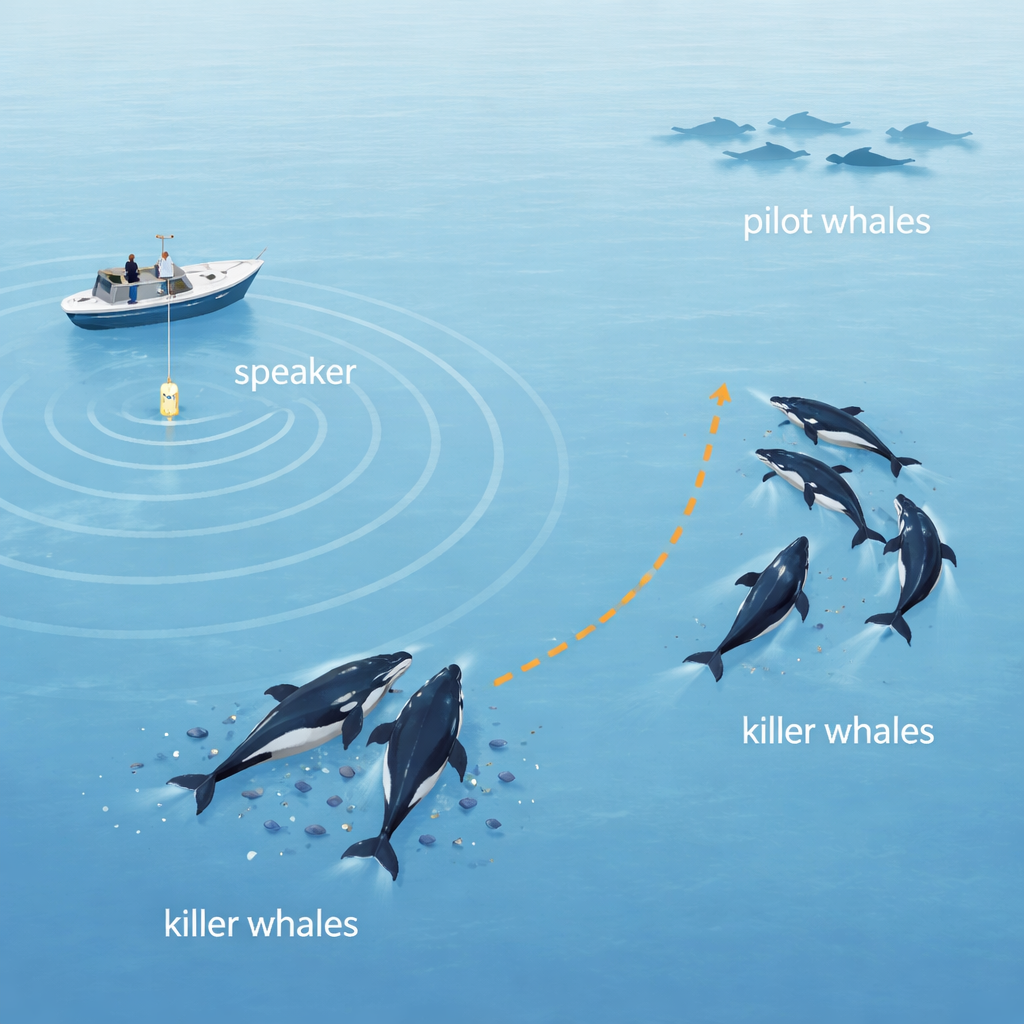
To answer this, researchers worked in a herring spawning area off South Iceland where both species are common. They attached temporary suction-cup “Dtags” to eight killer whales. These devices recorded sound, depth and movement in fine detail. From a small boat, the team then played back underwater recordings of pilot whale calls, as well as comparison sounds: broadband noise and, in a few trials, a synthetic upsweeping tone similar in frequency to naval sonar. Each experiment consisted of a quiet period before, a 15-minute sound exposure, and a quiet period after. At the same time, observers on another vessel watched how the whales’ group spacing and swimming patterns changed at the surface.
Flight Over Fight: How Killer Whales Reacted
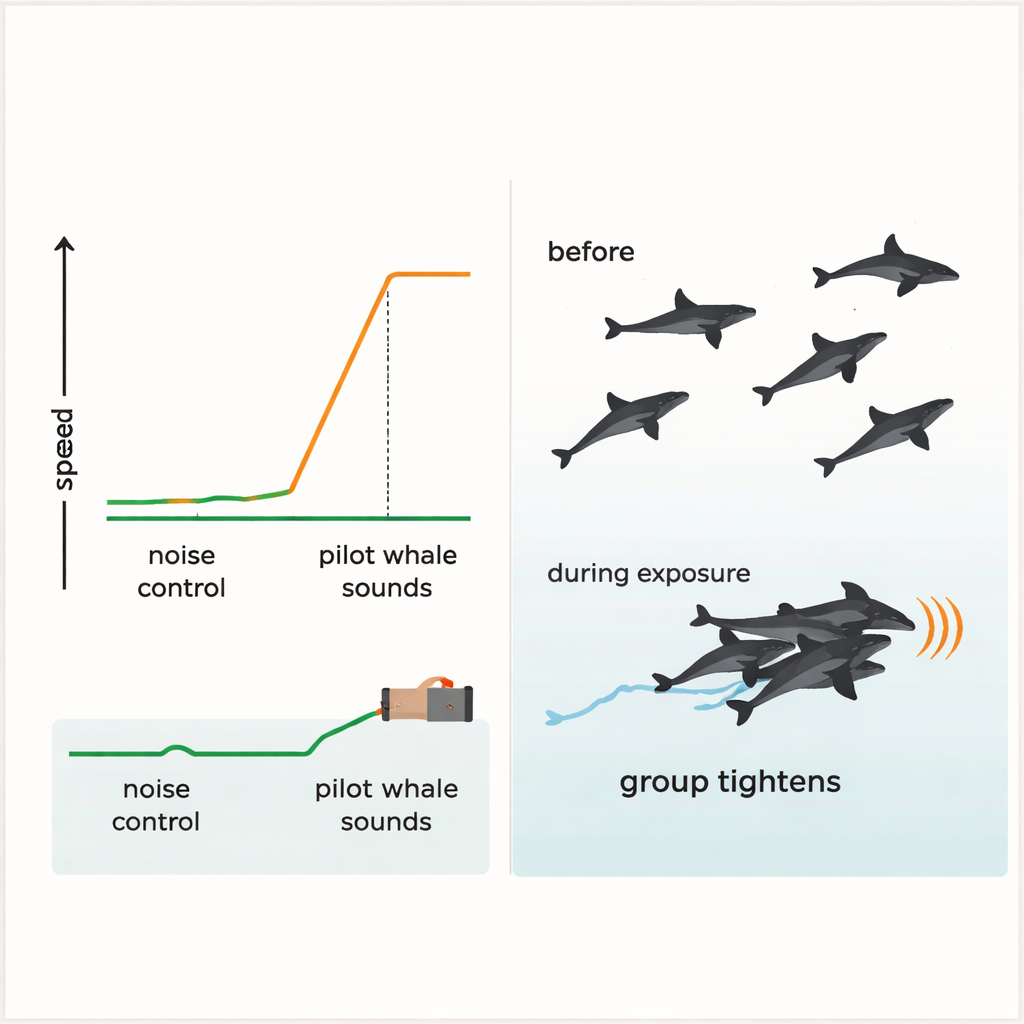
Analysing the tag data with statistical models, the scientists found that hearing pilot whale sounds reliably pushed killer whales into a “travelling” mode. Compared with quiet periods or noise alone, the whales moved faster and covered more distance in a straight line, often heading away from the sound source. A simple measure of horizontal movement showed that pilot whale calls produced the strongest “avoidance” scores. At the group level, killer whales drew closer together, lined up in the same direction, and swam in a more coordinated way, while disorganized milling dropped. Their voices also changed: during the pilot whale sounds, calling often rose briefly—possibly to alert and coordinate group members—before dropping sharply afterward, when the whales frequently fell silent.
Threat in the Noise, Even for a Top Predator
The way killer whales reacted to pilot whale calls resembled their responses in earlier studies to naval sonar, another sound they treat as threatening. This suggests that, despite being top predators, killer whales perceive large, noisy pilot whale groups as a serious disturbance—or at least a nuisance worth fleeing. Yet the escape responses were short-lived: whales usually slowed down and relaxed their formation soon after the playback ended, and they did not abandon the productive feeding area. That means each single event may be relatively low cost, but repeated encounters could add up, forcing whales to spend extra energy moving and interrupting feeding.
What This Means for Life in a Noisy Sea
For a general reader, the key message is that sound is not just a way for whales to “talk”—it is also a way to negotiate power, space and risk between species. Pilot whales approach killer whales when they hear them, while killer whales tend to move away when they hear pilot whales. These two-way, sound-driven reactions help explain how such large animals can coexist in the same waters without constant violence. The findings also provide a natural benchmark for how seriously killer whales treat other loud human-made sounds, like sonar. By comparing their “fear response” to pilot whale calls with their response to ships and sonar, scientists can better judge when human noise might be pushing even these ocean giants too far.
Citation: Selbmann, A., Samarra, F.I.P., Barluet de Beauchesne, L. et al. Aversive behavioural responses of killer whales to sounds of long-finned pilot whales. Sci Rep 16, 4716 (2026). https://doi.org/10.1038/s41598-026-35574-7
Keywords: killer whales, pilot whales, underwater sound, marine behaviour, acoustic playback