Clear Sky Science · en
Graphene oxide-zinc oxide nanocomposites as multifunctional materials for thermally stable and high-performance biodegradable water-based drilling muds
Why cleaner, smarter drilling fluids matter
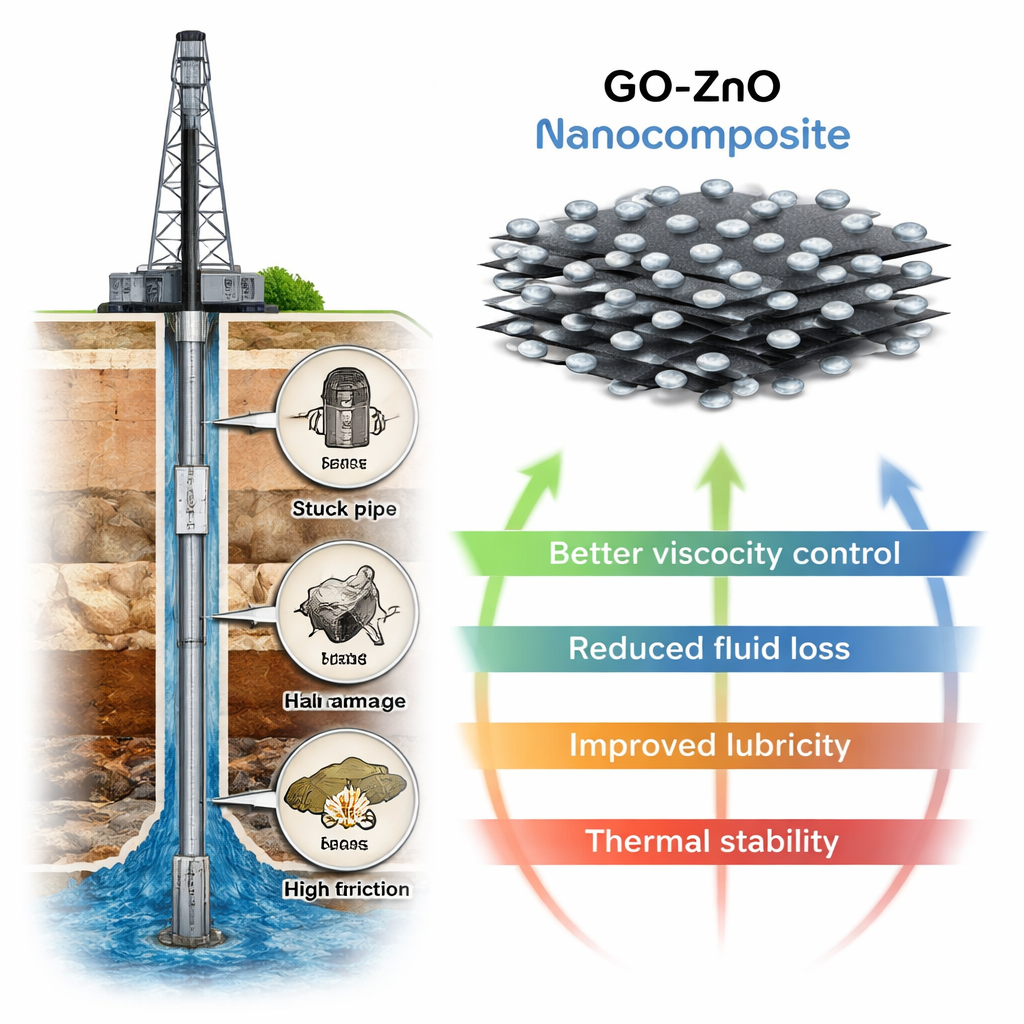
Modern life depends on oil and gas, but getting those resources out of the ground safely is harder than it looks. At the heart of every drilling operation is "drilling mud"—a circulating fluid that cools the drill bit, carries rock fragments to the surface, and protects the wellbore from collapsing. Conventional water-based muds are cheaper and greener than oil-based ones, yet they often struggle when temperatures rise deep underground. This study explores how a new nanoscale blend of graphene oxide and zinc oxide can turn ordinary water-based mud into a tougher, more efficient, and more environmentally friendly workhorse for drilling.
A fresh take on an old industrial workhorse
Drilling mud performs many jobs at once: it must flow easily through surface equipment, yet be thick enough downhole to lift and suspend rock cuttings; it has to hold pressure against the surrounding rock while losing as little water as possible; and it should lubricate the steel drill string to reduce wear and stuck pipe. In current practice, operators often choose oil-based muds for hot, demanding wells because standard water-based formulations thin out and lose their protective properties at high temperature. However, oil-based muds come with higher costs and tougher environmental regulations, creating a strong incentive to upgrade water-based systems instead of replacing them.
Building a nano-enhanced mud ingredient
The researchers designed a new additive by combining two advanced materials: graphene oxide, a sheet-like form of carbon covered with oxygen-containing groups, and zinc oxide, a well-known metal oxide used in everything from sunscreens to sensors. They first produced graphene oxide nanosheets and zinc oxide nanoparticles separately, then fused them into a single nanocomposite using a solvothermal process in ethanol. X-ray diffraction, electron microscopy, infrared spectroscopy, thermogravimetric analysis, and surface charge measurements confirmed that zinc oxide particles were successfully anchored onto wrinkled graphene sheets, forming a stable, thermally resistant structure that disperses well in water.
Putting the new mud to the test
To see how the graphene oxide–zinc oxide nanocomposite behaved in a real formulation, the team mixed it into a standard water-based mud recipe containing bentonite clay, common polymers, and barite weighting agent. They tested nanocomposite loadings between 0.1 and 1 weight percent over temperatures from 85 °F (near surface) to 175 °F (downhole conditions). Using industry-standard instruments, they measured flow behavior (viscosity, yield point, and gel strength), filtration (how much fluid leaks through a filter cake over time), and lubricity (friction between metal parts). They then applied a statistical tool called response surface methodology to map how temperature and nanocomposite concentration jointly affect these properties and to pinpoint the best operating window with a minimum number of experiments.
What changed inside the mud
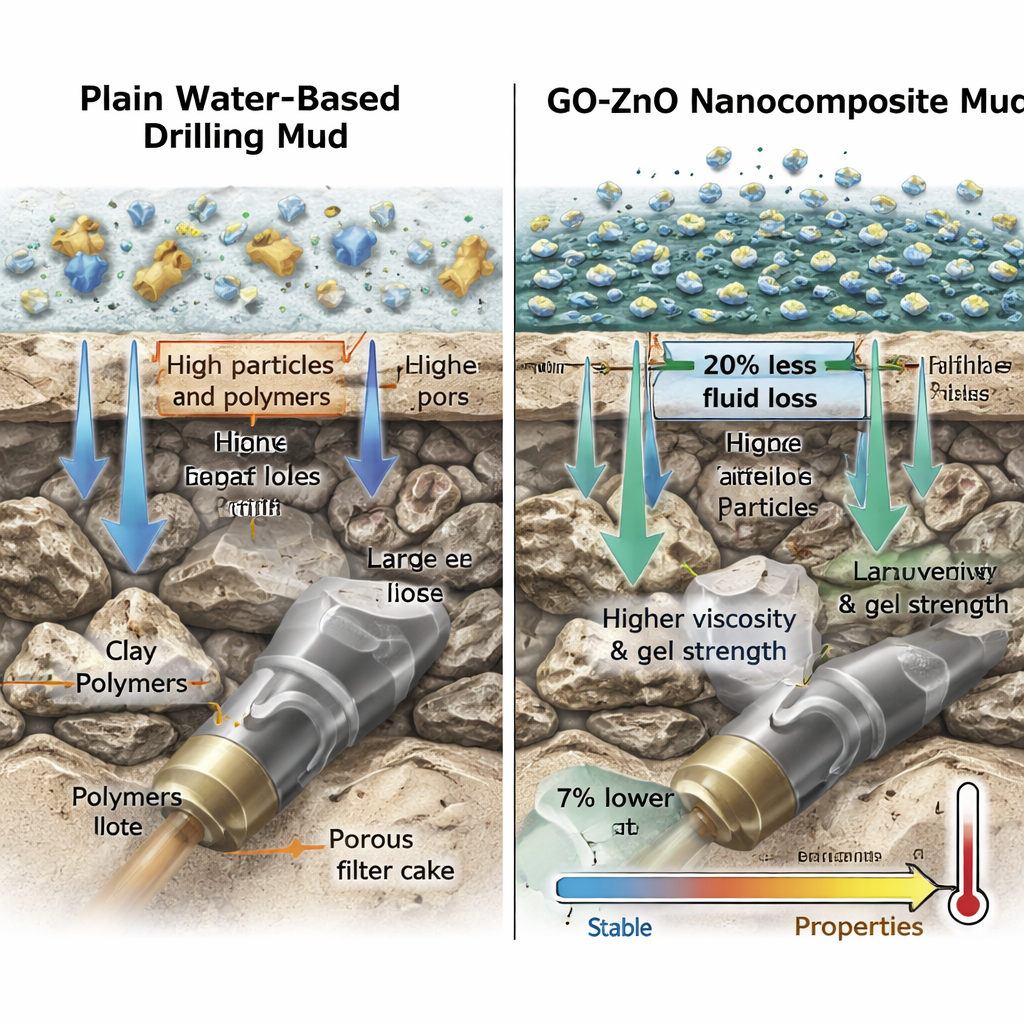
Adding the nanocomposite led to simultaneous improvements in several critical mud functions. Plastic viscosity, which relates to how easily the mud can be pumped while still carrying solids, rose by about 25 percent, and yield point, which reflects how well the mud can lift cuttings out of the hole, increased by nearly 20 percent. Short- and long-term gel strengths, important for keeping cuttings suspended when circulation stops, also climbed by roughly 20 and 15 percent, respectively. At the same time, the volume of fluid lost through the filter cake dropped by around 20 percent, indicating a denser, more protective barrier on the rock face, while the coefficient of friction fell by about 7 percent, suggesting smoother contact between drill string and wellbore. Crucially, these gains held up far better with rising temperature than in the unmodified mud, thanks to the nanocomposite’s enhanced thermal stability.
Finding the sweet spot for field use
The statistical optimization showed that the mud’s performance could be tuned by adjusting both nanocomposite concentration and operating temperature. The best compromise—balancing strong viscosity and suspension with low fluid loss and friction—occurred at about 0.87 weight percent nanocomposite and 137 °F. At this point, the gap between predicted and experimentally measured properties stayed below about 7 percent, giving confidence that the mathematical model can guide real-world formulation decisions. The authors also discuss cost and safety considerations: while detailed economic and long-term stability studies remain to be done, the low additive dosage and the potential to replace costlier oil-based systems hint at favorable economics, and existing toxicity work suggests that impacts will depend strongly on dose and exposure conditions.
What this means for everyday energy
For non-specialists, the key message is that a small amount of carefully engineered nanomaterial can make a water-based drilling fluid behave more like a premium oil-based system, without the same environmental and regulatory burden. By reinforcing the mud’s internal structure and building a tighter seal on the wellbore wall, graphene oxide–zinc oxide nanocomposites help the fluid stay thicker at high temperatures, leak less into the rock, and slide more smoothly along steel surfaces. This could translate into fewer drilling problems, better well integrity, and lower overall costs. While questions about long-term stability, large-scale deployment, and full environmental impact remain, the work points toward a future where smarter, nano-enhanced water-based muds support safer and more sustainable energy production.
Citation: AlBajalan, A.R., Rasol, A.A.A. & Norddin, M.N. Graphene oxide-zinc oxide nanocomposites as multifunctional materials for thermally stable and high-performance biodegradable water-based drilling muds. Sci Rep 16, 4929 (2026). https://doi.org/10.1038/s41598-026-35573-8
Keywords: drilling mud, graphene oxide, zinc oxide, nanocomposite additives, water-based drilling fluids