Clear Sky Science · en
Linking energy service access and human capabilities to assess energy justice in the rural Sahel
Why Lights, Roads, and Phones Matter Beyond the Wires
In much of the Sahel, stretching across rural Senegal and its neighbors, new power lines, solar mini-grids, roads, and phone towers are spreading fast. Yet many villagers still cook with wood, travel by donkey cart, and struggle to turn energy into better health, income, and security. This article asks a deceptively simple question: when we say people have “energy access,” are their lives actually getting better—and for whom?
Looking Past the Light Bulb
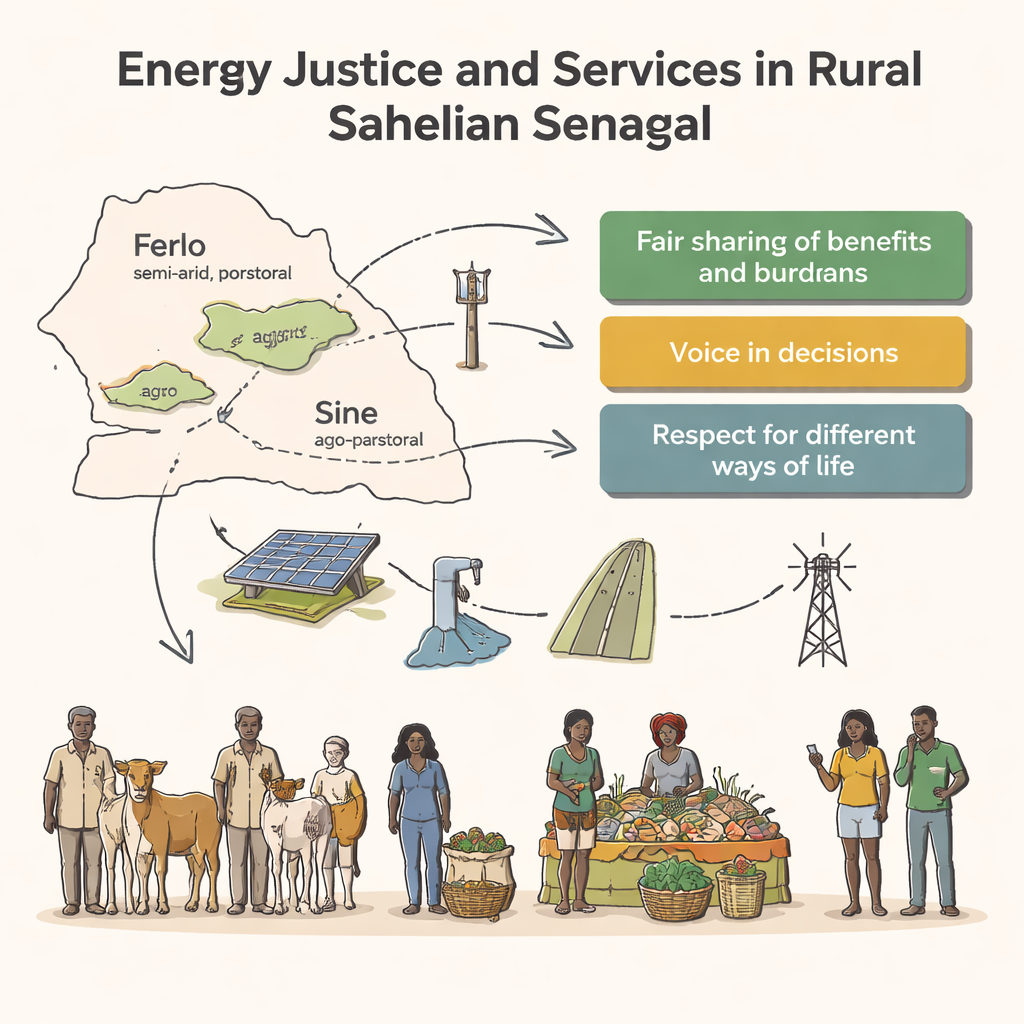
Global development goals often define success as connecting more people to electricity or cleaner fuels. The authors argue this is too narrow, especially in the Sahel, where per-person energy use is among the world’s lowest. Instead of counting who has grid connections or gas cylinders, they focus on “energy services” — what energy lets people do, like cook safely, keep food cold, move goods to market, pump water, or make phone calls. They link this to the idea of human “capabilities”: real freedoms to live a decent life, such as being able to work, learn, travel, or take part in community life.
Listening to Daily Life in Two Rural Worlds
To see how this plays out on the ground, the researchers conducted interviews, focus groups, and field observations in two very different regions of Senegal: Ferlo, a sparsely populated, semi-nomadic pastoral area, and Sine, a denser agro-pastoral zone. In Sine, villages have been connected to the national power grid for about two decades. Electricity supports lighting, refrigeration, milling, phone charging, schools, health centers, and small businesses—many run by women processing local crops. Roads and phone networks link farmers to urban markets, allowing, for example, fresh fish from coastal cities and palm oil from distant regions to reach remote villages. In Ferlo, access is newer and patchier, often relying on small solar mini-grids and diesel boreholes. Recent road construction is beginning to open markets and improve mobility, but many settlements remain literally and figuratively off the beaten track.
Who Gets Left Behind—and How
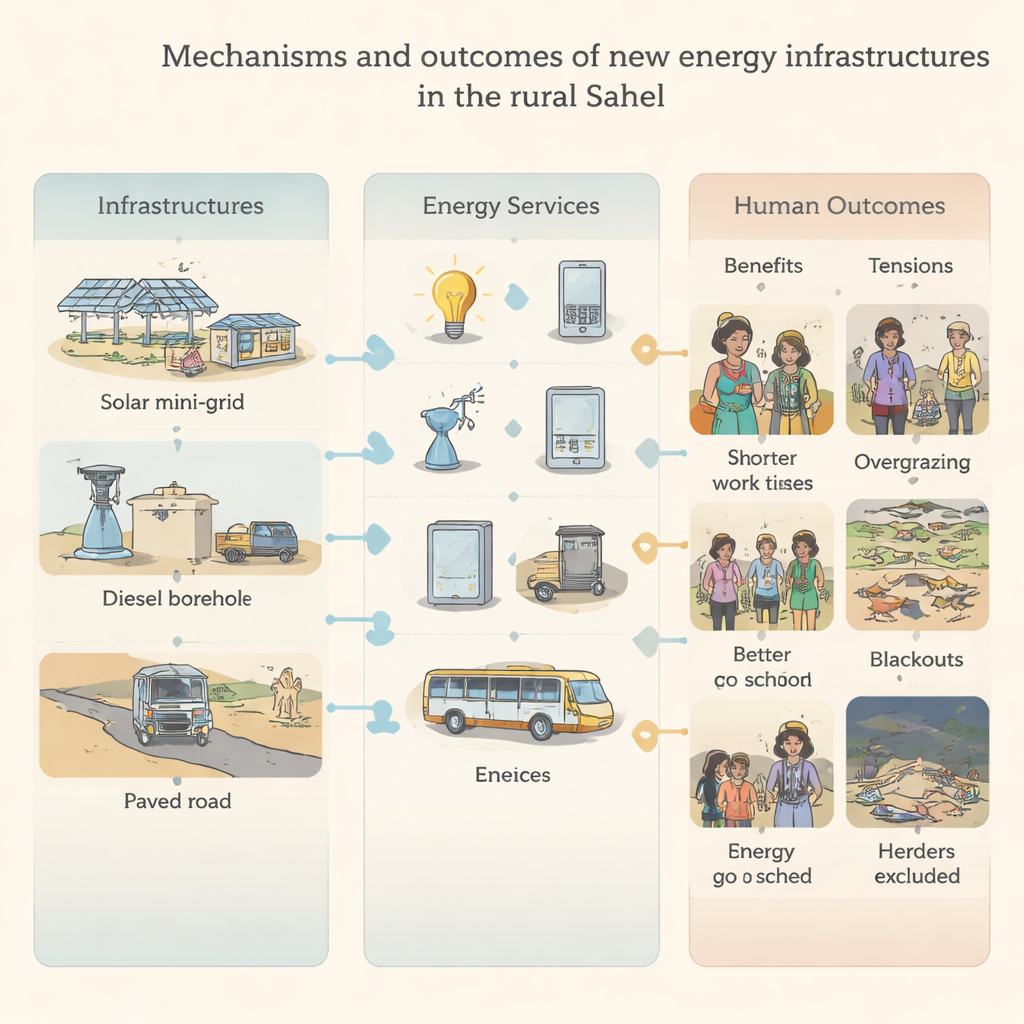
Even where new infrastructures exist, their benefits are uneven. Semi-nomadic herders living in scattered hamlets are rarely prioritized for electrification because their mobility and low year-round consumption make them “uneconomic” in the eyes of utilities. Villages along main roads gain power and telecom towers, while off-road communities remain unserved. Within villages, only households with savings, access to credit, or relatives in cities or overseas can afford equipment like mills, refrigerators, motors, or vehicles. Many basic activities that were once unpaid—milling grain, fetching water, cooking—are becoming paid services, but a large share of people lack regular income to buy them. The result is a new layer of inequality: infrastructures may be present, yet the ability to turn energy into real opportunities is far from universal.
New Energy, New Pressures and Conflicts
The study also shows that more energy does not automatically mean less hardship. Diesel-powered boreholes and better roads make it easier to water and move livestock, encouraging larger herds and putting extra pressure on fragile grazing lands. Wood for cooking is increasingly scarce around some villages; bans on cutting trees have pushed women to burn crop residues and animal manure instead. But farmers need the same manure to fertilize fields, sparking conflicts and undermining long-standing informal agreements between herders and cultivators. In solar mini-grid villages, government rules that harmonize electricity tariffs with the national grid can lead to daily blackouts when small systems are overloaded, cutting off lighting and cold storage just when people need them most. Meanwhile, there are few local institutions to collectively decide how limited energy should be shared.
Rethinking Fairness in the Sahel’s Energy Future
The authors conclude that judging success by kilometers of grid or numbers of connections hides important injustices. From a fairness perspective, it matters not just how many infrastructures are built, but whether they deliver meaningful services to different kinds of people—sedentary farmers, semi-nomadic herders, women with little cash income, youth seeking to start businesses. Policies should therefore shift from merely spreading hardware at national scale to ensuring that, at local scale, people can actually use energy to cook, move, communicate, and earn a living without degrading the resources they depend on. In short, true “energy access” in the Sahel means designing systems and rules that recognize diverse ways of life, give communities a say in how scarce energy is managed, and turn wires, roads, and fuels into genuine improvements in everyday freedom and well-being.
Citation: Ka, M., Chamarande, T., Loireau, M. et al. Linking energy service access and human capabilities to assess energy justice in the rural Sahel. Sci Rep 16, 6518 (2026). https://doi.org/10.1038/s41598-026-35568-5
Keywords: energy justice, Sahel rural development, energy services, Senegal electrification, human capabilities