Clear Sky Science · en
Multiscale insights into biofilm development on hydrophobic fouling-release coatings
Why Slime on Ships Matters
Any object left in the sea—ship hull, sensor, fish farm cage—quickly becomes coated with a slimy layer of microbes. That thin film may look harmless, but it can dramatically slow ships, drive up fuel use and emissions, and speed corrosion of metal structures. This study asks a deceptively simple question with big economic and environmental implications: how does this microscopic slime develop on modern low-stick "fouling-release" coatings designed to shed organisms, and what happens when those coatings experience real-world water movement?
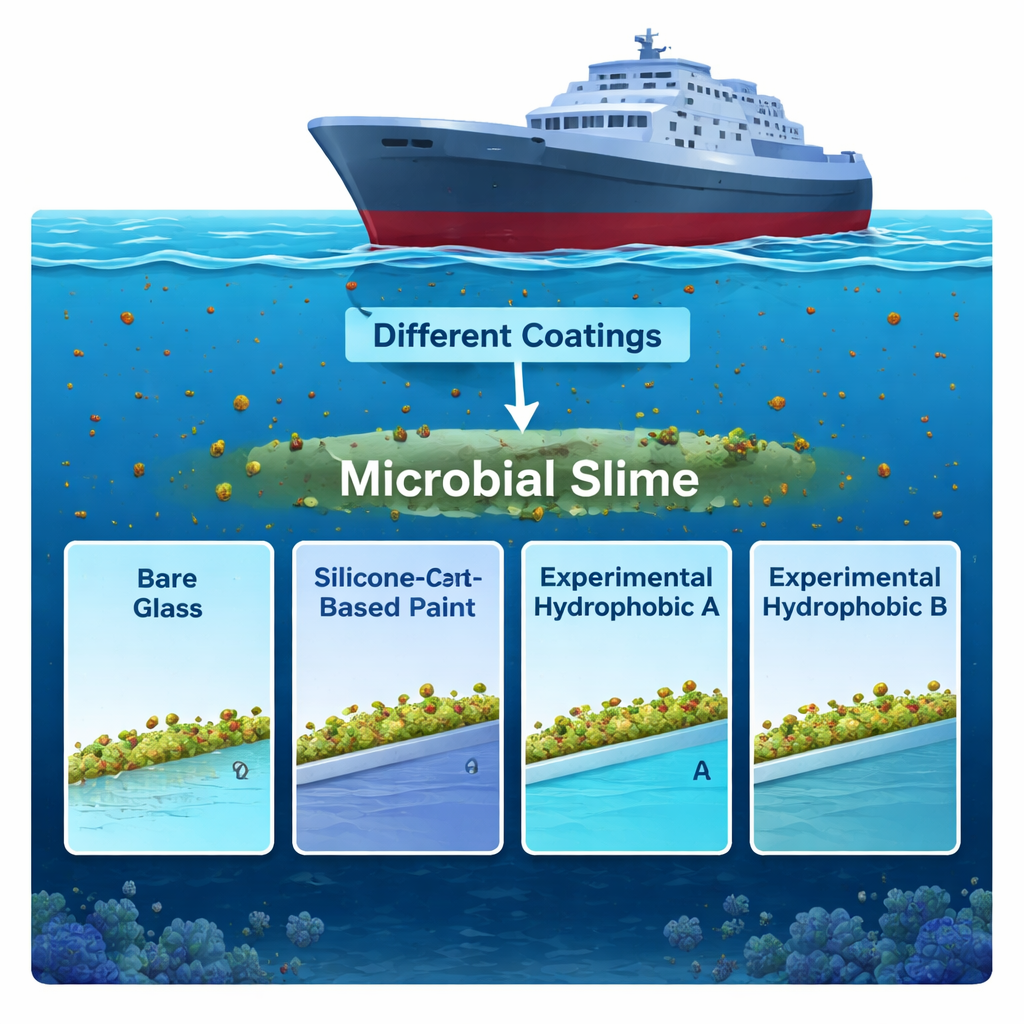
Testing New Low-Stick Surfaces
The researchers compared three specially prepared, very smooth surfaces: two experimental hydrophobic coatings built from fluorinated interpenetrating polymer networks, and a widely used commercial silicone-based fouling-release paint. Plain glass served as a reference. All surfaces were mounted on glass slides and immersed for six months in flowing natural seawater from the Mediterranean, exposing them to real marine communities and a seasonal plankton bloom. Over time, the team tracked how much material accumulated on each slide using color stains and pigment measurements, and then probed the microscopic structure and chemistry of the resulting biofilms with advanced imaging, DNA sequencing, and metabolite profiling.
Who Moves In and How Communities Change
Despite being engineered to be hard to stick to, every surface was quickly colonized. Within a month, all carried an early slimy film; by three to six months, the experimental coatings and bare glass supported thicker, more advanced biofilms, while the commercial paint held noticeably less biomass and stayed at an earlier growth stage. DNA analyses showed that bacterial communities changed strongly over time but also depended on the underlying material. Early on, one major bacterial group dominated across all surfaces, but as biofilms matured, additional groups took hold and communities on different coatings began to resemble one another. At the same time, many less abundant bacterial lineages slowly built up, hinting that late-arriving specialists help stabilize long-lived slime layers even on low-adhesion materials.
The Overlooked Role of Marine Fungi
Beyond bacteria, the team paid rare, detailed attention to marine fungi—an often ignored part of sea biofilms. Fungal communities also shifted with time and surface type, but they followed their own ecological patterns. Early films contained a broad mix of fungal classes that differed between coatings. As months passed, these communities simplified and converged, with one large group of filamentous fungi becoming dominant on all surfaces. These fungi likely act as microscopic scaffolding and glue, producing sticky polymers that help hold the biofilm together and provide pathways for bacteria to colonize. High numbers of fungal DNA sequences could not be confidently identified, underscoring how little is still known about marine fungi even as they emerge as key players on antifouling coatings.
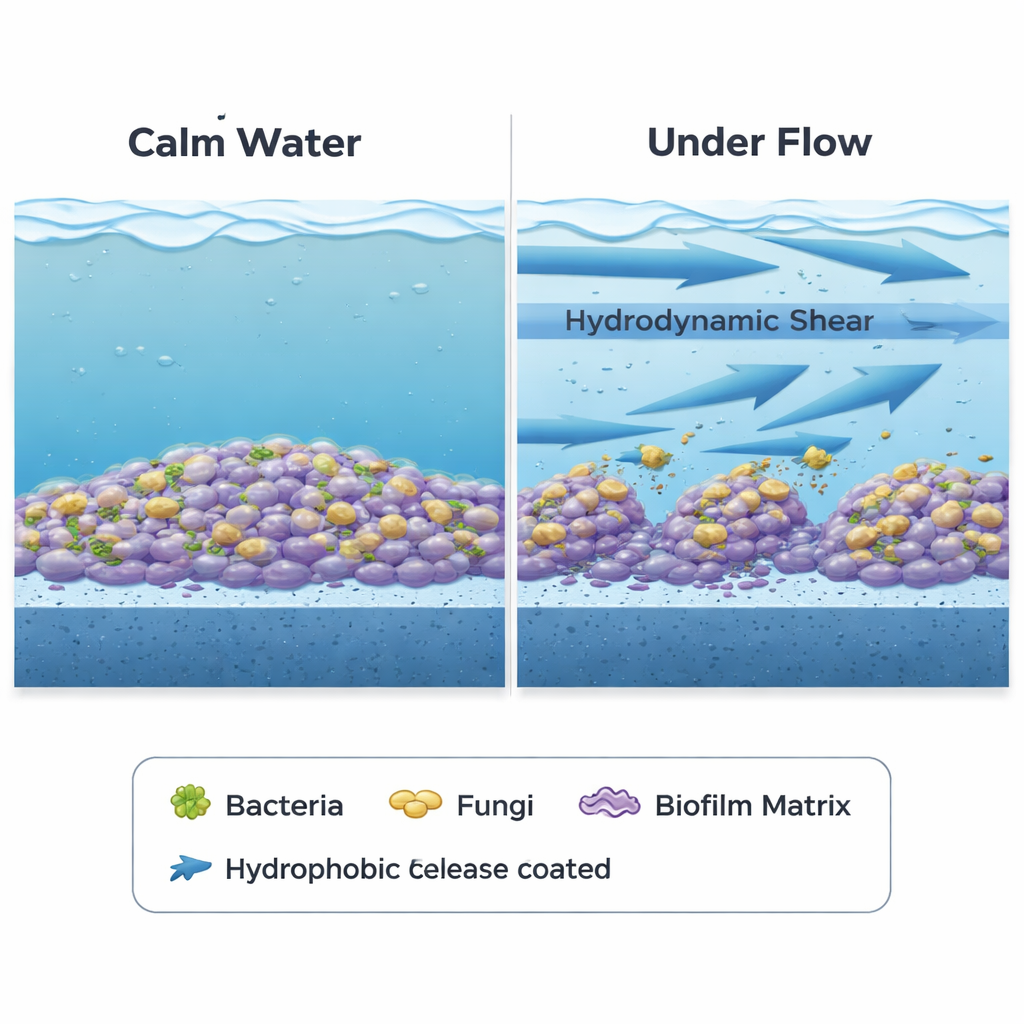
Shear, Sloughing, and Chemical Fingerprints
After six months, the researchers mimicked moderate ship motion by spinning some slides in seawater to generate a flow equivalent to about five knots. This treatment stripped away part of the biofilm from all surfaces, thinning and simplifying the slimy layer, yet it only modestly altered which microbes were present. In some cases, dominant groups shrank while rarer bacteria and fungi became more prominent, suggesting that gentle mechanical stress can subtly reshape communities without wiping them out. Chemical analyses of thousands of small molecules produced within the films revealed a shared "core" chemistry across all surfaces, but also distinct fingerprints tied to each coating. For example, lipid-like compounds associated with cell membranes and signaling were especially enriched on the commercial paint, while the experimental coatings carried more small peptides and plant-like defense molecules, pointing to different physiological strategies for coping with a low-stick, shifting habitat.
What This Means for Cleaner Ships
Altogether, the study shows that even the slipperiest current coatings cannot prevent microscopic life from settling; instead, they influence how biofilms assemble, how tough they become, and how easily they shed under realistic water flow. The commercial silicone paint limited total slime build-up but still hosted distinct bacterial, fungal, and chemical communities, while the new fluorinated coatings behaved more like untreated glass in terms of biomass but fostered different microscopic architectures and chemistries. Importantly, marine fungi emerged as central, previously underestimated builders of biofilms on these low-adhesion surfaces. For ship operators and designers of marine infrastructure, these findings highlight that controlling slime is less about stopping colonization altogether and more about steering community structure and mechanical resilience so that biofilms are easier to wash off, reducing drag, fuel use, and maintenance without relying on toxic paints.
Citation: Ferré, C., Gbaguidi, L., Fagervold, S.K. et al. Multiscale insights into biofilm development on hydrophobic fouling-release coatings. Sci Rep 16, 7118 (2026). https://doi.org/10.1038/s41598-026-35567-6
Keywords: marine biofouling, ship coatings, biofilms, marine fungi, antifouling technology