Many of us trust devices like ultrasonic humidifiers to make indoor air more comfortable, and we assume that if the overall chemical level in the air is low, risk must be low too. This study shows that what really matters for our lungs is not just how much chemical is in the air, but how big the airborne particles are. The same total amount of a cleaning or disinfectant chemical can reach very different parts of the breathing system depending on particle size, changing which tissues are most at risk.
From room air to the surface of your lungs
Regulators and companies often test inhalation safety in animals by reporting an external air concentration: how many milligrams of substance are in each cubic meter of air. By contrast, modern cell-based tests measure how much actually lands on the surface of lung cells. To compare the two, scientists need to know how much of what is in the air actually ends up deposited inside different lung regions. For gases this link is fairly straightforward, but for tiny particles it is much trickier, because big particles tend to stick higher up in the airways while smaller ones can slip deep into the lungs.
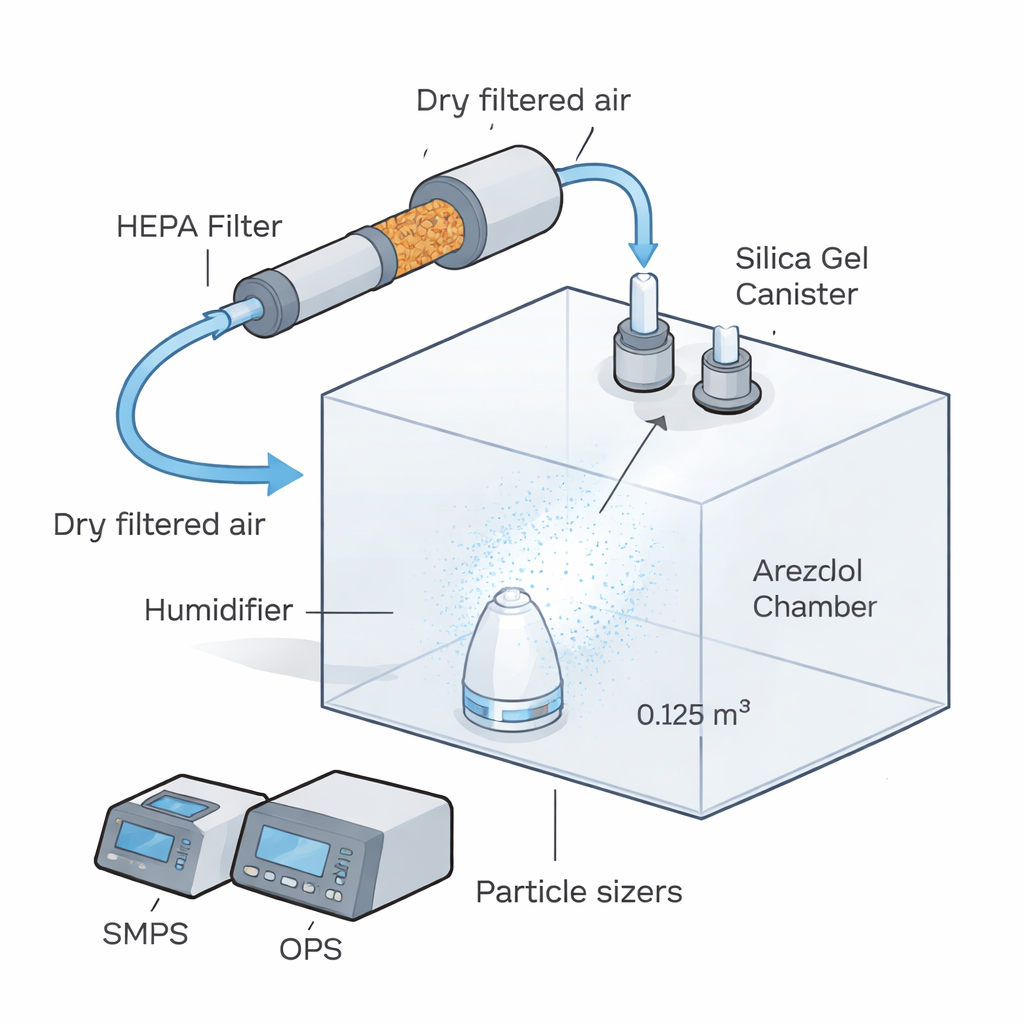
Building a controlled cloud of particles Figure 1.
The researchers focused on four non-volatile, water-soluble disinfectant chemicals, including those involved in a major humidifier disinfectant disaster in Korea. They placed solutions of these chemicals into an ultrasonic humidifier inside a small, well-mixed acrylic chamber and carefully controlled temperature, humidity, and airflow. Using specialized instruments, they measured how many particles of each size (from 0.01 to 10 micrometers across) were present over time, and then converted those counts into mass. Instead of compressing this information into a couple of summary numbers, they kept the full size spectrum and fed it into a detailed lung-deposition computer model for rats.
When stronger mixtures make bigger particles
Across all chemicals, the pattern was strikingly similar: when the liquid in the humidifier was more concentrated, the device produced a cloud with more mass but also with larger typical particle sizes. Very fine particles stayed relatively constant, while the number of larger particles grew sharply. As a result, the “mass median aerodynamic diameter” — a standard way to describe where most of the mass sits — increased two- to threefold as solution strength rose. This meant that higher airborne concentrations did not simply scale up exposure in a uniform way; they also shifted where in the respiratory system the particles were likely to land.
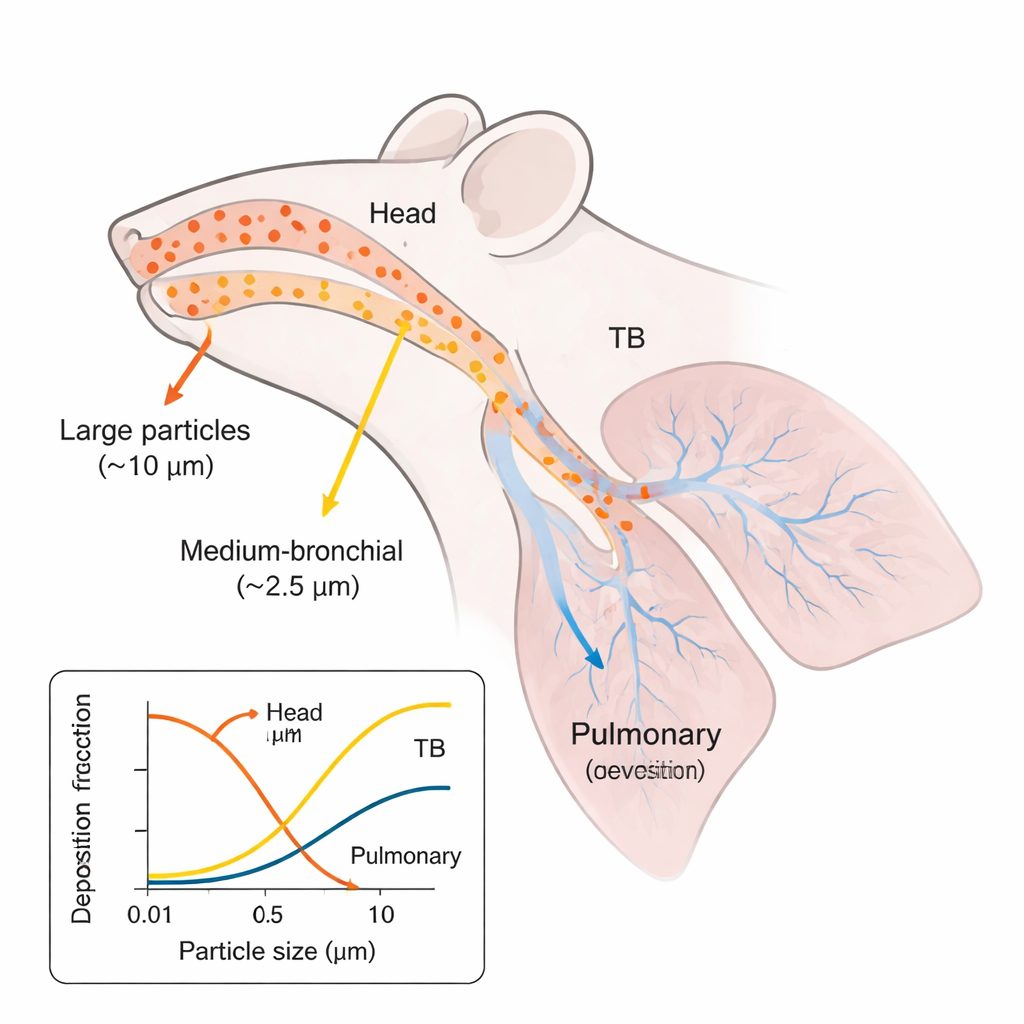
Which parts of the airways take the hit Figure 2.
Using the multi-path particle dosimetry model, the team estimated how much mass would deposit in three main regions: the head and nose, the branching tubes of the tracheobronchial region, and the deep, sponge-like pulmonary region where gas exchange occurs. As the airborne concentration climbed, total deposited dose went up everywhere, but not evenly. The head region showed a steep, almost saturating rise in dose because larger particles collided and stuck there more efficiently. Meanwhile, the deep lung actually received less dose per unit of external concentration as particles grew, since the fraction of the smallest, most penetrating particles shrank. The middle region of the airways responded in a more complex way, particularly sensitive to how broad the size spread was rather than just the average size.
Why simple assumptions can mislead safety decisions
Many risk assessments shortcut the problem by assuming that airborne particles follow a tidy, lognormal size pattern defined only by an average size and a spread. The authors showed that real humidifier-generated particles from these disinfectants do not always behave so neatly, often forming more complex or multi-peaked distributions. When they compared real measured distributions to the standard simplified ones, they found meaningful mismatches in the ratio of internal to external dose, especially for the deep lung and mid-airway regions. This means that common modeling shortcuts can underestimate risk to the most delicate parts of the lung while overestimating impacts higher up.
What this means for safer products and tests
For non-specialists, the take-home message is straightforward: two rooms with the same measured air concentration of a chemical can pose very different risks depending on particle size, and devices like humidifiers can shift that size in systematic ways as their solutions get stronger. The study argues that accurate safety evaluations must go beyond a single concentration number and explicitly measure and model the full particle size distribution. Doing so not only improves our understanding of past incidents but also helps align animal data with modern cell-based tests, paving the way for safer consumer products and fewer animal experiments.