Clear Sky Science · en
Modular Harris Hawks optimization with trend-guided differential evolution and Gaussian exploration for global optimization and engineering design
Smarter Search for Better Designs
From designing lighter bridges to tuning neural networks, engineers and scientists constantly face puzzles where they must sift through vast numbers of possibilities to find the best one. Traditional trial-and-error or even modern computer algorithms can easily get "stuck" in so-so solutions, especially when the design space is huge and bumpy. This study introduces a new search method called DEHHO that aims to explore these difficult landscapes more intelligently, finding better answers faster and more reliably.
Why Finding the Best Option Is So Hard
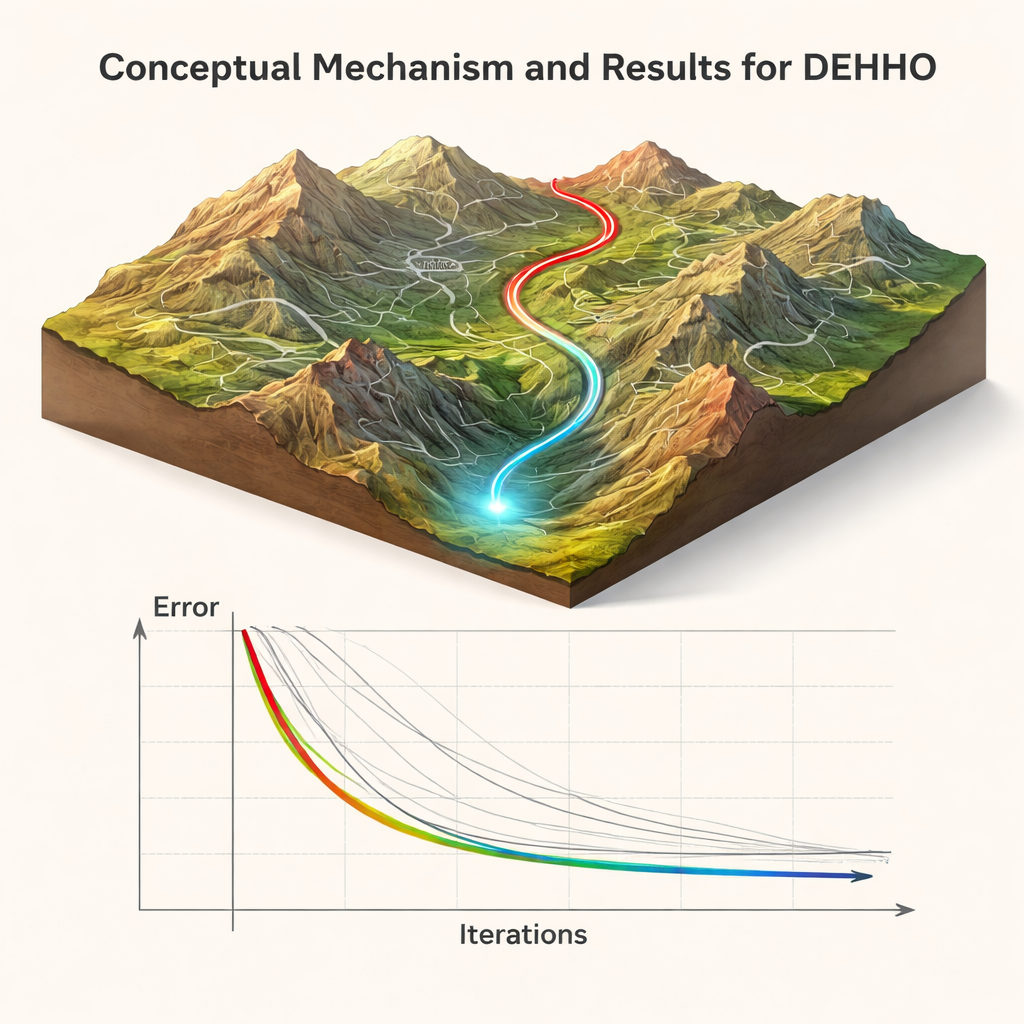
Many real problems can be thought of as landscapes: every point represents a different design, and the height represents how good or bad it is. These landscapes are often rugged, with countless hills and valleys. The challenge is to find the lowest valley (the best design) without getting trapped on a nearby hill (a merely decent design). A popular algorithm inspired by the hunting behavior of Harris hawks, called HHO, has been used to tackle such problems because it is simple and does not require knowing the exact shape of the landscape. Yet, when the number of design choices grows very large, the original HHO tends to lose its sense of direction, clustering too quickly and circling around good-but-not-best solutions.
Blending Two Ideas: Careful Wandering and Guided Motion
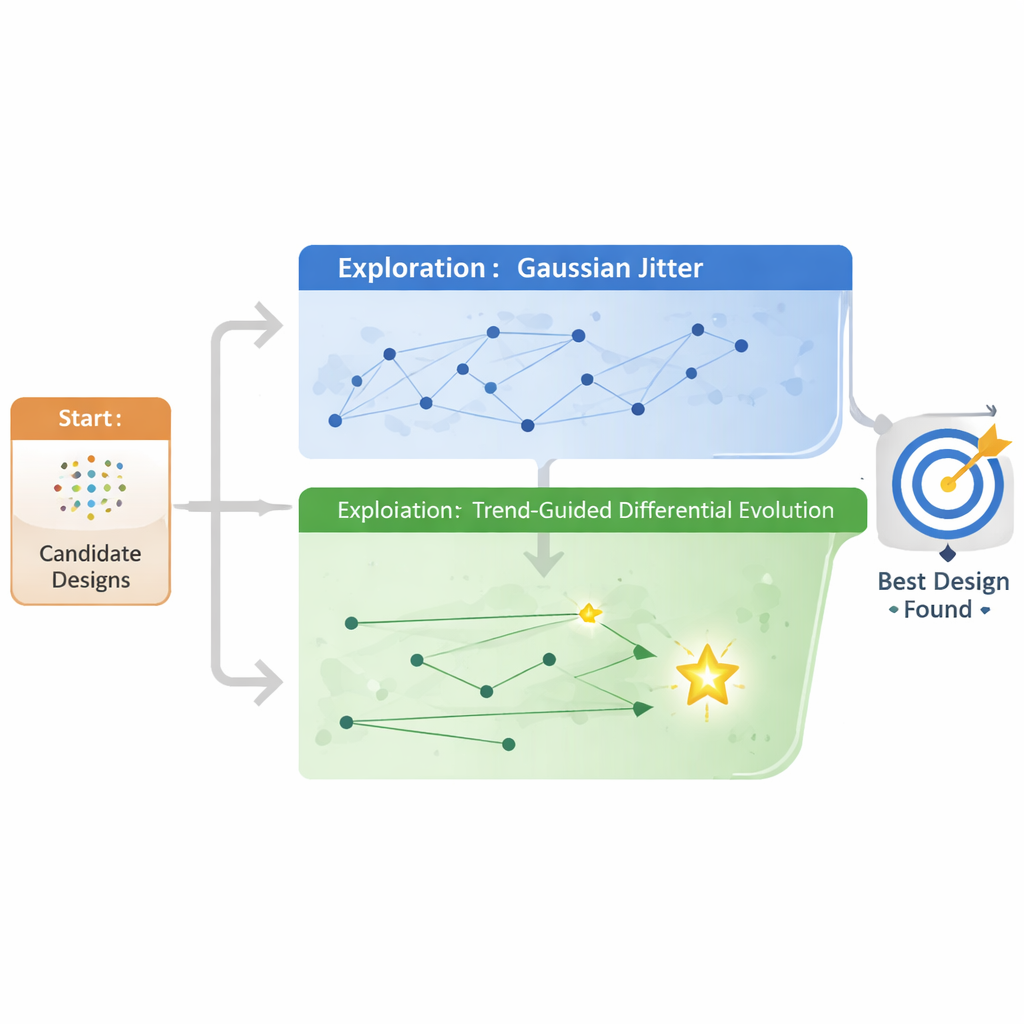
The authors propose DEHHO, a modular tweak of HHO that blends two complementary ideas. First, during the early "exploration" stage, DEHHO adds controlled Gaussian noise—a kind of gentle, random jitter—to the positions of candidate solutions. Instead of jumping blindly across the entire landscape, this jitter encourages the search to look carefully around promising regions while still maintaining variety in the population. Second, during the later "exploitation" stage, DEHHO borrows a mechanism from another successful method, Differential Evolution. Here, each candidate solution moves not just toward the current best, but also in a direction shaped by the differences between other candidates and by its own recent movement history, a kind of momentum. This trend-guided step smooths the path across the landscape, reducing the zig-zagging that wastes time and can cause the search to stall.
Testing on Tough Mathematical Benchmarks
To see whether these ideas pay off, the researchers tested DEHHO on two demanding collections of standard test problems known as CEC 2017 and CEC 2020. These benchmarks include smooth and rough landscapes, ones with many deceptive local valleys, and ones where variables interact in complicated ways. The team ran DEHHO and ten rival algorithms—five upgraded forms of HHO and five other well-known search methods—on problems with 50 and 100 design dimensions, meaning the search space was extremely large. Across most of the 39 benchmark functions, DEHHO reached lower error values and did so consistently over 30 independent runs, even though its settings were kept fixed rather than tuned for each case. Statistical tests confirmed that these gains were unlikely to be due to chance.
From Equations to Real Machines
Beyond abstract math problems, the study checked how DEHHO performs on classic engineering tasks: designing a three-bar truss structure, a welded beam, and a speed reducer mechanism. Each design must satisfy strict safety and performance constraints while minimizing weight or cost. DEHHO used a penalty-and-barrier trick to favor designs that stay within allowable limits while pushing toward the edges where the best trade-offs often lie. In all three cases, it either matched or slightly improved on the best-known solutions while respecting the constraints, and it did so more reliably than the competing algorithms. This suggests the method is not just a theoretical curiosity but a practical tool for difficult engineering design.
What It Means for Non-Specialists
In everyday terms, DEHHO is like combining a cautious scout who explores nearby terrain with a seasoned hiker who remembers which directions have led downhill before. The scout’s careful wandering (Gaussian exploration) keeps the group from settling too quickly on a poor campsite, while the hiker’s sense of direction (trend-guided evolution) helps the group descend efficiently toward the valley floor. The results show that this simple, modular combination can search very large and tricky design spaces with better accuracy and stability than several established methods, without a big increase in computing cost. For anyone relying on computers to find better shapes, schedules, or settings—whether in engineering, data science, or beyond—DEHHO offers a more dependable way to get closer to the true best solution.
Citation: Kang, F., Su, X. Modular Harris Hawks optimization with trend-guided differential evolution and Gaussian exploration for global optimization and engineering design. Sci Rep 16, 6007 (2026). https://doi.org/10.1038/s41598-026-35565-8
Keywords: global optimization, metaheuristic algorithms, Harris Hawks optimization, differential evolution, engineering design