Clear Sky Science · en
Hybrid machine learning and Gaussian process for antenna parameter estimation
Smarter Antennas for a Wireless World
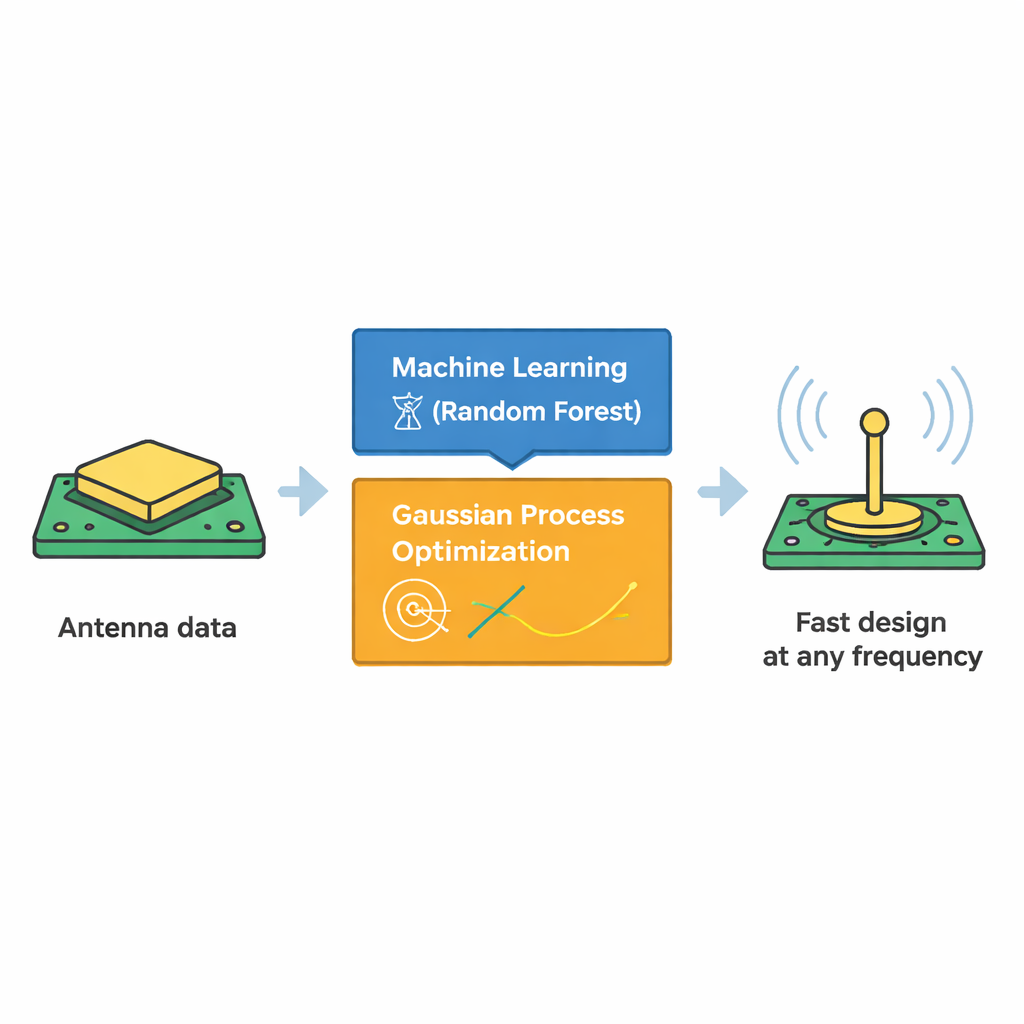
From smartphones to Wi‑Fi routers, nearly every wireless gadget depends on tiny metal shapes called antennas to send and receive signals. Designing these antennas traditionally means running long, computer‑heavy simulations and tweaking dimensions by hand. This paper shows how a blend of modern machine learning tools can almost automate that process, cutting design time by about 99% while keeping performance extremely accurate across a wide range of wireless frequencies.
Why Antenna Design Is So Slow Today
Engineers often use a popular type of antenna called a microstrip patch: a flat metal rectangle printed on a circuit board. Its length, width, and feed line determine which frequency it will work at, for example for 5G or Wi‑Fi. While textbook formulas give a starting point, getting a real, manufacturable design usually requires many rounds of detailed electromagnetic simulations. Each simulation can take minutes, and shifting to a new target frequency may mean repeating the whole process. Past attempts to speed this up with machine learning have been promising, but many relied on small or unverified datasets, risking “overfitting,” where a model looks good on paper but fails on new designs.
Teaching a Model with High‑Quality Data
The authors tackle this reliability problem head‑on by first building a large, carefully checked dataset. Using professional CST simulation software, they design and optimize 1,041 different patch antennas covering frequencies from 0.6 to 6.5 gigahertz, a range that spans many everyday wireless systems. For each design, they record the operating frequency and three key dimensions of the antenna. Only designs with very good signal matching are kept, which ensures clean, trustworthy examples. They also fabricate a real antenna and measure its behavior in the lab, confirming that the simulations closely match physical hardware, which boosts confidence that the training data reflect reality.
Blending Two Learning Methods into One Tool
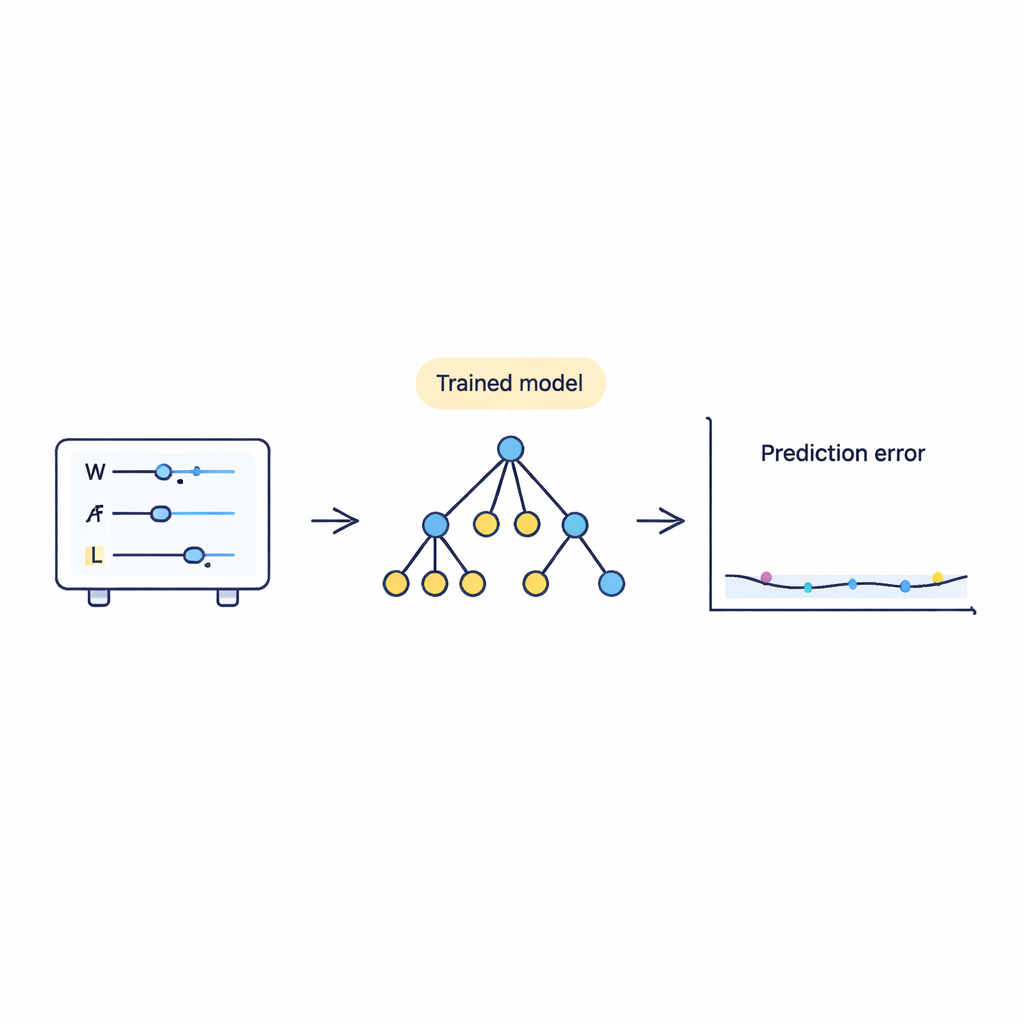
On top of this dataset, the team builds a hybrid model that combines a fast decision‑tree ensemble method, called Random Forest, with a statistical optimization method known as a Gaussian process. Random Forest learns how antenna dimensions relate to resonant frequency, while the Gaussian process is used as a “coach” that tunes the many internal settings, or hyper‑parameters, of the learning model. This tuning is done through Bayesian optimization, which searches for settings that minimize prediction error without exhaustively testing every possibility. The authors compare six different machine learning approaches and find that Random Forest, once guided by the Gaussian process, delivers the most accurate predictions of antenna dimensions.
Accuracy, Speed, and What It Means in Practice
The optimized hybrid model predicts the three main antenna dimensions from a desired frequency with very small error. A standard metric, the root mean square error, is as low as 0.0056, and a separate score that measures how well predictions match true values is essentially 1 for the best models. The authors further validate the system by asking it to design patch antennas at several frequencies, then comparing the predicted designs with fresh CST simulations and real measurements. Across the tested range, the curves of predicted and measured performance almost overlap. In timing tests on a standard desktop‑class computer, the trained model needs less than three seconds to propose suitable dimensions, whereas a full CST optimization run takes about 300 seconds, even under favorable assumptions. This means the new method can serve as a near‑instant design assistant.
From Expert Art to Push‑Button Design
In plain terms, this work turns what used to be a slow, expert‑driven task into something closer to push‑button engineering. Once the hybrid model has been trained just once, antenna designers can type in a target frequency between 0.6 and 6.5 gigahertz and immediately obtain high‑quality dimensions that closely match what a full simulation would produce. That saves effort, reduces trial and error, and makes it easier to explore new wireless products or adapt designs to new bands. Future extensions could cover wider frequency ranges and more complex antenna shapes, further shifting radio hardware development from weeks of manual tuning to seconds of intelligent prediction.
Citation: Thao, H.T.P., Kien, T.V. Hybrid machine learning and Gaussian process for antenna parameter estimation. Sci Rep 16, 6076 (2026). https://doi.org/10.1038/s41598-026-35564-9
Keywords: antenna design, machine learning, random forest, gaussian process, microstrip patch