Clear Sky Science · en
Fluid–structure interaction in underwater blasting demolition of cofferdam structures: a case study of three gorges phase III RCC cofferdam
Blasting a Temporary Dam, Safely
When a giant dam like the Three Gorges on China’s Yangtze River is built, temporary “helper” dams called cofferdams keep construction zones dry. Eventually those cofferdams must be removed, often with explosives, without harming the main dam or disturbing power generation. This study explains how engineers used advanced computer simulations to understand, in detail, how a massive concrete cofferdam breaks apart and topples underwater during blasting—and how the surrounding water helps shape that motion.
Why Water Makes Demolition So Tricky
Blasting rock and concrete in the open air is already a complex business. Underwater, it becomes far more complicated. Water changes how explosions behave: it presses on the explosive, carries powerful shock waves, and channels high-pressure gas into cracks. As a result, the way concrete shatters and the way broken blocks move on the riverbed cannot be predicted reliably using land-based blasting rules. Yet underwater blasting is now common in ports, navigation channels, hydropower projects, and large docks, where cofferdams must be demolished close to valuable structures. Engineers need better ways to foresee how fragments will fly, slide, and settle so they can keep nearby dams and power plants safe.
A Giant Temporary Wall in Deep Water
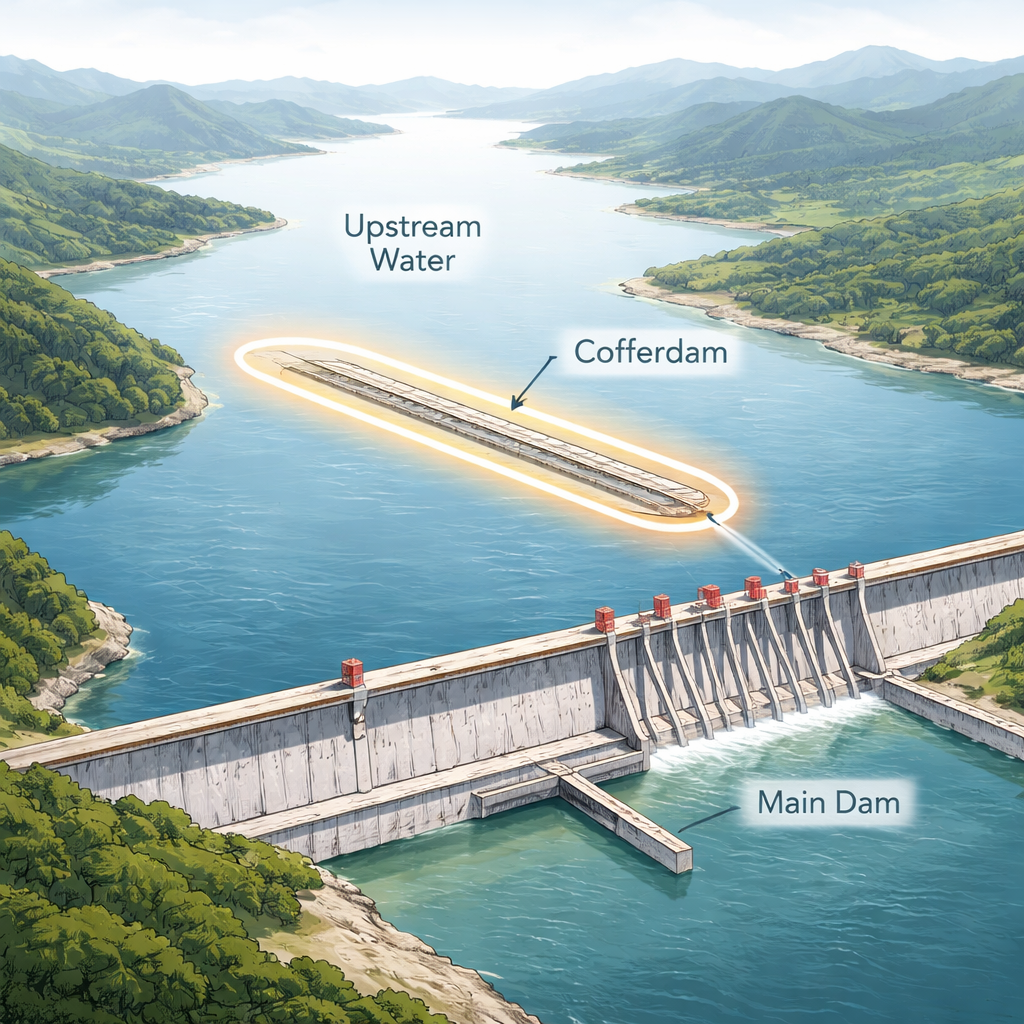
The focus of this work is the Phase III roller-compacted concrete cofferdam at the Three Gorges Project, a long, gravity-style wall running parallel to the main dam about 114 meters upstream. Unlike many temporary works, this cofferdam was built with its future demolition in mind. During construction, three internal charge chambers and special “fracture” holes were cast into the structure so that later explosions could slice through the upper portion and make it topple in a controlled direction. The challenge was enormous: over 180,000 cubic meters of concrete had to be removed in a single 480-meter-long section, at water depths up to about 40 meters—nearly double those used in earlier cofferdam blasts worldwide—while staying within tight safety limits near the main dam and powerhouse.
Simulating Every Block and Every Swirl
To study this risky operation, the authors built a detailed computer model that treats the cofferdam as thousands of individual concrete “particles” bound together, surrounded by water that flows and pushes on them. They combined two powerful tools: one that tracks fluid motion (computational fluid dynamics) and another that follows the motion and breakage of many solid pieces (discrete element modeling). By coupling these codes, the team could track how explosion-driven high-pressure water first carves a notch in the wall, then how the upper section cracks, rotates, slides, and finally falls to the riverbed, all while water surges, recirculates, and slows or redirects the debris.
How the Cofferdam Falls Apart
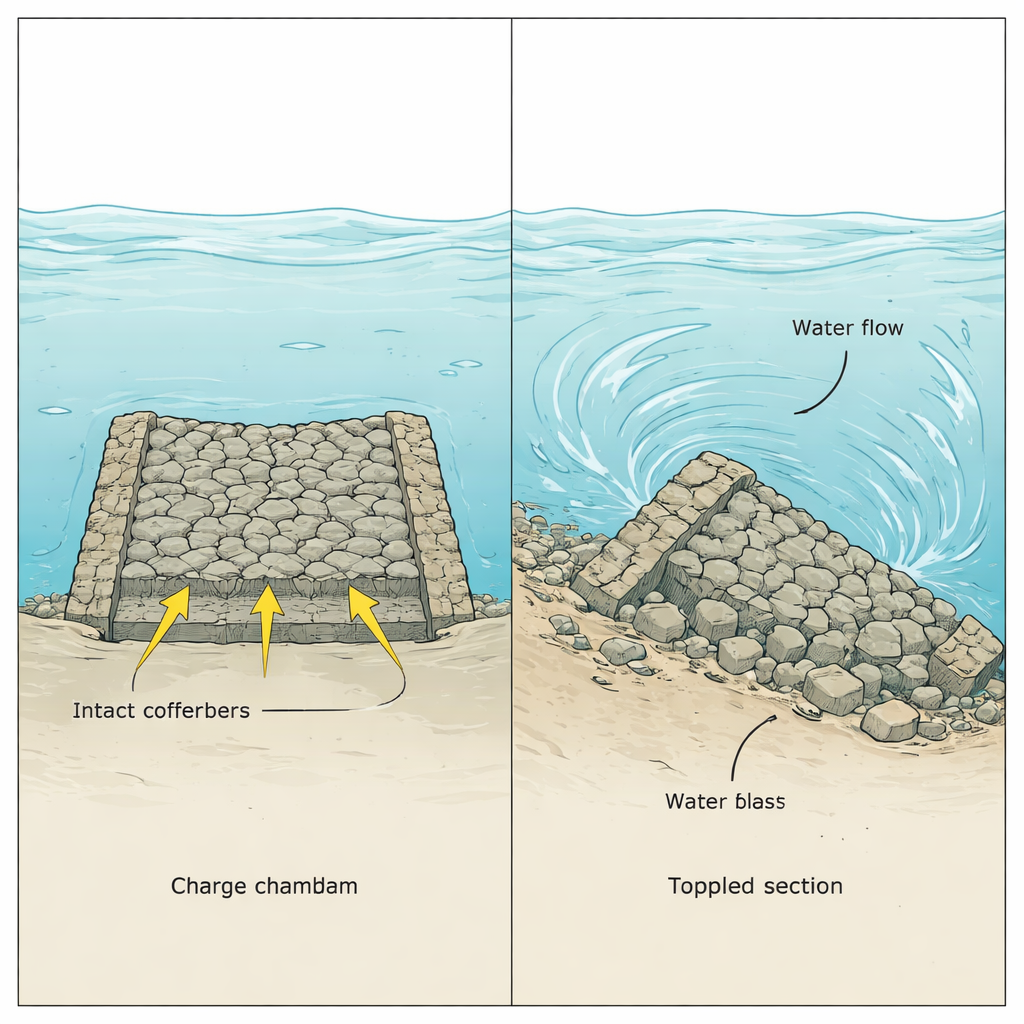
The simulations show the demolition unfolding in three main stages. First, the timed blasts in the internal chambers and fracture holes cut a deep, sloping breach, shifting the support point of the upper section. Under its own weight and the push of uneven water levels inside and outside the cofferdam, this upper block begins to rotate like a slowly falling door. Second, as it leans over, the block slides down along the newly formed slope of the remaining concrete, with water pushing on its face and flowing beneath it. Broken chunks sliding into the riverbed speed up the surrounding water and create countercurrents that slow fragments near the edges while pieces in the middle move faster. Finally, the upper section loses contact with the slope and drops freely underwater to the riverbed, where eddies and vortices swirl around the settling debris. The model also captures how the remaining lower cofferdam keeps roughly the planned shape and elevation.
Putting the Model to the Test
Computer models are only useful if they match reality. During the actual blast at Three Gorges, sensors on the main dam recorded vibrations as the toppled cofferdam struck the riverbed. The first strong impact signal appeared about 16.1 seconds after detonation—the same timing predicted by the simulation. Surveys of the underwater terrain showed that the gap left by the demolished cofferdam and the height of the remaining portion closely matched the design and the computed results. This agreement gives engineers confidence that the coupled model can capture both how the concrete fails and how the water responds.
What This Means for Future Dams
For non-specialists, the key takeaway is that the study turns a highly energetic, hard-to-observe underwater blast into a predictable, visualized process. By treating the cofferdam as many bonded blocks and the river as a moving fluid, the researchers reveal how water not only conveys explosive energy but also cushions, redirects, and sometimes slows falling debris. Their approach can help designers plan safer demolition strategies for large cofferdams and other underwater structures, reducing the risk to main dams, power stations, and workers while making better use of explosives and site conditions.
Citation: Wu, L., Liang, Z., Cai, Y. et al. Fluid–structure interaction in underwater blasting demolition of cofferdam structures: a case study of three gorges phase III RCC cofferdam. Sci Rep 16, 5175 (2026). https://doi.org/10.1038/s41598-026-35562-x
Keywords: underwater blasting, cofferdam demolition, Three Gorges Dam, fluid-structure interaction, numerical simulation