Clear Sky Science · en
The application of a three-dimensional gradient spin‒echo sequence (GRASE) in magnetic resonance cholangiopancreatography
Faster Scans for Troubled Digestion
People with diseases of the liver, gallbladder, or pancreas often need detailed scans of their bile and pancreatic ducts to find blockages, tumors, or stones. Today this is usually done with a special MRI scan called MRCP, which creates pictures of these fluid-filled tubes without surgery or X‑rays. But standard MRCP can take several minutes and is easily blurred by normal breathing, which is especially hard for patients already in pain. This study tested a much faster type of MRCP that can be done in a single breath‑hold, asking whether it can provide images good enough for doctors while making the exam easier on patients.
A New Way to Take the Picture
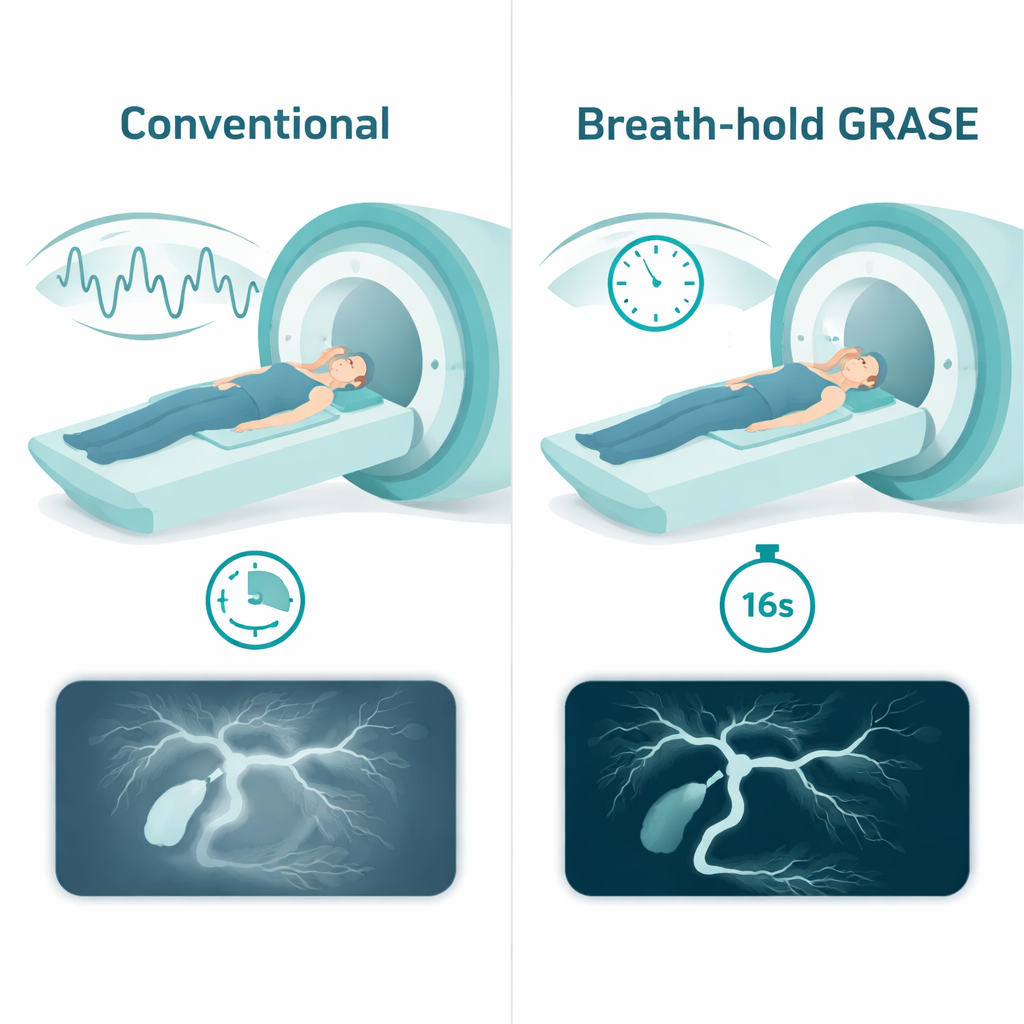
The researchers compared two MRI methods in 56 people who were being examined for suspected problems in the bile ducts, liver, gallbladder, or pancreas. The usual method, called 3D NT‑TSE, collects signals over several minutes while tracking the patient’s breathing. The new method, called 3D breath‑hold GRASE, combines two kinds of MRI echoes so it can grab all the needed information in just one 16‑second breath‑hold. Every patient had both types of scans, and two experienced radiologists judged the pictures without knowing which technique had been used.
Sharper Images in a Single Breath
The difference in scan time was dramatic: the traditional method took about four minutes on average, and sometimes much longer, while the new breath‑hold method always finished in about 16 seconds—roughly a 93% reduction. Despite being so fast, 3D BH‑GRASE actually produced better overall image quality scores for key structures such as the common bile duct, main liver ducts, and the gallbladder and its outlet tube. It also showed fewer motion‑related streaks and blurring, because the patient did not need to keep breathing steadily for several minutes. Measurements of image strength and contrast confirmed this: the breath‑hold scans had higher signal‑to‑noise and contrast‑to‑noise values, meaning the ducts stood out more clearly from the background.
Trade‑Offs in the Smallest Branches
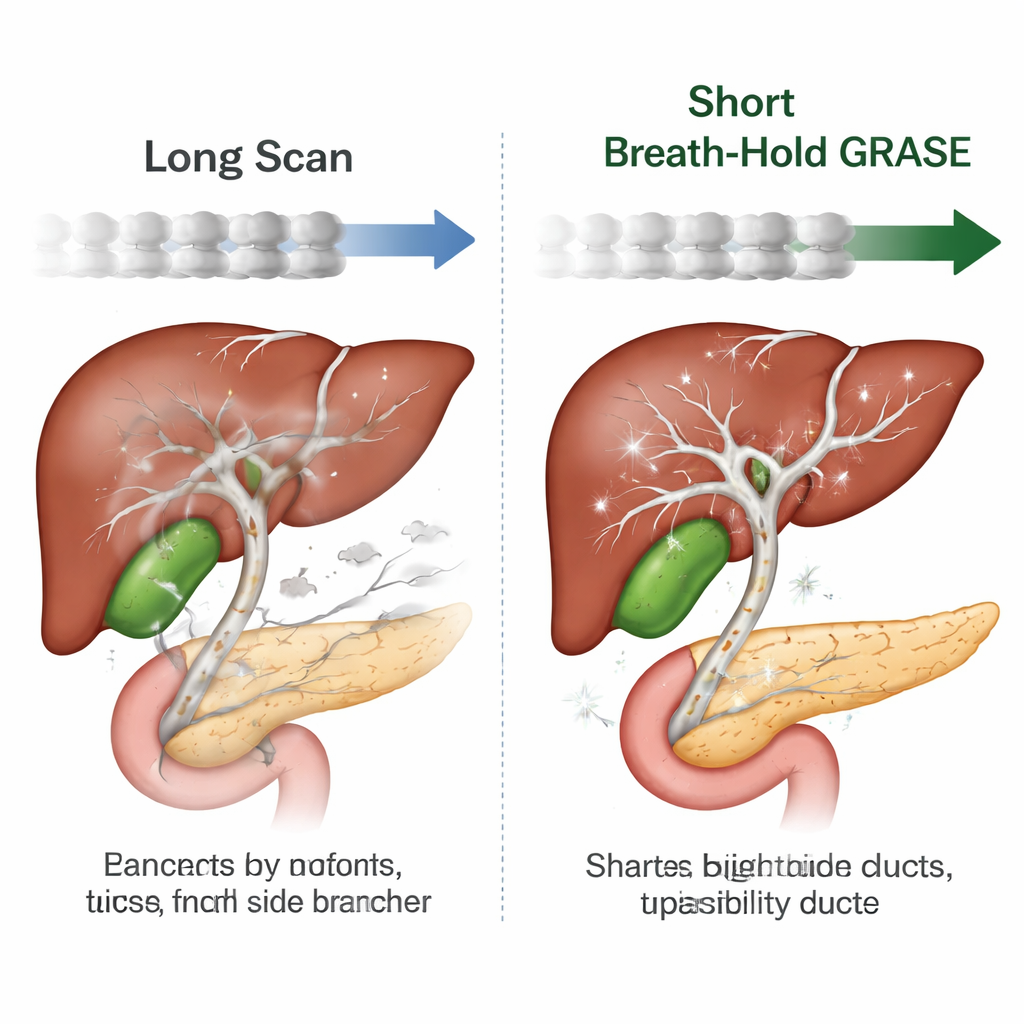
The breath‑hold technique was not perfect. When the radiologists scored the tiniest side branches inside the liver and the narrow pancreatic duct, the standard longer scan did a bit better. These secondary ducts are thin, twisted, and surrounded by moving bowel and gas, which demand very fine detail. Because the fast GRASE method sacrifices some spatial resolution to gain speed, it was more likely to miss or blur these delicate offshoots, especially on the left side of the liver and in the mid‑portion of the pancreatic duct. Still, for the main ducts that are most often involved in major blockages, performance was similar or superior with the fast method.
Stronger Together Than Alone
Importantly, the authors also looked at what would happen if doctors could choose the better image from either method for each duct segment. This combined approach—picking the best of both worlds—produced higher image quality scores than either scan type alone. In practice, this could mean using the speedy breath‑hold scan first to quickly assess most patients and then relying on the longer, navigation‑guided scan mainly when fine mapping of the smallest branches is essential, or when the breath‑hold image leaves specific questions unanswered.
What This Means for Patients
For someone lying in an MRI scanner with abdominal pain, the ability to obtain a high‑quality MRCP image in a single, short breath‑hold can make the exam much more tolerable. This study shows that the fast 3D BH‑GRASE method not only saves time but often yields clearer pictures of the main bile ducts and gallbladder, while the traditional approach still has an edge for the tiniest branches. The authors conclude that clinics may get the best results by combining the two methods: using the rapid breath‑hold scan to reduce discomfort and motion blur, and reserving the longer scan to fill in fine details when needed. In other words, smarter scanning—rather than just faster or just sharper—may offer both doctors and patients the greatest benefit.
Citation: Chen, Xy., Deng, Hp., Yang, XG. et al. The application of a three-dimensional gradient spin‒echo sequence (GRASE) in magnetic resonance cholangiopancreatography. Sci Rep 16, 5295 (2026). https://doi.org/10.1038/s41598-026-35560-z
Keywords: MRCP, bile ducts, gallbladder imaging, pancreatic disease, breath-hold MRI