Clear Sky Science · en
Study of a wideband high data rate implantable antenna for cortical visual prosthesis
Bringing Sight Back with Smart Implants
For millions of people who are blind, especially those whose eyes or optic nerves are badly damaged, glasses or surgery are not enough. One promising route is to bypass the eye entirely and send visual information straight into the brain. This study describes a crucial piece of that future system: a tiny wireless antenna that can be implanted on the surface of the brain to carry high‑speed visual data safely and reliably.
How a Brain‑Based Vision Device Works
In a cortical visual prosthesis, vision begins with a small camera mounted on a pair of glasses. The camera captures the scene in front of the wearer and sends it to an external processor that turns the images into patterns of electrical pulses. These patterns must then be transmitted wirelessly through the skull to an implanted module that stimulates nerve cells in the visual cortex, creating spots of light that the brain can interpret as shapes. The link between the outside world and the brain is a matched pair of antennas: one in the glasses, and one sealed inside the implant on the brain surface. 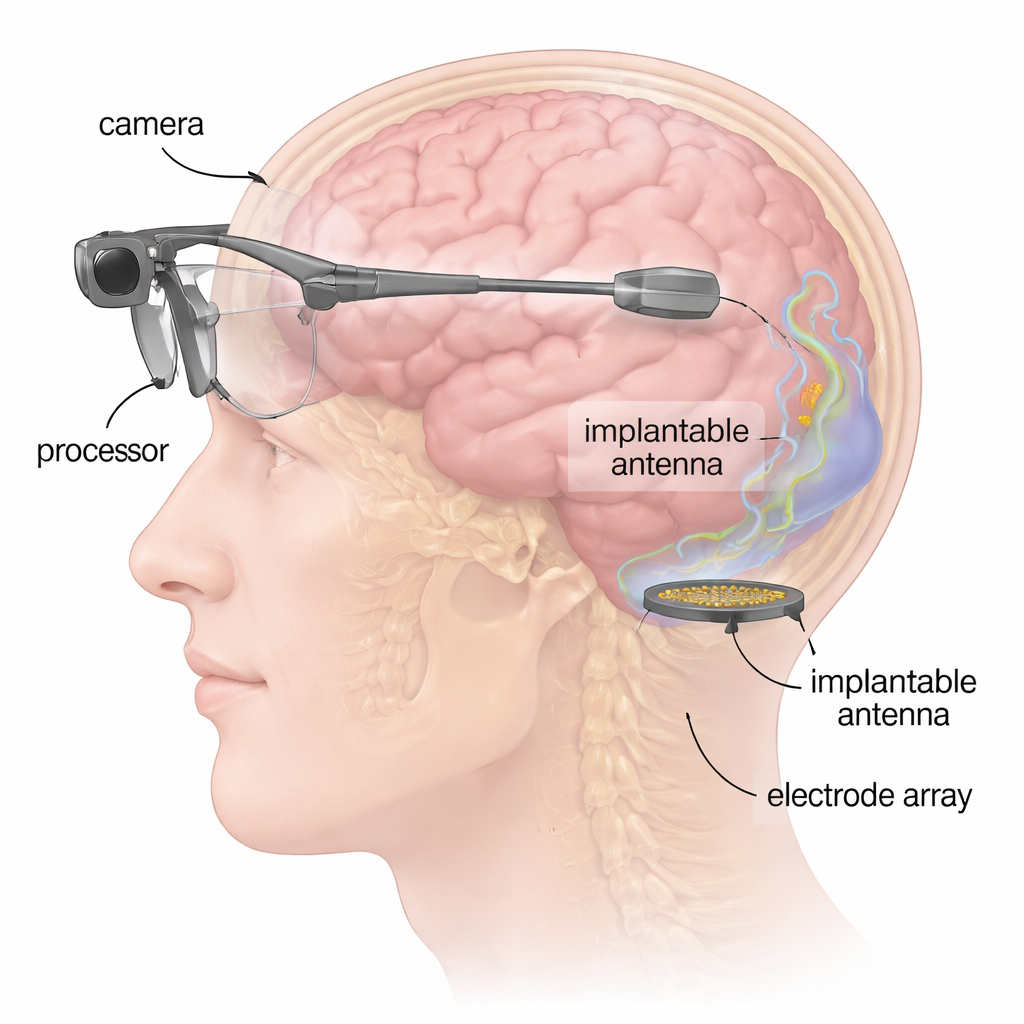
Making a Tiny Antenna Do a Big Job
The researchers set out to create an implantable antenna that operates in the widely used 2.45 GHz industrial, scientific and medical (ISM) band, the same part of the spectrum used by Wi‑Fi and Bluetooth. Their final device is a flat square only 8 millimeters on a side and less than a millimeter thick. To squeeze good performance out of such a small footprint, they used several clever layout tricks. A central square opening is filled with an array of specially shaped metal patterns known as complementary resonant rings, which behave like an engineered material and help the antenna resonate at a lower frequency than a simple patch of the same size would. Around the edges, narrow meandering tracks lengthen the current path without increasing the overall dimensions, further lowering the operating frequency and improving how well the antenna matches the driving electronics.
Shaping the Signal for Reliable Transmission
Beyond just tuning the frequency, the team wanted the antenna to produce circular polarization, a twisting motion of the radio wave that makes communication less sensitive to how the implant or external antenna are rotated. By carefully adjusting the size and spacing of the resonant rings, they created two vibrating modes in the metal that are at right angles and slightly shifted in time—exactly the recipe for circular polarization. Additional U‑shaped slots in the ground layer beneath the patch introduce closely spaced resonances that broaden the useful frequency range. In computer simulations and physical tests in a saltwater solution that mimics cerebrospinal fluid, the antenna achieved a wide operating band of about 26.5% around 2.45 GHz and maintained strong circular polarization over more than 22% of that band, all while keeping its gain and efficiency stable across the range. 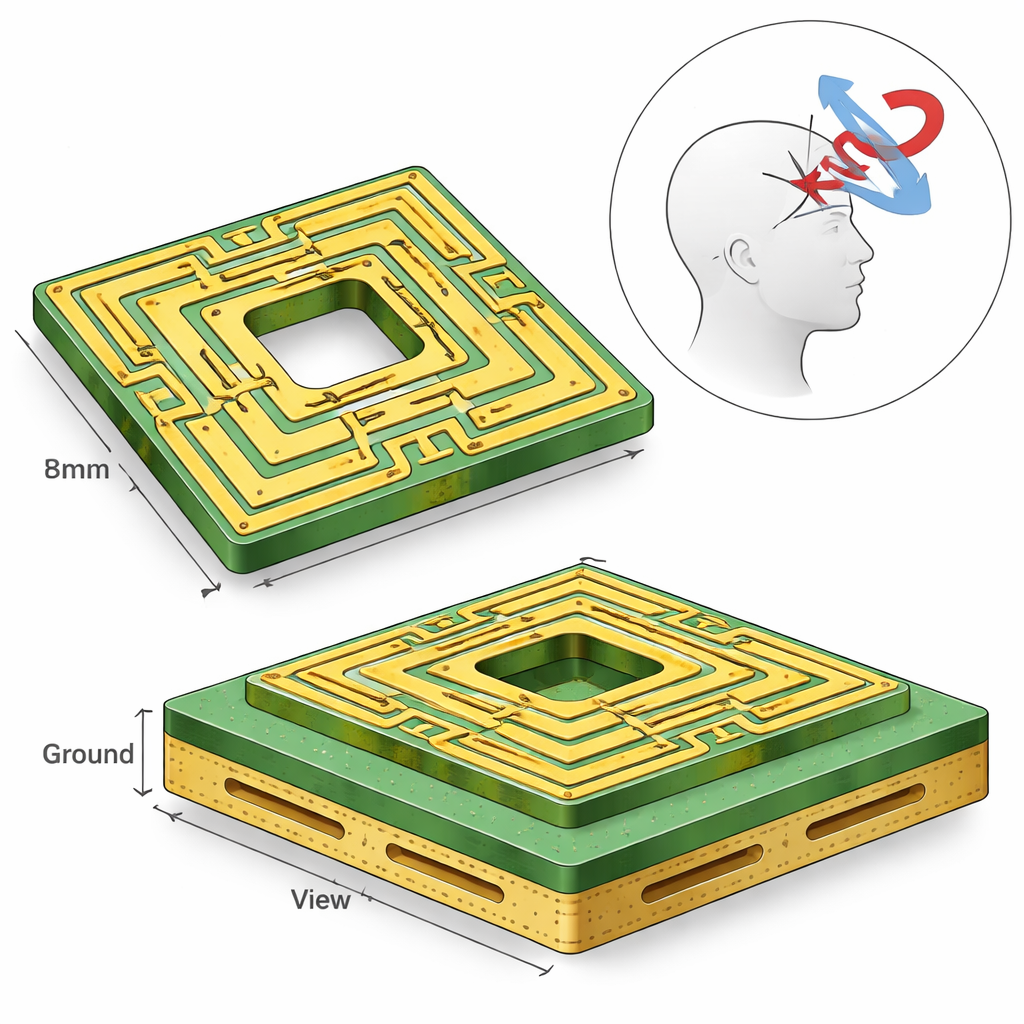
Testing Safety and Communication Range
Because the antenna sits in the brain, safety is critical. The authors built a detailed ten‑layer digital head model, including skin, skull and different brain regions, to calculate how much energy nearby tissue would absorb. From these simulations they determined safe limits on the power that can be fed into the implant while staying within international guidelines for specific absorption rate (SAR), which measure tissue heating. Using these limits, they then performed a "link budget" analysis that combined antenna gain, tissue losses, noise and data rate to estimate how far reliable communication could be maintained. With a data rate of 1 megabit per second—enough for high‑resolution stimulation patterns—they found that the implant could still communicate over distances of about 4.1 meters, giving generous room for everyday movement relative to external equipment.
What This Could Mean for Future Vision Restorations
In simple terms, this work shows that it is possible to build an antenna small enough to sit on the surface of the brain, yet powerful and efficient enough to carry high‑speed visual information wirelessly and safely through the skull. The design balances size, bandwidth, signal quality and safety in a way that surpasses previous antennas aimed at visual prostheses. While many other challenges remain—such as long‑term biocompatibility, stable electrodes and smarter stimulation algorithms—this antenna provides a strong building block for future cortical visual prosthesis systems that aim to restore useful sight to people who are blind.
Citation: Ou, RX., Yu, WL. & Xu, CZ. Study of a wideband high data rate implantable antenna for cortical visual prosthesis. Sci Rep 16, 5240 (2026). https://doi.org/10.1038/s41598-026-35557-8
Keywords: cortical visual prosthesis, implantable antenna, wireless brain interface, visual restoration, medical implants