Clear Sky Science · en
Optimization-driven steganographic system based on fused maps and blowfish encryption
Hiding Messages in Plain Sight
Most of us send pictures every day without thinking about what else they might carry. This research explores how to hide an entire image inside another image so cleverly that even advanced artificial intelligence tools struggle to notice anything unusual. The work matters for anyone concerned with privacy and secure communication, from medical data sharing to law enforcement and journalists operating under censorship.
Why Hide Data Inside Pictures?
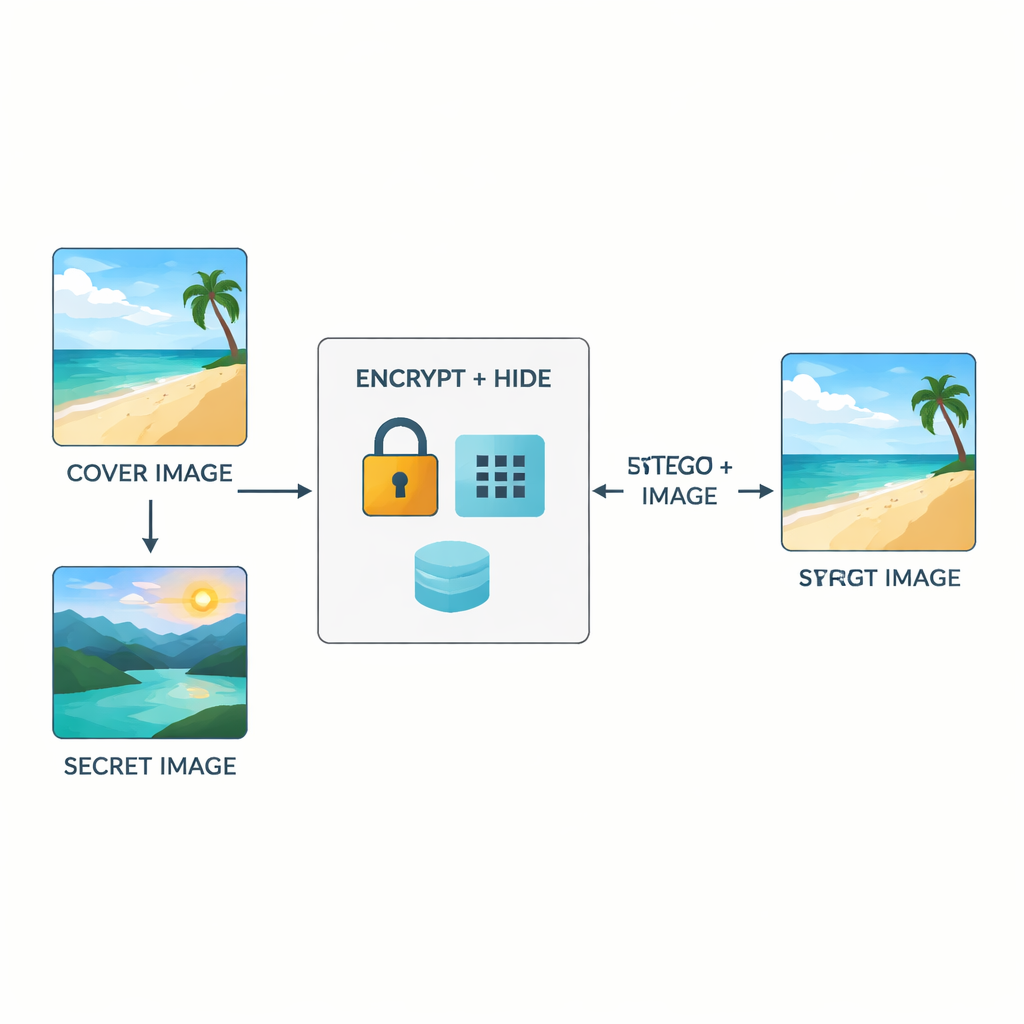
Steganography is the art of concealing information so that its very existence is secret. Instead of scrambling data like traditional encryption, steganography slips a hidden message into an ordinary-looking file, such as a photo. The challenge is to pack in enough secret data while keeping the image looking perfectly natural and making sure that attackers, including powerful deep-learning systems, cannot detect that anything has been hidden. This paper tackles that three-way balancing act: how to stay invisible, carry a lot of data, and remain robust against automated detection.
Smarter Hiding With a Map of “Busy” Regions
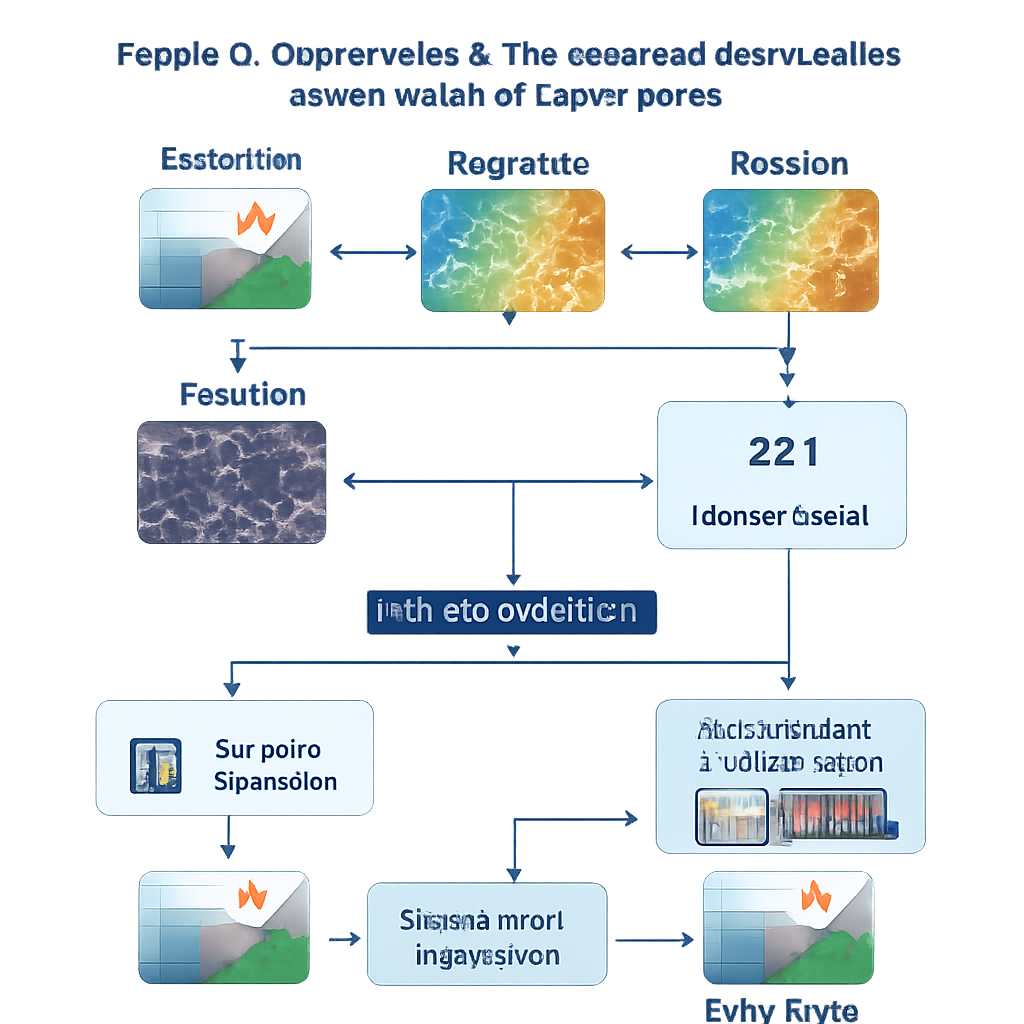
The authors start by asking a simple question: where in a picture can you make tiny changes that no one will notice? Human eyes are less sensitive to small tweaks in complex, textured areas than in smooth skies or flat walls. The system first studies the so-called cover image—the picture that will carry the secret—by building two guides. One guide measures local randomness, or entropy, to find regions full of fine detail. The other uses an edge-detection style measure to highlight noisy, high-contrast zones. These two guides are blended into a single “fused map” that acts like a heat map of the best hiding spots, steering the system away from smooth, fragile areas.
Locking the Secret Before It Is Hidden
Before any hiding happens, the secret image is fully encrypted using a well-known cipher called Blowfish. This step means that, even if an attacker somehow peeled out the hidden bits, they would see only encrypted noise, not a readable picture. The encrypted image is then turned into a stream of bits that must be threaded into the cover image one by one. The actual hiding uses a classic trick: adjusting the least significant bits of selected pixels. These tiny tweaks are too small to notice visually but can reliably store the encrypted data if placed carefully.
Letting a Swarm Search for the Best Strategy
Choosing where and in what order to hide bits turns out to be a complex puzzle. To solve it, the authors use Particle Swarm Optimization, a nature-inspired search method that mimics how flocks of birds or schools of fish move toward good locations. Each “particle” represents a candidate way to combine the fused map settings and rank pixels. The swarm repeatedly tests different strategies, scoring them by how little they distort the cover image and how accurately the secret can be recovered. Over a few dozen rounds, the swarm converges on an embedding plan that keeps the picture looking natural while preserving perfect reconstruction of the hidden image.
Putting the System to the Test
The researchers tested their method on standard image collections often used in the steganography community. Even when hiding up to about one secret bit per pixel—a relatively heavy load—the altered, or stego, images remained visually almost indistinguishable from the originals. Measured image quality stayed well above levels where humans would notice changes, and the secret images were recovered perfectly. Crucially, two modern deep-learning steganalysis networks, designed specifically to spot hidden content, performed no better than random guessing. A traditional statistical test also showed only modest signals, especially at more realistic, moderate hiding rates.
What This Means for Everyday Security
In plain terms, this work shows that it is possible to hide substantial amounts of encrypted information in ordinary grayscale photos while keeping the pictures looking unchanged and largely undetectable, even to current AI-based detectors. The method works quickly enough for real-time use and could support applications such as secure telemedicine, confidential image sharing, or sensitive field reports that need to travel disguised as everyday photos. While the study focuses on grayscale still images and leaves color, video, and harsh compression for future work, it demonstrates a powerful combination: first encrypt the message, then hide it only where the image can safely “absorb” changes, and let an optimization algorithm fine-tune the details.
Citation: Aljughaiman, A., Alrawashdeh, R. Optimization-driven steganographic system based on fused maps and blowfish encryption. Sci Rep 16, 4922 (2026). https://doi.org/10.1038/s41598-026-35556-9
Keywords: image steganography, data hiding, digital privacy, encrypted images, deep learning detection