Clear Sky Science · en
Forage quality shapes physiological and gut microbial responses in moose (Alces alces) of Isle Royale National Park
How Winter Trees Challenge a Giant Herbivore
On a remote island in Lake Superior, moose survive long, harsh winters by browsing evergreen trees. But these seemingly reliable foods come with a hidden twist: many evergreens defend themselves with natural chemicals that can be toxic in large doses. This study asks a simple but far-reaching question: how do moose on Isle Royale cope with a winter diet that is both low in nutrients and laced with plant toxins, and what role do their gut microbes play in that struggle?
A Natural Experiment on a Wild Island
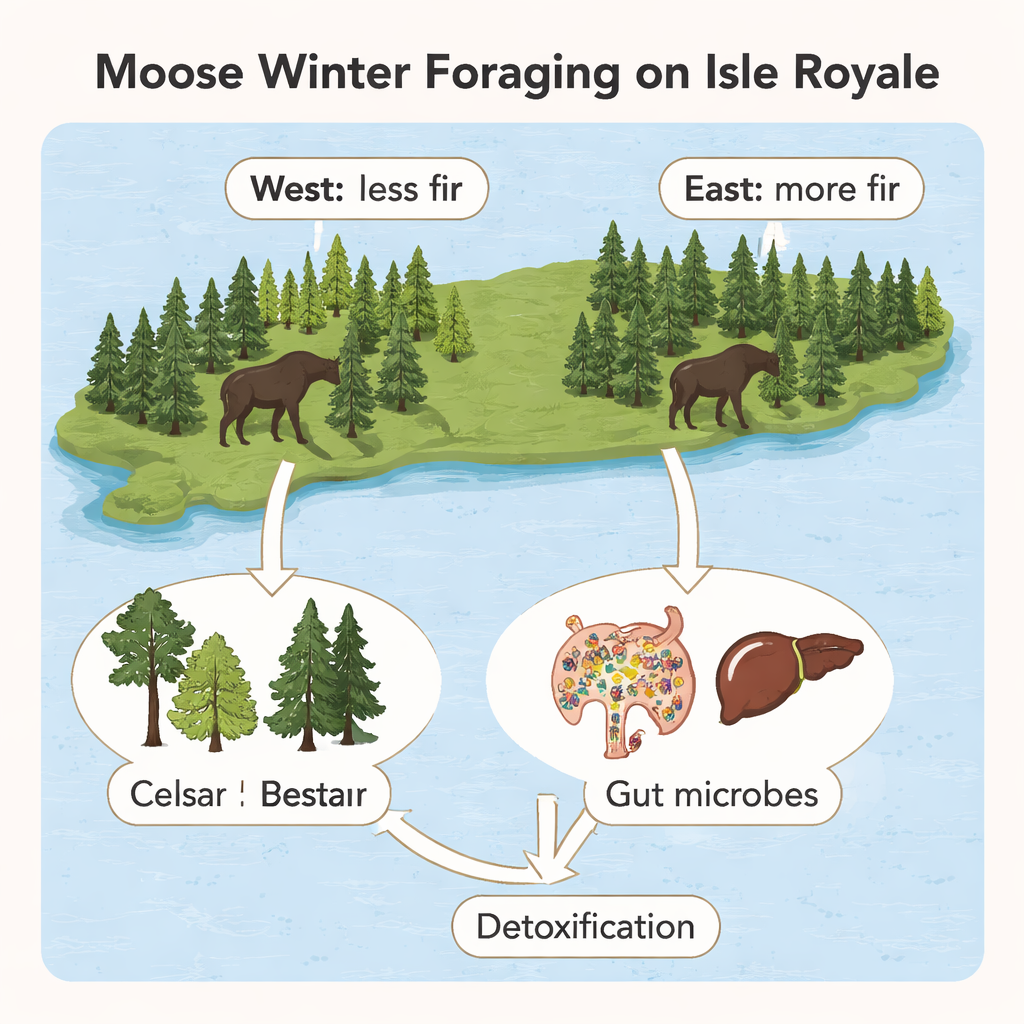
Isle Royale National Park offers a rare, living experiment. Moose on the eastern end of the island have abundant access to balsam fir, a staple winter tree that is rich in plant secondary compounds—natural chemical defenses. In the west, balsam fir has declined, forcing moose to rely more on other species such as cedar. The researchers took advantage of this east–west contrast. During one winter, they collected fecal pellets and snow urine from dozens of free-ranging moose across the island. From these samples they reconstructed each animal’s diet, measured chemical signs of detoxification and nutritional stress in the urine, and sequenced the bacteria living in the moose gut, including both who is there and what genes they carry.
When Food Is Both Toxic and Poor
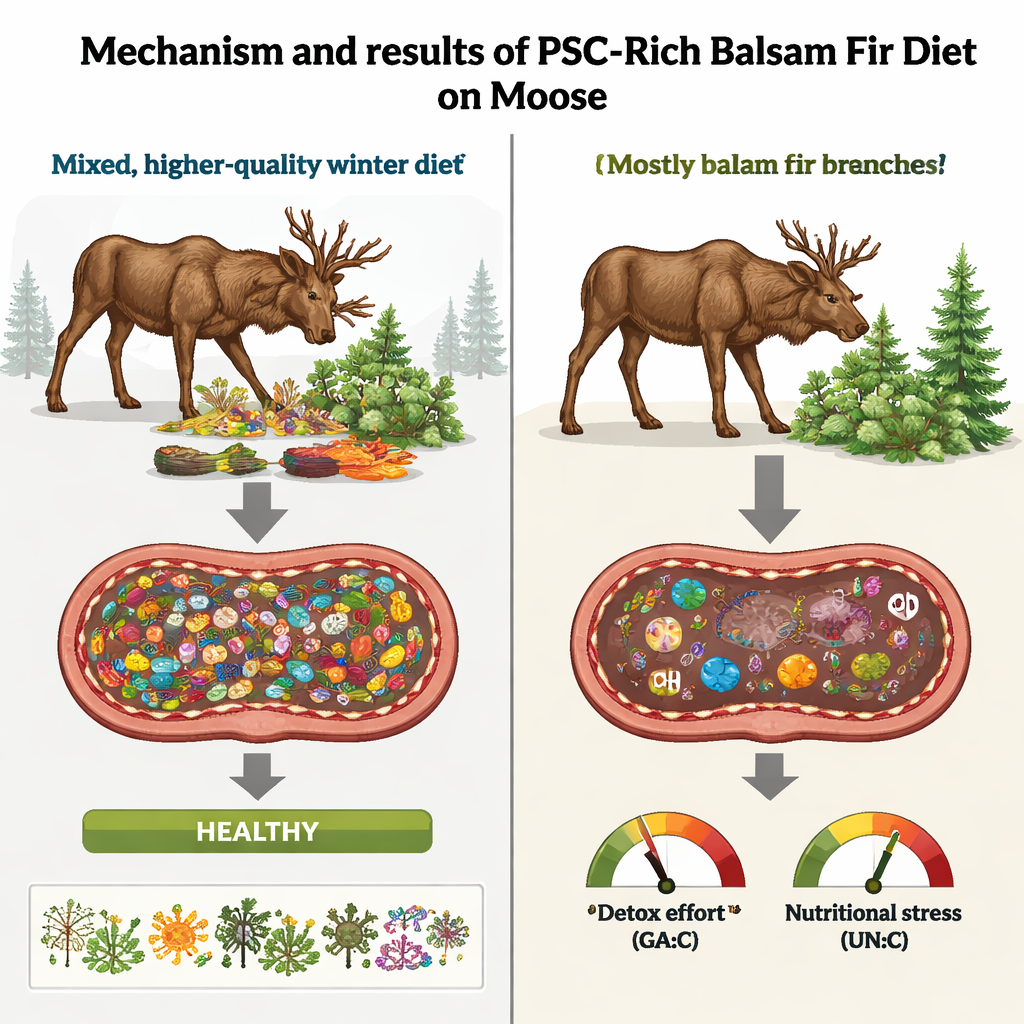
The first finding is stark: eastern moose ate far more balsam fir than their western neighbors, and that choice came at a cost. Two key urine markers told the story. One, involving glucuronic acid, reflected how much effort the body was investing in detoxifying plant chemicals. The other, a ratio of urea nitrogen to creatinine, signaled whether the animals were breaking down their own body protein—a warning sign of poor nutrition. Both markers rose with increasing balsam fir in the diet, and they rose together. In other words, moose that browsed more on this chemically defended tree were simultaneously working harder to neutralize toxins and showing signs of nutritional strain.
Gut Microbes Under Chemical Pressure
The moose gut hosted a typical community of plant-digesting bacteria dominated by Firmicutes and Bacteroidetes, including abundant butyrate-producing genera such as Roseburia. Yet this community shifted in response to diet and condition. Overall, more balsam fir meant lower bacterial diversity, especially in animals already in poor nutritional shape. The specific mix of bacterial types also differed between east and west, and with how much fir moose consumed and how stressed they were nutritionally. Several bacterial groups became more common as exposure to plant chemicals increased, including Roseburia and a genus called Phascolarctobacterium that became a central hub in microbial interaction networks under high toxin loads. Despite these compositional changes, the way communities assembled was largely governed by chance and limited movement of microbes among animals, rather than by strong filtering for a few “perfect” detoxifying species.
Hidden Chemical Work in the Gut
By sequencing all DNA from the fecal samples, the team looked beyond who the microbes were to what they could do. They found many genes involved in breaking down complex plant compounds, including aromatic chemicals and terpenes commonly used by trees as defenses. Pathways for processing benzoate-like molecules and for building and degrading terpenoid structures were clearly present, showing that the gut microbiome is biochemically equipped to help handle plant toxins. However, the overall abundance of these pathways did not rise sharply with increased fir consumption once strict statistical corrections were applied. This suggests that rather than flipping individual detox pathways on or off, the microbial community as a whole reorganizes its membership and connections to keep digestion and detoxification functioning under chemical and nutritional stress.
Living on the Edge of What Plants Allow
For lay readers, the takeaway is that moose on Isle Royale survive winter by walking a nutritional tightrope. Balsam fir is abundant but chemically booby-trapped and relatively low in protein. Eating more of it forces moose to spend more energy detoxifying and pushes them closer to starvation, and it nudges their gut bacteria toward a less diverse but more specialized community. Those microbes carry the tools to break down many plant toxins and appear to reorganize themselves to keep the moose going, even when food is both scarce and chemically harsh. The study highlights that large herbivores do not cope with tough diets through their own physiology alone; they rely on a partnership with their gut microbes. Together, the moose and their microscopic allies form an integrated detox team that allows them to persist on a difficult winter menu that might otherwise be deadly.
Citation: Menke, S., Fackelmann, G., Vucetich, L.M. et al. Forage quality shapes physiological and gut microbial responses in moose (Alces alces) of Isle Royale National Park. Sci Rep 16, 3724 (2026). https://doi.org/10.1038/s41598-026-35555-w
Keywords: moose, gut microbiome, plant toxins, balsam fir, herbivore nutrition