Clear Sky Science · en
Delineating homogeneous zones for rock joint wall mechanical properties in open-pit mine slope based on a multi-indicator stacked generalization model
Why the Strength of Hidden Cracks Matters
High above the trucks and excavators in an open-pit mine, the stability of the stepped rock walls decides whether a workday is routine or disastrous. These walls are not solid blocks but are cut by countless natural cracks and seams, called joints. The condition of the thin rock surfaces along those joints strongly influences whether a slope stands firm or fails. This study shows how a modern, data-driven approach can map out areas of similar joint quality across a mine wall, providing a clearer, more objective picture of where slopes are safest and where they are most at risk.
Cracked Rock Is Not All the Same
In an open-pit mine, engineers often divide the rock mass into “homogeneous zones” – areas where the rock behaves in roughly the same way. Traditional systems, such as long-used rock quality ratings, compress many observations into single scores. While useful for broad decisions, they can blur the fine-scale differences that really matter along joint surfaces. Joints vary in strength, how easily they break down when wet and dry, how weathered they are, and how densely they are spaced. Treating a whole slope as one uniform block risks overlooking weaker subzones where failure is more likely to start.
Measuring What Really Controls Slope Safety
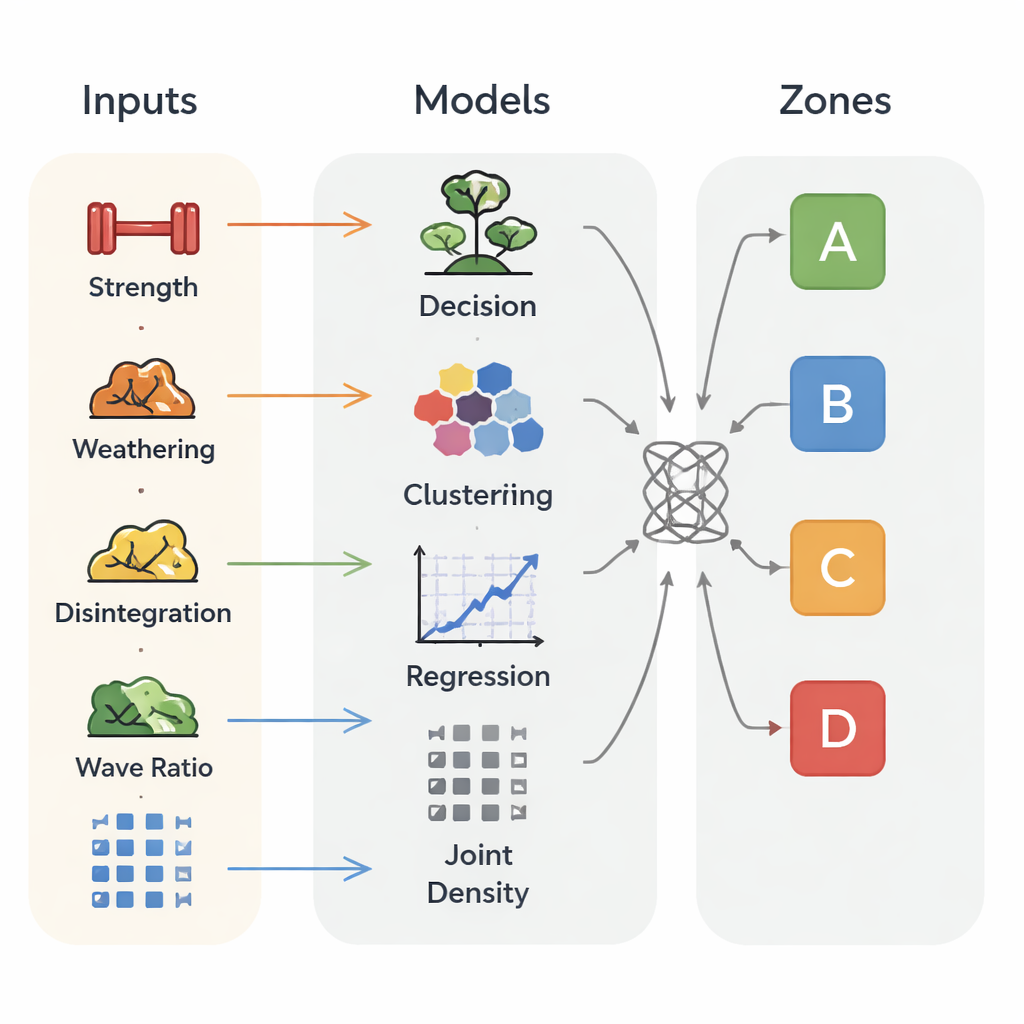
The authors focus directly on the mechanical properties of joint walls in a large open-pit lead–zinc mine in Yunnan, Southwest China. Working within a single sandstone formation, they collected 153 rock samples and carefully measured five key indicators. These include how strong the joint surface is in compression (using a rebound hammer on exposed joints), how resistant the rock is to crumbling under repeated wetting and drying, two measures that reflect the degree of weathering, and how many joints cut through the rock per unit length. Together, these measurements capture how likely joints are to weaken, open, and slip under the weight of a mine slope.
From Field Data to Smart Zoning
Rather than rely on one rating scheme or a single type of model, the researchers turned to a machine-learning strategy called stacked generalization. In simple terms, several different algorithms first learn patterns in the data and make their own predictions about which rock subzone each sample belongs to. A final “meta” model then learns how to best combine these opinions into a single, more reliable decision. To help the system recognize subtle, curved relationships between the five indicators and rock behavior, the authors expanded the raw measurements into additional squared and cross-product terms, and then used an information-based filter to keep only the most informative ones.
Four Zones, One Slope
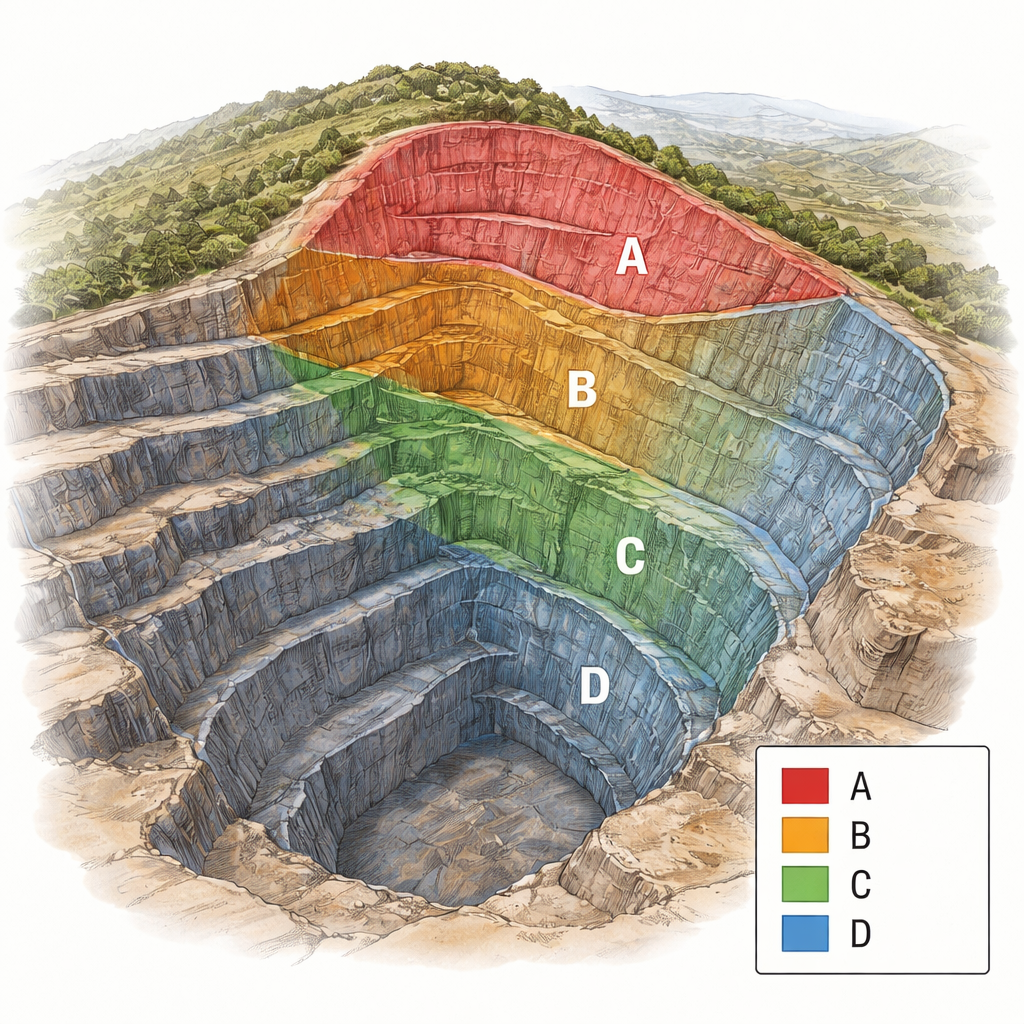
Using 53 samples whose subzones were identified in the field, the team trained and tuned six common machine-learning models, then built a stacked model from the three strongest performers. This ensemble reached a balanced accuracy of about 94 percent in classifying rock samples into four subzones, notably better than any single model on its own. The remaining 100 samples, collected from areas that were visually ambiguous, were then assigned to zones by the stacked model. Plotting all 153 classified points onto a geological map of the pit revealed four distinct homogeneous zones spanning the slope, each with its own characteristic joint strength, weathering state, and joint density.
What This Means for Safer Mines
For mine planners and safety engineers, the payoff is a more realistic map of where slopes are inherently stronger or weaker. Instead of assuming that one set of rock properties applies everywhere, they can assign different mechanical parameters to each zone in their stability calculations and numerical simulations. This helps to narrow down where reinforcement, drainage, or design changes are most urgently needed, while avoiding unnecessary conservatism elsewhere. Although the current work is based on one sandstone mine, the approach relies on measurements that can be made in most rock types. With more data from other sites, this stacked modeling framework could become a standard way to translate detailed joint-wall measurements into practical, zone-based guidance for keeping open-pit slopes standing safely over the long term.
Citation: Yu, X., Zheng, A., Ye, J. et al. Delineating homogeneous zones for rock joint wall mechanical properties in open-pit mine slope based on a multi-indicator stacked generalization model. Sci Rep 16, 5117 (2026). https://doi.org/10.1038/s41598-026-35547-w
Keywords: slope stability, open-pit mining, rock joints, machine learning, geotechnical zoning