Clear Sky Science · en
Additive effects of high intensity interval training and therapeutic adenosine on gene and protein expression in lipid metabolism and weight loss in high fat diet-induced obese rats
Why this study matters for everyday health
Obesity is not just about the number on the scale; it raises the risk of diabetes, heart disease, and many other illnesses. Doctors know that intense exercise can help, and scientists are also exploring medicines that nudge the body to burn more fat. This animal study asks a simple but important question: can a specific type of hard interval exercise, combined with a naturally occurring molecule called adenosine, team up to switch the body from storing fat to burning it more effectively?
Training tiny athletes on treadmills
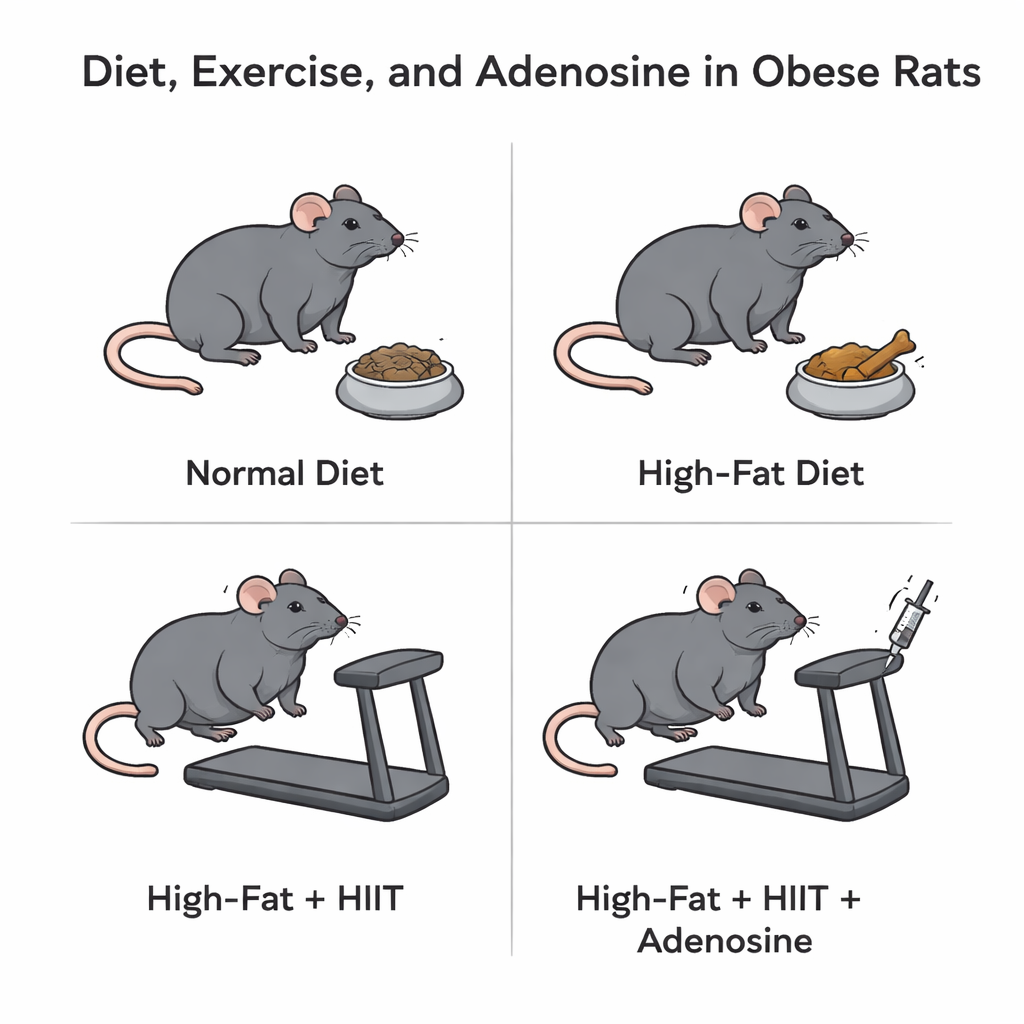
To explore this, researchers worked with male rats, some eating a normal diet and others fed a high-fat diet for many weeks to induce obesity. After the rats were fattened, the high-fat group was split into four branches: one continued with the high-fat diet only, one received high-intensity interval training (HIIT) on a treadmill, one received injections of adenosine, and one received both HIIT and adenosine. HIIT sessions were short but tough, made up of repeated bursts near the rats’ top running speed, several days per week. Adenosine, which our own bodies release when energy is used up, was given in low doses by injection for 12 weeks. By the end, the team compared body weight and muscle samples across all groups.
Inside the body’s fat switches
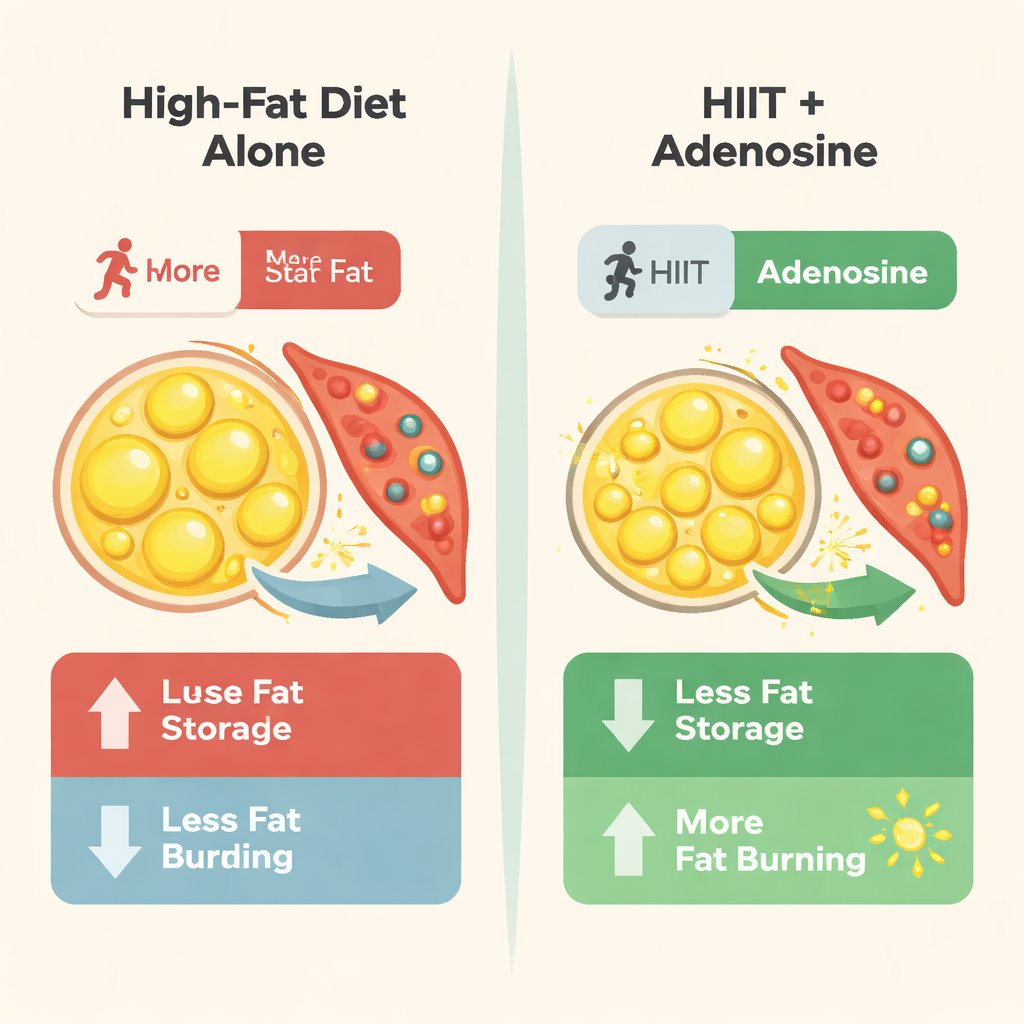
The scientists focused on a handful of molecular “switches” in skeletal muscle that decide whether the body stores fat or burns it. Some of these, like AMPK and HSL, encourage fat breakdown and use; others, such as ACC, favor fat storage. They also examined proteins like CGI-58, which helps start fat release from cells, and a receptor called A2A, which responds to adenosine and can promote fat burning. In obese rats that stayed on the high-fat diet without extra help, these fat-burning switches were generally turned down, while the fat-storing signals were turned up, matching their continued weight gain.
HIIT and adenosine: better together
When HIIT was added, the picture changed. Rats that exercised showed higher activity of several fat-burning genes and proteins and less activity of the main fat-building enzyme, ACC. The combination of HIIT plus adenosine produced the strongest overall shift: these rats had the greatest increase in AMPK and HSL, the largest drop in ACC, and the most weight loss of any high-fat group. HIIT alone was especially powerful at boosting CGI-58, suggesting that hard interval exercise by itself strongly primes the machinery that frees stored fat. Adenosine on its own did improve some molecular markers and weight compared with a high-fat diet alone, but its impact was clearly smaller than when it was paired with intense exercise.
From fat storage to fat burning
Putting the pieces together, the researchers propose that HIIT mainly acts as a strong trigger for fat release and energy demand, while adenosine fine-tunes the system toward steady fat oxidation—actually burning those freed fats for fuel rather than letting them settle back into storage. In rats fed a high-fat diet, doing HIIT while receiving adenosine led to the largest shift in the muscle’s internal chemistry away from lipogenesis (making and storing fat) and toward lipolysis (breaking down and using fat). This molecular reprogramming lined up with the simple outcome most people care about: the combined group lost the most weight.
What this could mean for people
Although this work was done in rats and used injections not given to humans, the overall message is straightforward. Short, demanding intervals of exercise do more than burn calories in the moment: they reset the body’s fat-control switches to favor burning over storage. Adding the right kind of helper molecule—here, adenosine—can push those switches even further, at least in animals. For a layperson, the takeaway is that well-designed high-intensity workouts may be a particularly efficient way to fight obesity, and that future medicines could someday amplify these effects by working hand in hand with exercise rather than trying to replace it.
Citation: Eslami, Z., Ghafi, A.G., Wong, A. et al. Additive effects of high intensity interval training and therapeutic adenosine on gene and protein expression in lipid metabolism and weight loss in high fat diet-induced obese rats. Sci Rep 16, 6695 (2026). https://doi.org/10.1038/s41598-026-35546-x
Keywords: high-intensity interval training, adenosine, obesity, fat metabolism, weight loss