Clear Sky Science · en
A spatial perspective on the impact of official development assistance on sustainable development goals
Why Foreign Aid Still Matters
When wealthy countries send “foreign aid” to poorer nations, the money is often justified as a way to fight poverty, hunger, and environmental damage. But does this support really help countries reach the United Nations’ 17 Sustainable Development Goals (SDGs) by 2030—and does progress in one country affect its neighbors? This study takes a global, map-based look at how Official Development Assistance (ODA) relates to SDG performance from 2000 to 2021, revealing that aid works well for some basic needs but can fail—or even backfire—for other goals.
Seeing the World as Connected Neighborhoods
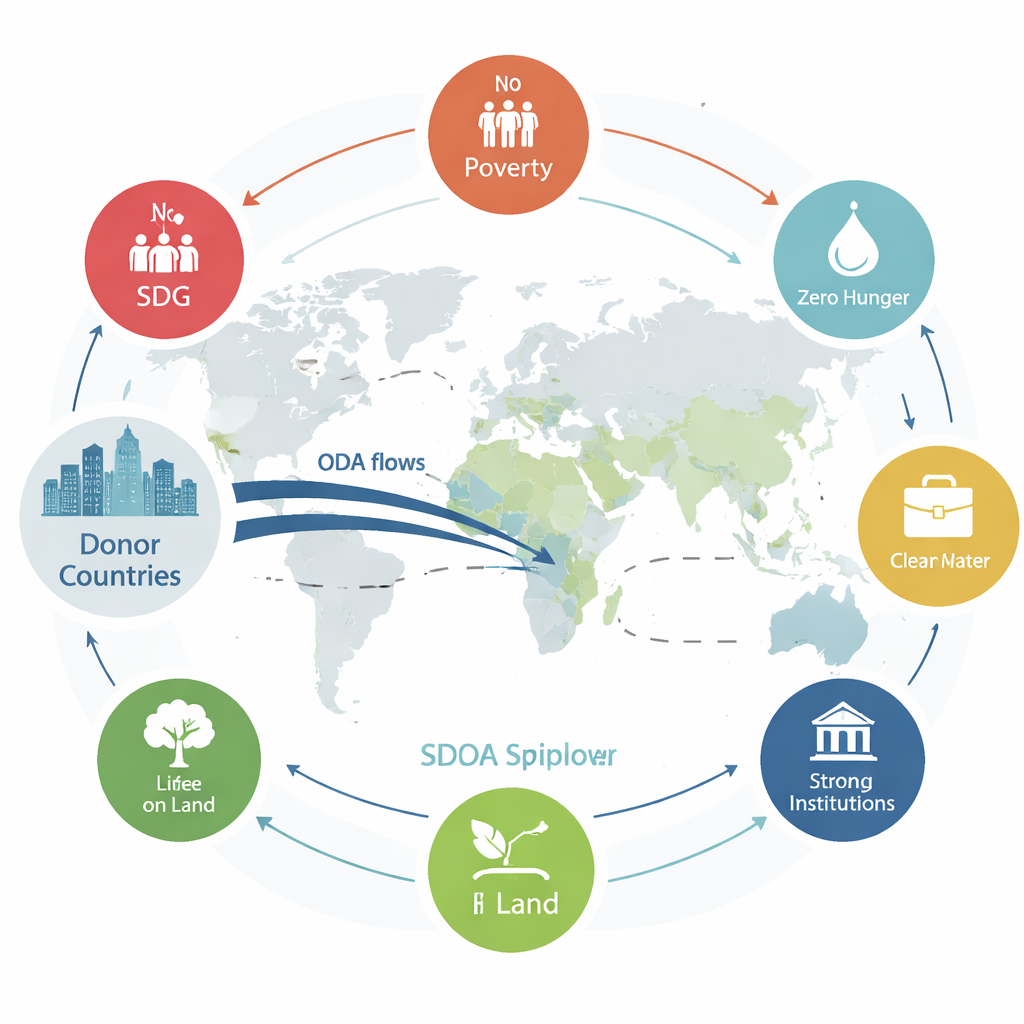
The authors start from a simple idea: no country develops in isolation. Pollution crosses borders, trade links economies, and conflicts spill into neighboring states. To capture this, the researchers use a statistical tool called Moran’s I to measure whether countries that share borders tend to score similarly on SDGs. They find strong clustering: countries with high SDG scores are mostly in Europe and the Americas, while many with low scores are in sub-Saharan Africa. In particular, goals like no poverty, good health, clean water, and reduced inequality show especially strong “neighborhood effects”—countries next to each other tend to rise or fall together.
Tracking Aid Flows and Development Scores
Next, the study links these patterns to foreign aid. Using data from the Sustainable Development Report 2022, the authors track one overall SDG index and 17 goal-specific indices for 163 countries from 2000 to 2021. They combine these scores with detailed information on how much net ODA each country receives, along with factors such as population size, income per person, oil production, political alignment at the United Nations, and levels of corruption. To avoid misleading results, they also correct for two issues: that neighboring countries influence one another, and that richer or poorer performance on the SDGs might itself change how much aid a country gets in later years.
Where Aid Works—and Where It Does Not
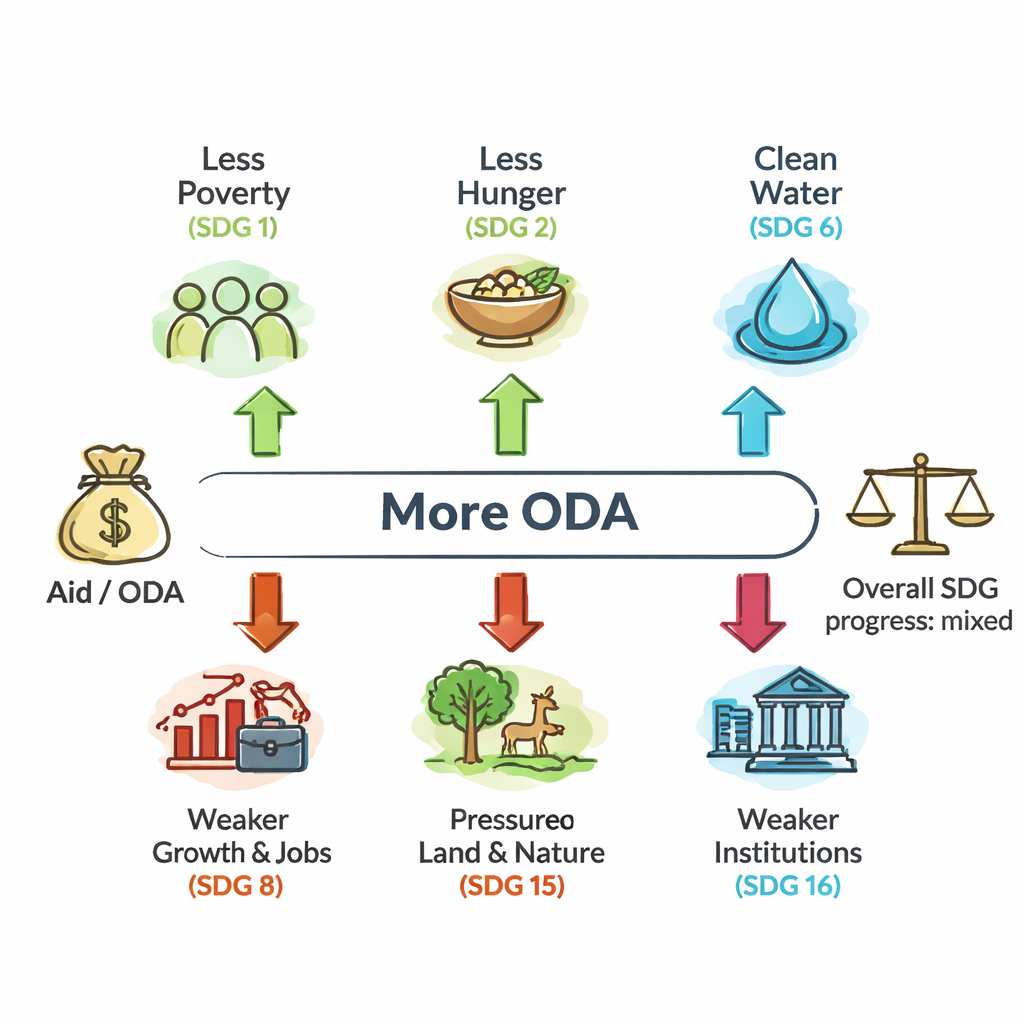
The results paint a mixed picture. On the positive side, higher aid is clearly associated with better performance on SDG 1 (no poverty), SDG 2 (zero hunger), and SDG 6 (clean water and sanitation). This fits with decades of aid projects focused on food security, basic infrastructure, and safety nets. However, when the researchers look at the overall SDG index, the relationship with ODA turns negative. Aid is also linked to worse outcomes on SDG 8 (decent work and economic growth), SDG 9 (industry, innovation, and infrastructure), SDG 15 (life on land), and SDG 16 (peace, justice, and strong institutions). Prior economic research offers reasons: large aid inflows can push up a country’s exchange rate, hurting local industries; they can also weaken accountability, fuel corruption, or encourage short-term exploitation of land and forests.
Different Countries, Different Outcomes
The study goes further by asking whether aid works differently depending on where and to whom it goes. It finds that low-income countries tend to benefit more from aid in terms of poverty reduction, but they may be hit harder by negative effects on industry and institutions. Landlocked developing countries often see stronger gains against hunger, while results differ across regions and cultural groups. For example, English-speaking countries appear to get somewhat better overall SDG outcomes from aid, possibly because shared language eases communication with donors. Former colonies show stronger aid links to improvements in hunger, health, water, and energy, but continued weaknesses in industrial development. These patterns suggest that history, geography, and culture shape how effectively aid can be turned into lasting progress.
Rethinking How We Use Aid
In the end, the authors conclude that foreign aid is far from useless—but it is far from a magic bullet. It reliably helps with life’s most fundamental needs: escaping extreme poverty, securing food, and gaining access to clean water. Yet it does not automatically strengthen economies, institutions, or ecosystems, and in some cases can even undercut these aims. For a layperson, the message is clear: if the world wants aid to truly support sustainable development, donors and recipients must broaden its focus beyond basic relief, tailor strategies to each country’s situation, and pay close attention to cross-border ripple effects. Only then can aid move from easing today’s hardships to building tomorrow’s resilient and fair societies.
Citation: Liu, S., Ölkers, T., Mußhoff, O. et al. A spatial perspective on the impact of official development assistance on sustainable development goals. Sci Rep 16, 5270 (2026). https://doi.org/10.1038/s41598-026-35544-z
Keywords: foreign aid, sustainable development goals, official development assistance, global inequality, international cooperation