Clear Sky Science · en
Experimental study on grouting diffusion mechanism of fractured rock
Keeping Underground Caverns Safe
Deep underground spaces—like those that house pumps in coal mines—must stand up to intense pressure from the rock around them. If the rock starts to crack and move, walls can bulge by tens of centimeters, threatening equipment, workers, and the entire project. This study looks at how to better "glue" broken rock back together using cement-based grout, so that long underground chambers remain stable and safe over many years.
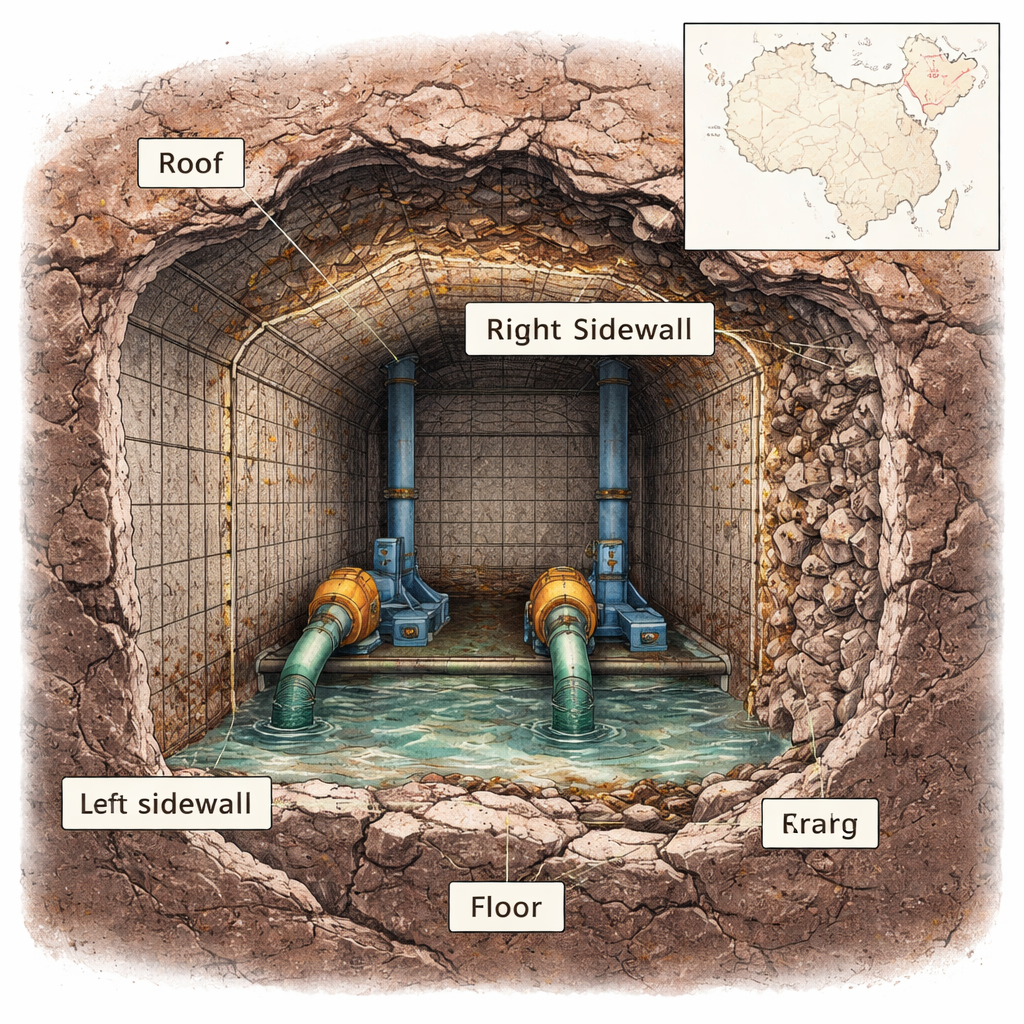
A Pump Room Under Extreme Stress
The researchers focused on a large pump chamber in China’s Wanfu Coal Mine, more than 800 meters below ground. Despite a heavy support system of steel bolts, cables, and concrete lining, the chamber’s walls and roof continued to deform. Over 450 days of monitoring, the right wall moved inward by as much as 751 millimeters—almost the width of a household door—and the floor heaved by more than 30 centimeters. Boreholes drilled into the surrounding rock showed a heavily cracked “severely damaged” zone extending up to 7 meters deep, a middle transitional zone, and then intact rock. Existing bolts and cables were anchored mainly in the broken region, so they could not develop their full strength.
How Grout Spreads Through Broken Rock
To understand how to re‑strengthen such damaged rock, the team built a large laboratory setup that could hold artificial fractured rock blocks 1.2 meters long. They pumped cement grout into these blocks and then sliced them into segments to test how strong each portion became with distance from the injection point. Two everyday‑style variables were explored: the size of the rock fragments and how watery the grout was (its water‑to‑cement ratio). In all cases, compressive strength—how much squeezing force the material can bear—dropped as the grout spread farther from where it entered.
Three Strength Zones Around a Bolt
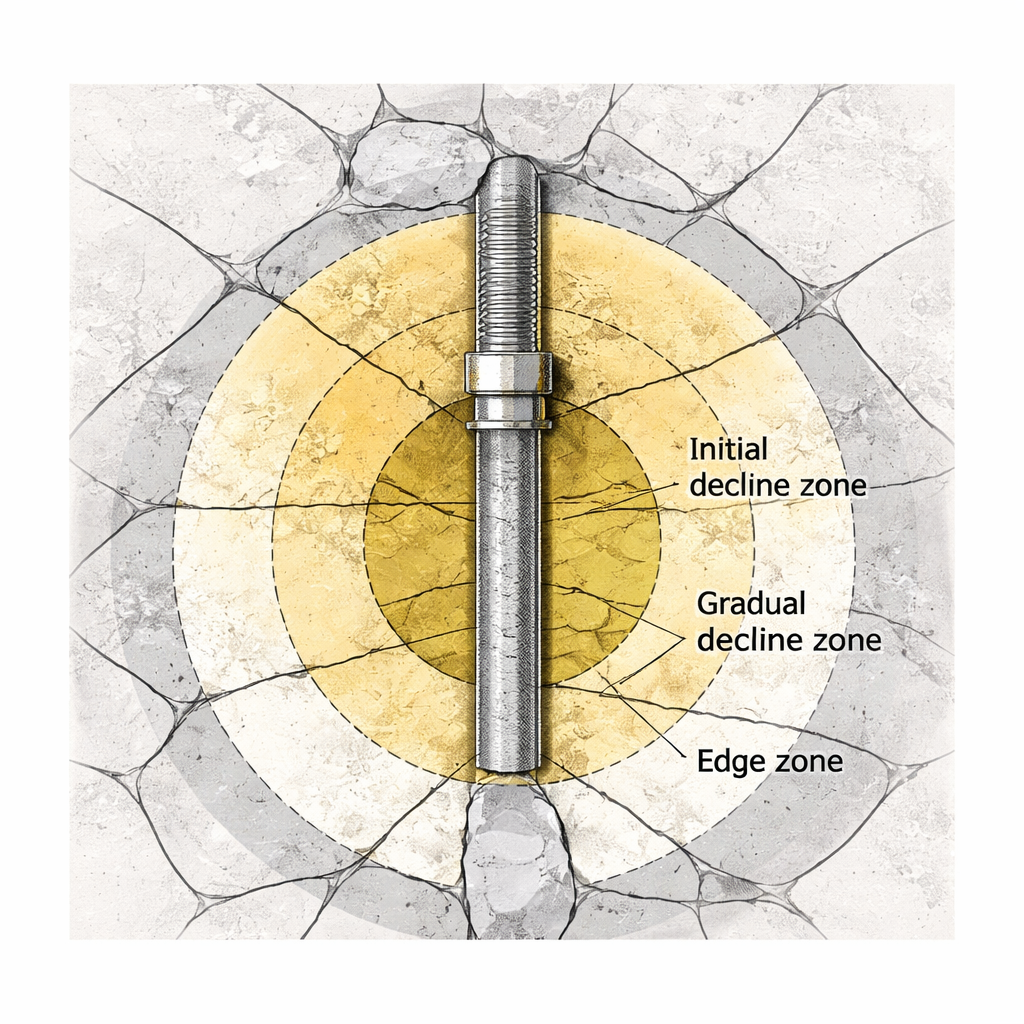
The strength tests revealed three distinct zones around the grouted area. Closest to the injection point, an “initial decline zone” up to about 400 millimeters showed high strength that fell off quickly. From roughly 400 to 1000 millimeters, a “gradual decline zone” appeared, where strength decreased more slowly. Beyond that lay an “edge zone,” where quality and strength dropped again. This pattern reflects how grout flows and settles: near the entry it is dense and well packed; farther out, it moves more slowly, separates slightly under gravity, and traps more voids, leaving weaker material at the outer edge.
Why Rock Fragment Size Matters More Than Watery Mix
Changing the size of the broken rock pieces turned out to be more important than changing how watery the grout was. Larger fragments created wider gaps that allowed grout to travel farther, extending the effective diffusion distance from 800 millimeters with small pieces to 1000 millimeters with the largest. However, very large fragments also introduced more weak interfaces where cracks could form. Adjusting the water‑cement ratio had a more modest effect on how far grout could reach—the diffusion distance stayed close to 1 meter—but it strongly influenced overall strength and consistency. A medium mix (water‑cement ratio of 0.5) produced a good balance: strong, relatively uniform material without too many air voids.
From Lab Tests to Real Mine Safety
Using these insights, the engineers redesigned the pump chamber support. They added grouted bolts in a staggered pattern and ensured that bolt and cable lengths extended at least 1 meter beyond the severely damaged zone into solid rock. They also adopted the recommended water‑cement ratio of 0.5 for field grouting. After six months of new monitoring, movements of the right wall dropped from over 750 millimeters to just under 40 millimeters—a reduction of about 95 percent. In plain terms, carefully planned grouting turned a badly deforming underground room into a stable space, showing how understanding grout spread and rock breakage can directly translate into safer, more reliable underground engineering.
Citation: Zhang, C., Li, D., Zhang, X. et al. Experimental study on grouting diffusion mechanism of fractured rock. Sci Rep 16, 5226 (2026). https://doi.org/10.1038/s41598-026-35539-w
Keywords: underground rock support, grouting, fractured rock, coal mine engineering, rock stability