Clear Sky Science · en
Meltwater and cold pump effects override climate control of grain size in polythermal glacier ice
Why Glacier Grains Matter to Us
Glaciers are often treated as frozen history books: by drilling ice cores and measuring the size of tiny ice crystals, scientists hope to reconstruct past temperatures and storms. This study on a high mountain glacier in western China asks a simple but crucial question: can we really trust the size of ice grains in such glaciers to tell us about ancient climate? The answer turns out to be more complicated than many had assumed—and it may force a rethink of how we read these icy archives. 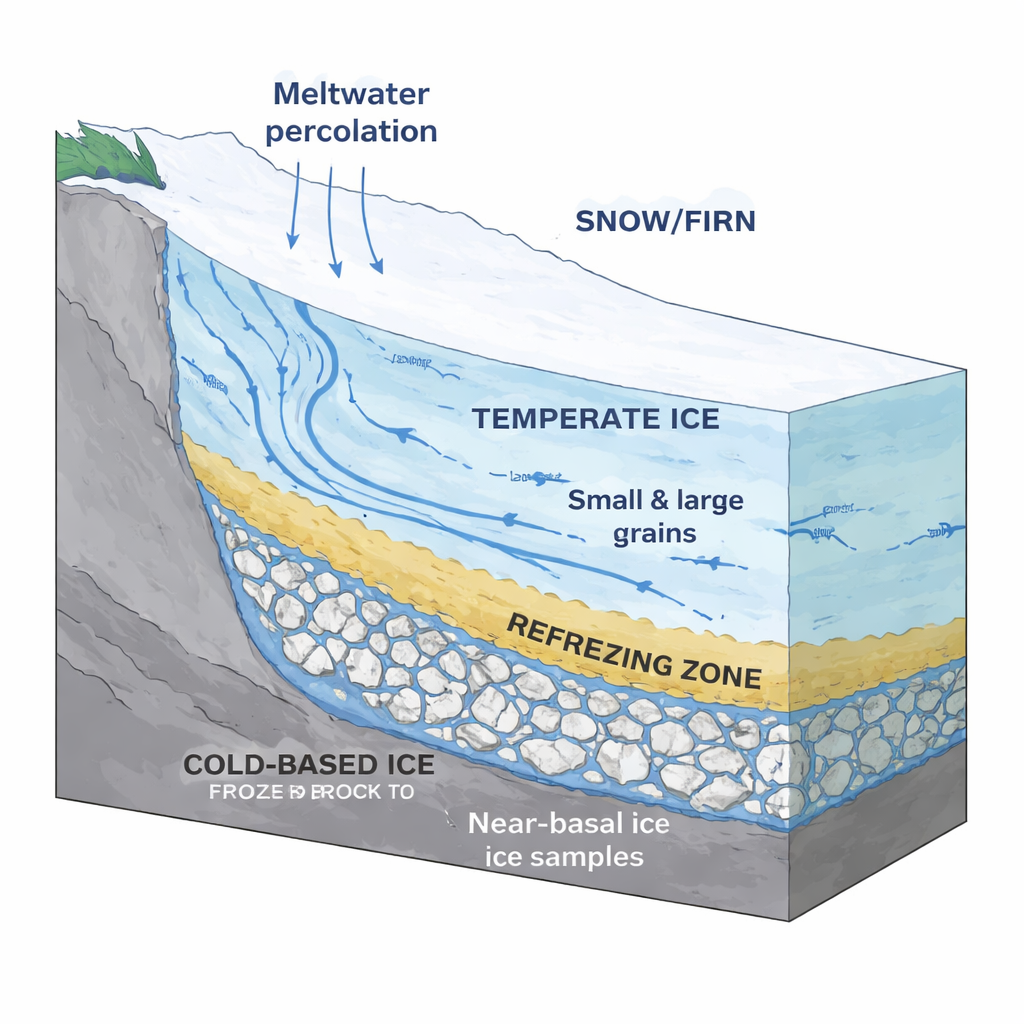
A Mountain Glacier with a Split Personality
The research focuses on the Miaoergou Glacier in the eastern Tien Shan range on the edge of the Gobi and Taklimakan deserts. Unlike the thick, deep-freeze ice sheets of Greenland or Antarctica, this is a polythermal glacier: some parts are at the melting point and contain liquid water, while deeper layers remain well below freezing and are stuck to the bedrock. The team drilled a 58.7-meter ice core down to the rock and selected twelve samples, mainly from the lower, near-basal section where the ice has been deformed and strained for a long time. They then prepared ultra-thin slices of ice and examined them under specialized microscopes to measure grain size, grain shape, and the directions in which the crystals point. These microstructural clues reveal how the ice has grown and changed over time, and whether that growth reflects climate conditions or something else.
When Meltwater Rewrites the Record
In polar ice sheets, grain size usually increases smoothly with depth and age, and smaller grains often line up with colder periods in Earth’s past. That pattern underpins the idea that grain size is a useful climate proxy. In Miaoergou’s deep ice, the story is different. The scientists found a very wide spread of grain sizes at the same depths, including unusually large grains alongside much smaller ones. Careful analysis linked the large grains to repeated episodes where surface meltwater trickled down through channels in the snow and firn, then refroze deeper inside the glacier. This process—called percolation and refreezing of meltwater—injects heat and water into the ice, allowing some grains to grow rapidly at the expense of their neighbors. The team also observed remnants of older, unmelted ice crystals and evidence that grains had been broken up and rotated before merging again, a process known as rotation recrystallization. Together, these melt-driven and mechanical effects scramble any simple relationship between grain size and the climate at the time the snow first fell. 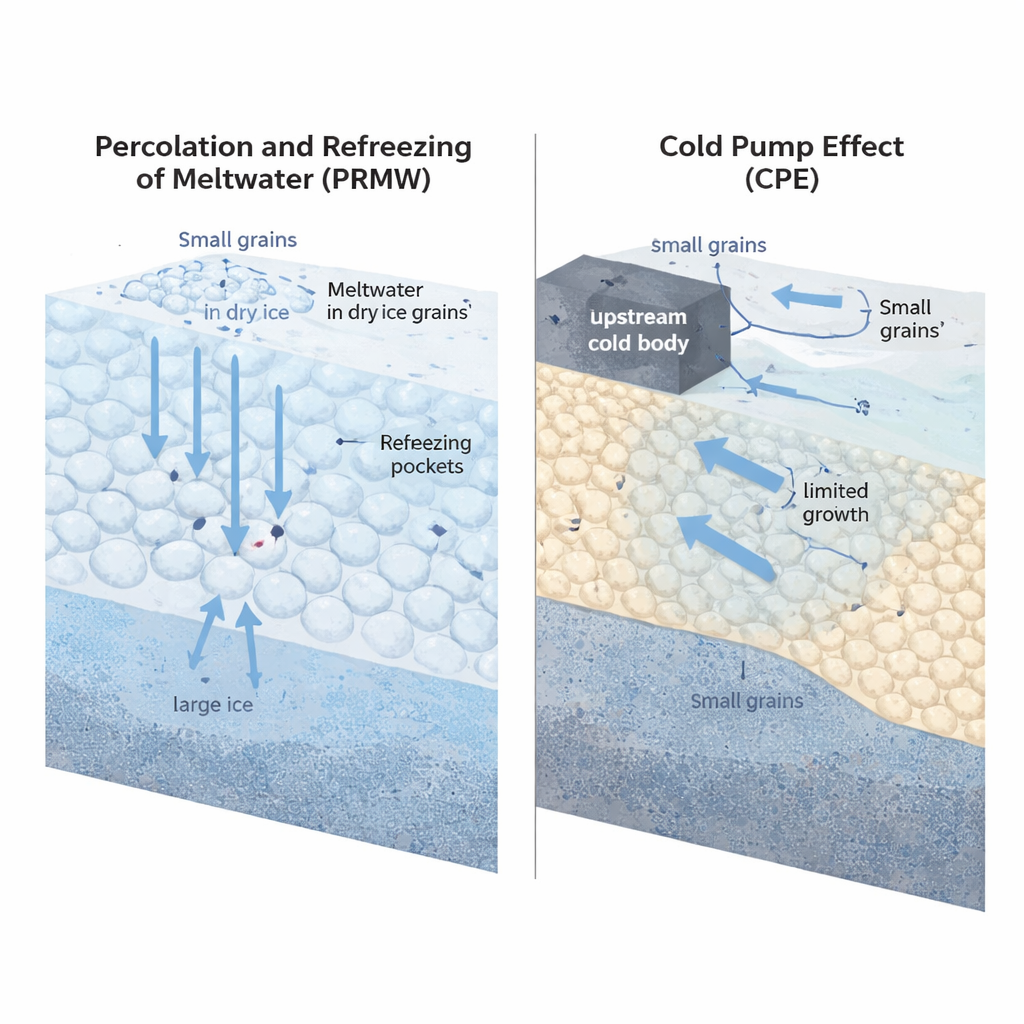
The Hidden Cold Pump in the Bedrock
Another surprise came from temperature measurements down the borehole. In many glaciers, ice warms with depth because of Earth’s internal heat and the slow deformation of ice. At Miaoergou, temperatures instead drop from about −7 °C at 30 meters to around −8.3 °C near the bottom, and the glacier remains frozen to its rocky bed. To explain this unusual pattern, the authors propose what they call a “cold pump effect.” In this picture, an upstream zone of higher, colder bedrock acts like a long-lived refrigerator. Because the surrounding rocks conduct heat well, warmth from a slightly warmer downstream area is steadily drawn toward this cold source. Heat flows through both the ice and the rock, subtly cooling the deep glacier and limiting how quickly grains can grow. Simple heat-flow calculations suggest this cold pump could remove enough energy—on the order of kilowatts—to offset some of the usual warming from below. This means that local geology and topography, not just air temperature, help set the thermal conditions that control grain growth.
Why Grain Size Fails as a Simple Climate Gauge
To test whether grain size still carries a climate signal, the researchers compared their measurements with several indicators: dust levels in the same core, temperature gradients in the ice, and oxygen isotope records from nearby Tibetan Plateau ice cores that track broader Northern Hemisphere climate swings. They found no consistent link between grain size and these climate markers. Dust peaks, which usually mark drier, windier, often colder periods, did not line up with changes in grain size, and the local oxygen isotope record was itself distorted by melt. Statistical tests showed that almost all relationships between grain size and climate-related variables were weak or highly uncertain. The one strong correlation, between grain size and temperature gradient in the ice, was based on very few data points and must be treated as preliminary. Overall, the evidence points to a microstructural history dominated by meltwater rearranging grains and by the cold pump setting the thermal backdrop, rather than by direct, undisturbed recording of past air temperatures.
Rethinking the Messages Locked in Ice
For lay readers, the core message is that not all glacier ice tells its climate story in the same straightforward way. In polythermal mountain glaciers like Miaoergou, the size of ice grains is heavily overprinted by meltwater flowing, refreezing, and reshaping the ice, and by hidden heat flows through the surrounding rock. As a result, grain size here cannot be treated as a simple thermometer of past climate. Instead, these glaciers archive a more complex tale of water movement, local geology, and temperature gradients. Future work may find new, more reliable microstructural indicators—such as the shape of grains rather than their size alone—but for now, this study warns that reading climate history from mountain glacier grain sizes requires great caution.
Citation: Li, Y., Fu, C. Meltwater and cold pump effects override climate control of grain size in polythermal glacier ice. Sci Rep 16, 5692 (2026). https://doi.org/10.1038/s41598-026-35538-x
Keywords: glacier microstructure, ice cores, meltwater refreezing, cold pump effect, paleoclimate proxies