Clear Sky Science · en
Nonlinear effects of the built environment on urban vitality in Jinan based on multi-source data and explainable AI
Why the Life of a City Matters
Why do some neighborhoods feel lively and inviting while others seem empty, even at rush hour? This study looks at “urban vitality” in Jinan, a major city in eastern China, to understand what really makes city streets hum with activity. By blending big data – from mobile phone heat maps to street photos – with an explainable form of artificial intelligence, the researchers reveal how shops, homes, transit, parks and the feel of the streets work together in non‑obvious, often nonlinear ways to shape the everyday pulse of city life.
Seeing City Life from Many Angles
To capture how alive different parts of Jinan are, the team built a composite vitality index that combines three kinds of activity: social (where people gather and move), economic (where businesses and jobs cluster), and cultural (where museums, libraries and theaters are located). They drew on mobile population heat maps, nighttime light from satellites, and tens of thousands of points of interest such as shops, offices and cultural venues. A special weighting method called CRITIC helped assign importance to each piece of data based on how much it varied and how strongly it conflicted or agreed with the others, avoiding the usual shortcut of simply treating all factors as equally important. The result is a richer, three‑dimensional picture of how people live, work and play across the city.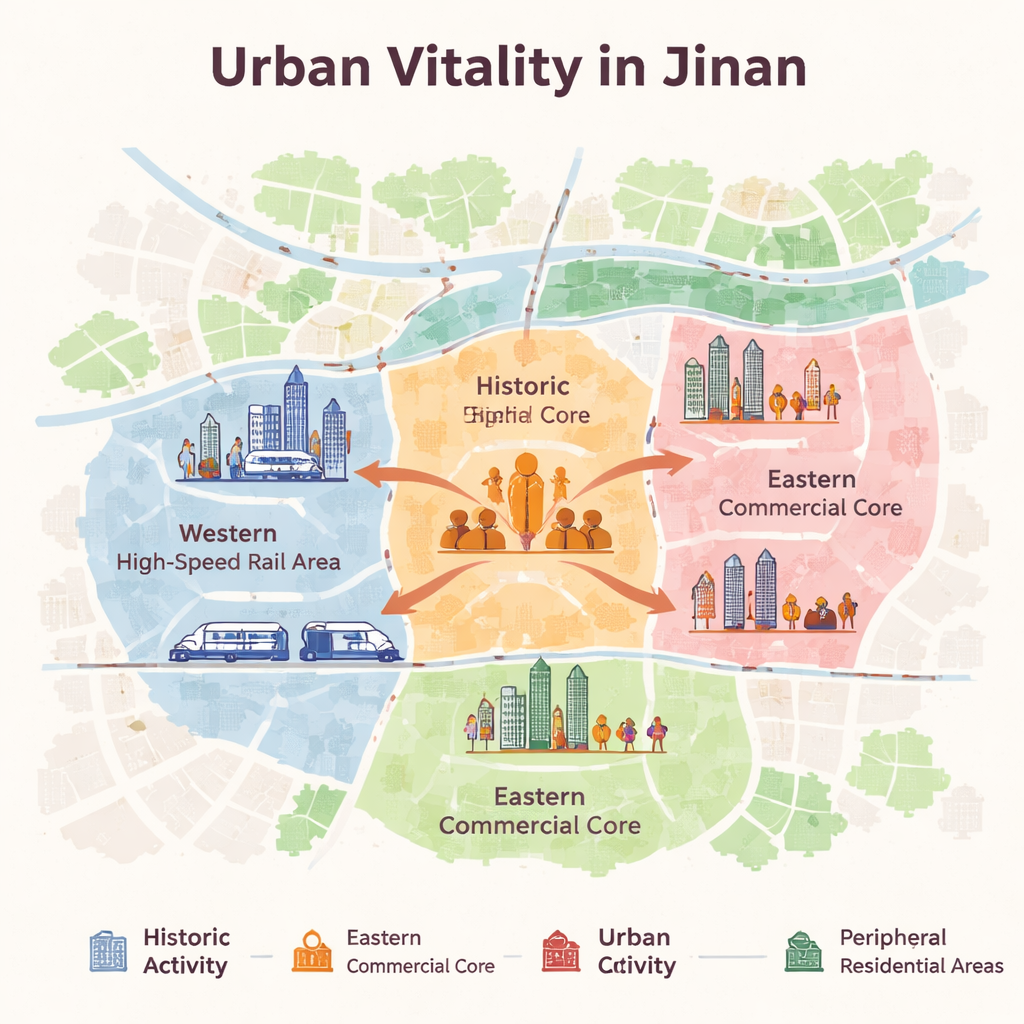
A City of Strong Cores and Quiet Edges
The maps show a clear pattern: Jinan’s historic center around Quancheng Road, Baotu Spring and Daming Lake, together with the newer eastern business district, form a powerful twin core of activity. Social life, shopping and jobs all cluster there and spread eastward along a main corridor, while much of the north and west behave like “dormitory towns” with housing but few services or attractions. Cultural life is somewhat more balanced, with multiple smaller hubs around historic areas and universities, but cultural venues are still sparse on the edges. Overall, comprehensive vitality is much higher in the east and south than in the west and north, reflecting an uneven development pattern of “strong east, weak west.”
What Matters More: Features or Feelings?
The study then asks which features of the built environment actually drive this vitality. The researchers divided influences into “objective” factors that describe what is physically present – such as how many and what mix of facilities exist, how dense they are, and how well streets connect – and “subjective” factors that describe what streets feel like at eye level, such as greenery, openness of the sky, and ease of walking, extracted from thousands of street‑view images using computer vision. An explainable AI model (XGBoost with SHAP analysis) showed that objective factors dominate: the mix of different types of places, their overall density, and how well the street network is integrated together explain more than 60 percent of the differences in vitality. By contrast, perception‑based measures like visible greenery or walkability played only a minor role in Jinan’s current stage of development.
Hidden Thresholds and Sweet Spots
Crucially, these drivers do not work in straight lines. The model revealed clear thresholds and “sweet spots.” When the mix of different place types (shops, services, culture, etc.) is too low, it actually suppresses vitality; only once a certain level of mixing is reached does vitality rise sharply. Adding more facilities per square kilometer boosts activity up to roughly a moderate level, after which the benefit tapers off. Street connectivity is most helpful within a middle range, beyond which congestion can erode gains. Even openness – how much sky you see – follows an inverted U‑shape: some openness makes a street feel welcoming, but very open spaces, like vast plazas, can feel empty and deter everyday use. These patterns highlight that more is not always better; balance matters.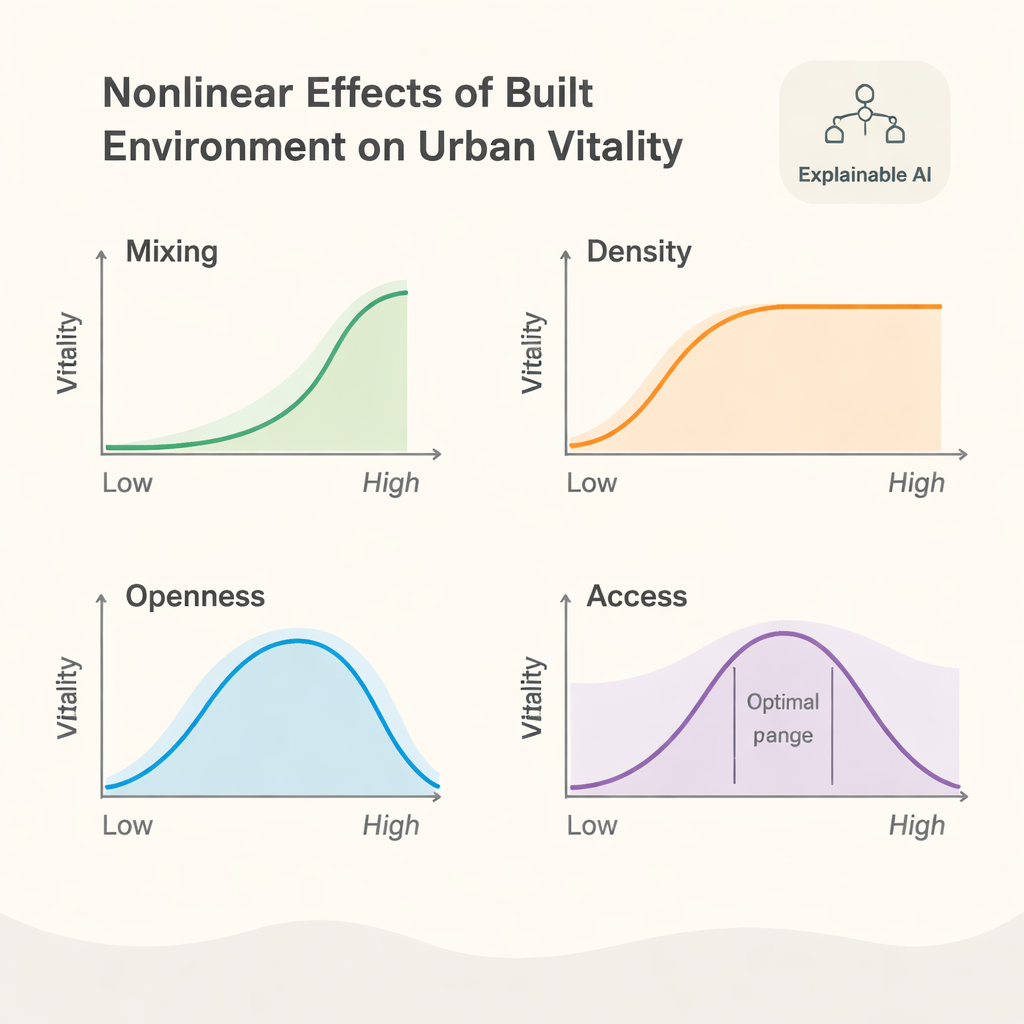
Guiding Smarter, Fairer Growth
By tying specific numbers to these thresholds, the study turns broad planning ideas into concrete guidance. For historic districts with pleasant streets but fewer services, the message is to carefully add mixed cultural and commercial uses without destroying their intimate scale. For dense modern business areas, the priority is to enrich the mix of functions and fine‑tune openness and street connection rather than simply building more towers. For quiet peripheral neighborhoods, the clearest need is basic functional supply – more everyday facilities and better public transport – before subtle design tweaks will have much effect. For a lay reader, the takeaway is simple: a lively city depends less on any single feature and more on getting the right combination and balance of places, connections and spaces at the right intensity, neighborhood by neighborhood.
Citation: Yu, M., Ji, Q., Zheng, X. et al. Nonlinear effects of the built environment on urban vitality in Jinan based on multi-source data and explainable AI. Sci Rep 16, 4923 (2026). https://doi.org/10.1038/s41598-026-35537-y
Keywords: urban vitality, built environment, city planning, explainable AI, mixed land use