Clear Sky Science · en
A lightweight residual dilated temporal transformer block for ECG classification on edge devices
Heart Health on Your Wrist
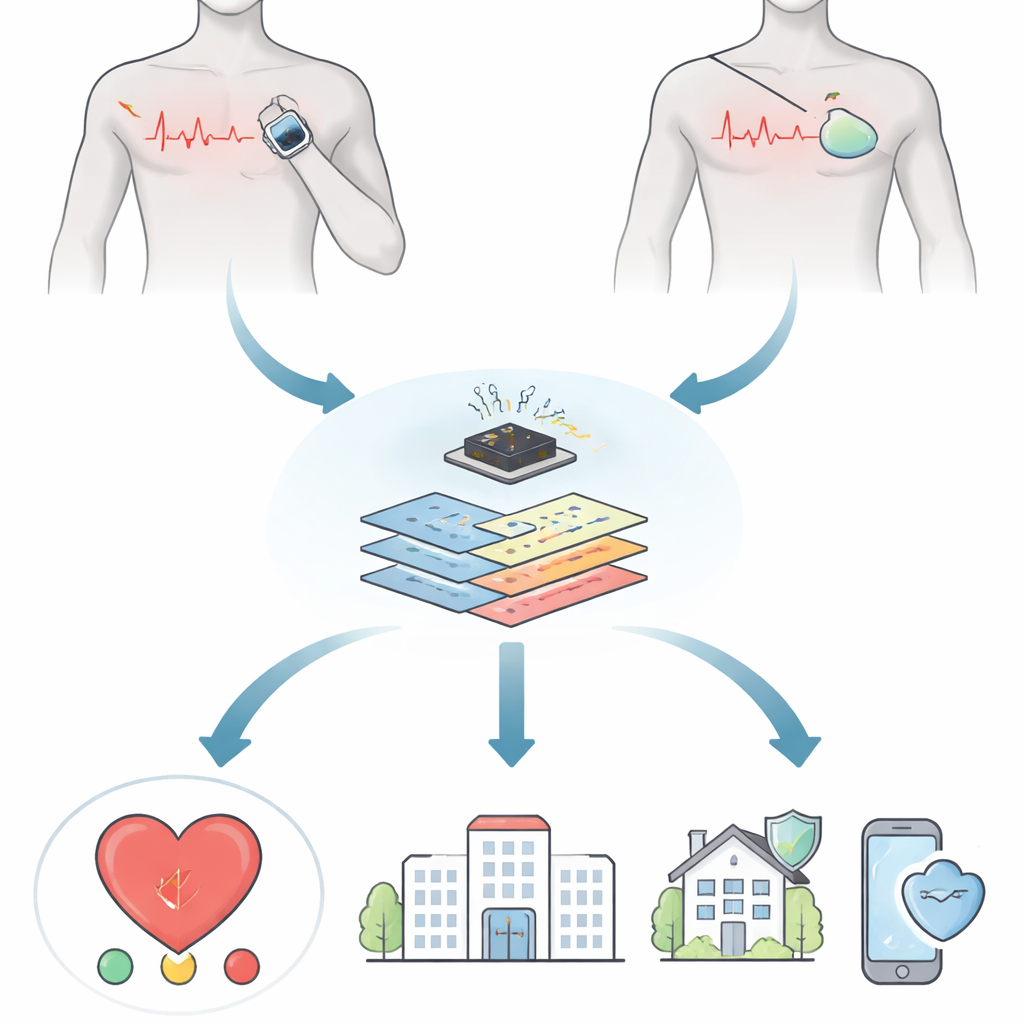
Heart disease is the world’s leading killer, yet many dangerous rhythm problems come and go in brief bursts that are easy to miss during a short clinic visit. This paper describes a new way to turn everyday wearables—like smartwatches and small chest patches—into powerful early-warning tools. The authors design a compact artificial-intelligence model that can spot three key heart states directly on the device itself, without sending raw medical data to the cloud, making continuous monitoring faster, more private, and less power-hungry.
Why Catching Hidden Heart Rhythms Matters
Cardiologists rely on the electrocardiogram (ECG), a trace of the heart’s electrical activity, to detect rhythm problems called arrhythmias and conditions such as congestive heart failure. But these events can be fleeting. A person may feel fine in the doctor’s office, only to experience a dangerous rhythm later at home or during sleep. Long-term monitoring with wearable sensors generates huge streams of data that are difficult for doctors to review by hand. Automatic classification of ECG signals is therefore essential: computers must reliably tell apart a normal heartbeat, an arrhythmia, and patterns linked to heart failure in real time, all while running on tiny battery-powered devices.
Bringing Smart Analysis to the Edge
Today, many AI systems for medical signals run in distant data centers, meaning that raw ECG data must be sent over the internet, raising concerns about delay, cost, and privacy. The authors instead focus on “edge” intelligence: analysis that happens locally on the wearable or a nearby gadget. Edge devices, however, have limited memory, processing power, and battery life. The central challenge is to build a model that is small and efficient enough to run on hardware like a Raspberry Pi or compact health monitor, yet accurate enough to be trusted with medical decisions. This work directly tackles that trade-off, aiming for hospital-grade performance in a footprint suitable for everyday consumer devices.
How the New Model Reads the Heartbeat
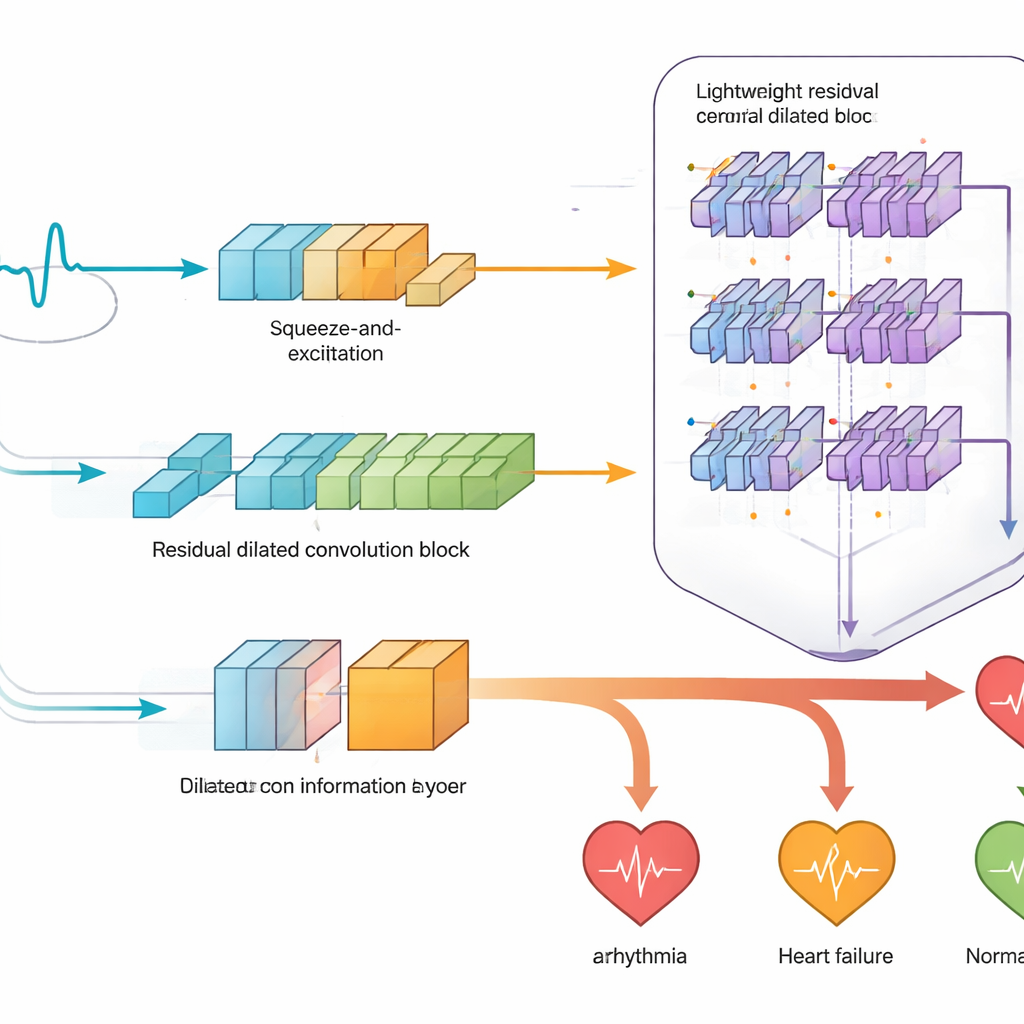
The team combines two powerful ideas from modern AI—convolutional neural networks and transformer networks—into a single streamlined design tailored for one-dimensional ECG signals. First, the model looks at short stretches of the waveform to capture the shapes of familiar features such as the sharp spikes and gentle bumps that represent each heartbeat. Special "dilated" filters let it see farther in time without adding much extra cost, so it can relate beats across longer intervals. A built-in attention mechanism then helps the model focus on the most informative parts of the signal, similar to how a clinician’s eye is drawn to suspicious sections of a trace. This sequence of steps allows the system to understand both the fine details of each beat and the broader rhythm over several seconds.
Making the Most of Limited Data
The authors train their model on a combined dataset drawn from well-known public ECG collections, covering arrhythmia, congestive heart failure, and normal sinus rhythm. Because these categories are unevenly represented—there are more examples of some rhythms than others—they use data-balancing techniques that create realistic synthetic samples and add slight variations and noise. This teaches the system to cope with messy, real-world measurements from wearable sensors and prevents it from becoming biased toward the most common patterns. The training and tuning process is carefully controlled so that the final model remains small: about 692,000 parameters, occupying roughly 2.6 megabytes and requiring only a fraction of a billion basic operations per prediction.
How Well It Performs and Why It Matters
Despite its modest size, the model achieves striking accuracy: it correctly classifies test signals more than 99 percent of the time and shows excellent separation between the three heart conditions according to multiple statistical measures. In practice, this means that a lightweight sensor could reliably flag suspicious rhythms, highlight possible heart failure patterns, or reassure users that their heartbeat is normal—all without streaming sensitive ECG traces to the cloud. For patients and clinicians, such on-device intelligence could enable earlier diagnosis, round-the-clock monitoring, and more personalized care, while preserving privacy and extending battery life. The study illustrates how carefully engineered AI can bring sophisticated cardiac analysis out of the hospital and into everyday life.
Citation: Gracy, G.A., Pravin, S.C. A lightweight residual dilated temporal transformer block for ECG classification on edge devices. Sci Rep 16, 8834 (2026). https://doi.org/10.1038/s41598-026-35531-4
Keywords: ECG monitoring, arrhythmia detection, wearable health devices, edge AI, cardiac deep learning