Clear Sky Science · en
Singularity in nonlinear systems: differential inclusion model for the standard and transformed fractional pantograph equation
Why singular delays and memory matter
Many real-world systems—from electric trains drawing power from overhead wires to signals traveling through complex networks—do not react instantly or smoothly. Their behavior depends on what happened in the past (memory), on scaled versions of time (multi‑scale effects), and sometimes they even blow up or become undefined at special points (singularities). On top of that, engineers and scientists rarely know all parameters exactly. This article presents a new mathematical framework that can handle all of these features at once, offering safer, more realistic models for such complicated systems.
Equations that stretch and remember time
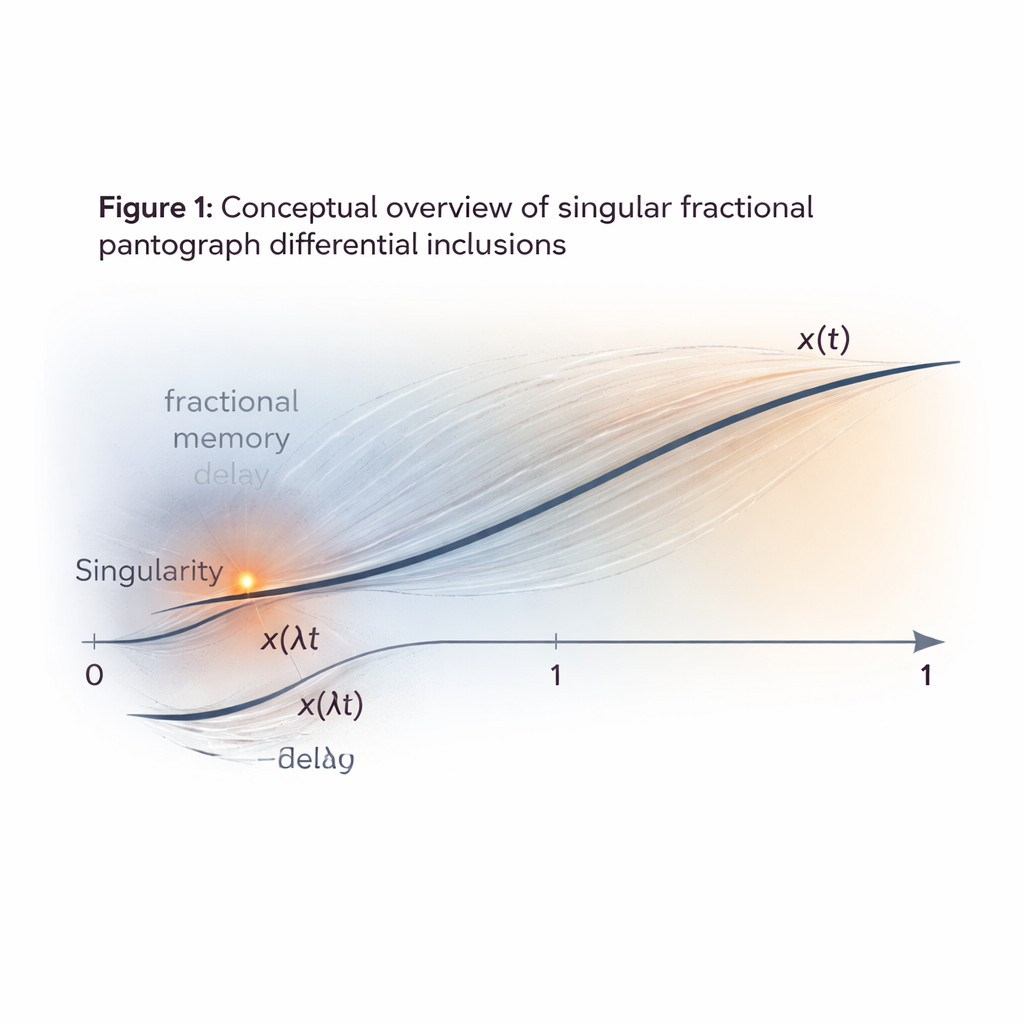
At the heart of the work are pantograph equations, a special type of delay equation where the present rate of change depends on the state at a scaled time, such as x(λt) with 0 < λ < 1. This mirrors the way an overhead pantograph on an electric train samples current along the wire and naturally encodes shrinking or expanding time scales. The authors move beyond classical versions by using fractional derivatives, which treat time as having memory rather than being purely instantaneous. In these models, the current state depends on a weighted history of all past states, capturing long‑range effects seen in materials, biological tissues, and complex signals far better than ordinary derivatives can.
Dealing with singular behavior and uncertainty
Real systems are often ill‑behaved near boundaries or special points, for example when energy is injected suddenly at the start of a process or when data are missing near t = 0. Mathematically, this shows up as singularities—terms that become extremely large or undefined. At the same time, important parameters may not be known precisely but only within a range. To reflect this, the authors work with differential inclusions, in which the equation does not prescribe a single next step, but a whole set of possible next steps. This allows the model to encode uncertainty and non‑smooth behavior explicitly and leads naturally to families of possible evolutions instead of a single predicted trajectory.
Standard versus transformed singularities
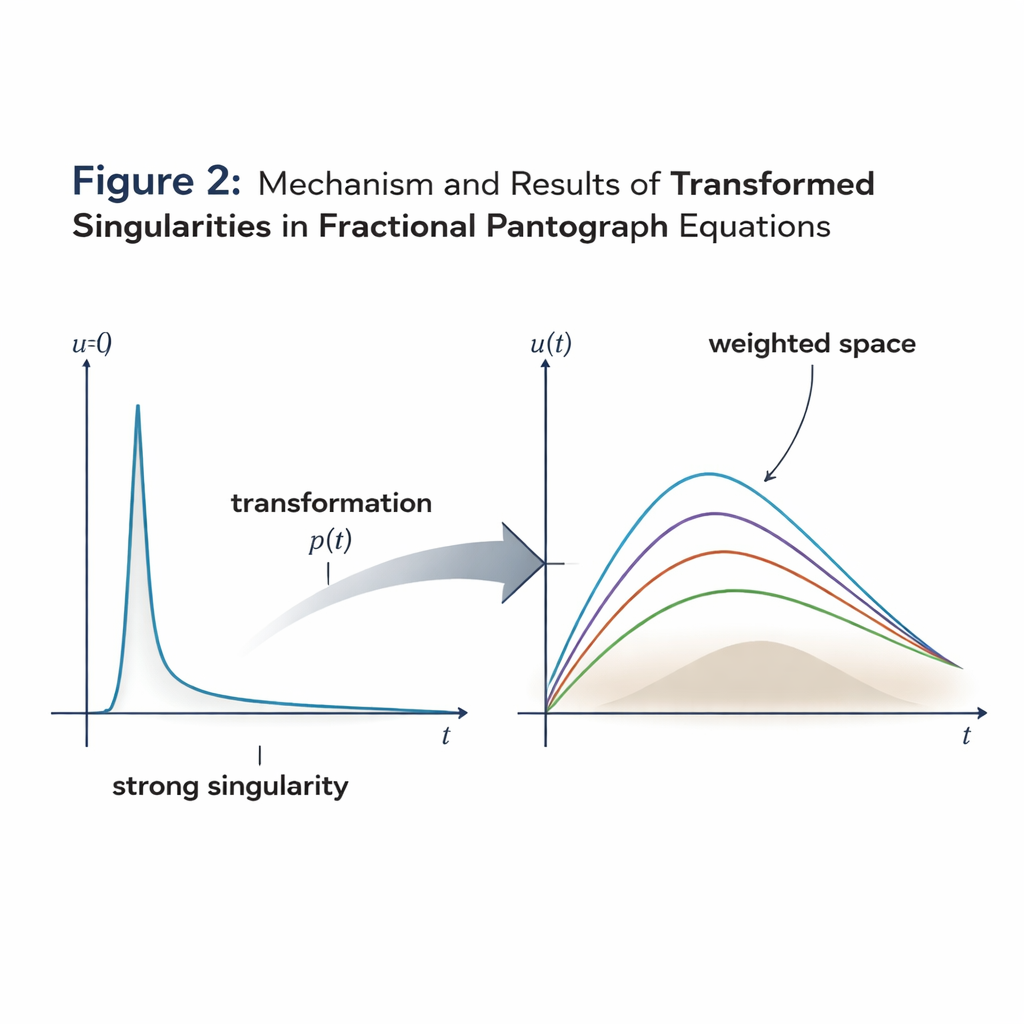
The paper develops an existence theory for two main classes of problems. In the “standard” case, the singular behavior is handled directly in the equation, and the authors prove that under fairly mild growth and continuity conditions, at least one exact solution exists that satisfies all boundary conditions. They rely on modern fixed‑point techniques tailored to set‑valued maps, using specialized versions of contraction principles and a distance that measures how far sets are from each other. In the “transformed” case, they introduce carefully chosen weight functions, denoted p(t), that absorb the strongest singular terms. By rewriting the unknown function in a weighted space defined via p(t), a problem that would otherwise be too wild becomes amenable to classical existence theorems.
What the numerical examples reveal
To show that the abstract theory is not just a formal exercise, the authors present three detailed examples. These examples feature fractional pantograph problems with singular coefficients that either blow up at the beginning of the time interval or near its end. For each case, they compute bounds that verify the assumptions of their theorems and then plot representative solutions and singular coefficients. The figures illustrate how the weighting transformation smooths out severe spikes, how the fractional “memory” terms shape the evolution, and how an entire bundle of possible solution curves can satisfy the same initial and boundary conditions when uncertainty is encoded through inclusions.
Take‑home message for complex systems
From a lay perspective, the main conclusion is that the authors have built a robust mathematical toolkit for systems that are delayed, remember their past, behave badly near certain points, and are subject to uncertainty—all at once. Their results guarantee that such systems do not collapse into contradictions: under clearly stated conditions, solutions do exist, and the transformed approach makes it possible to treat even very strong singular behaviors. This unified framework lays groundwork for future studies of stability, numerical simulation, and variable‑order memory, and it promises more realistic models in fields such as power engineering, biological growth, and multi‑scale signal processing, where clean, idealized equations are often not enough.
Citation: Mobayen, S., Ghaderi, M., Shabibi, M. et al. Singularity in nonlinear systems: differential inclusion model for the standard and transformed fractional pantograph equation. Sci Rep 16, 6482 (2026). https://doi.org/10.1038/s41598-026-35530-5
Keywords: fractional pantograph equations, differential inclusions, singular boundary value problems, delay differential equations, memory effects in dynamical systems