Clear Sky Science · en
Measuring electrooculograms of a simulated underwater diver by utilizing conductivity of seawater
Why Watching Divers’ Eyes Matters
Diving opens a hidden world, but it also exposes people to risks that can quickly turn serious. Today’s dive computers track depth and time, yet they know nothing about what the diver is actually experiencing—whether they are alert, confused, or on the edge of losing consciousness. Because blinking and eye movements reflect attention and mental strain, being able to read eye signals underwater could offer an early warning system. This study explores a surprisingly simple idea: using the natural conductivity of seawater itself to measure tiny voltages around the eye, potentially turning an ordinary diving mask into a smart safety device.
A New Way to Listen to the Body Underwater
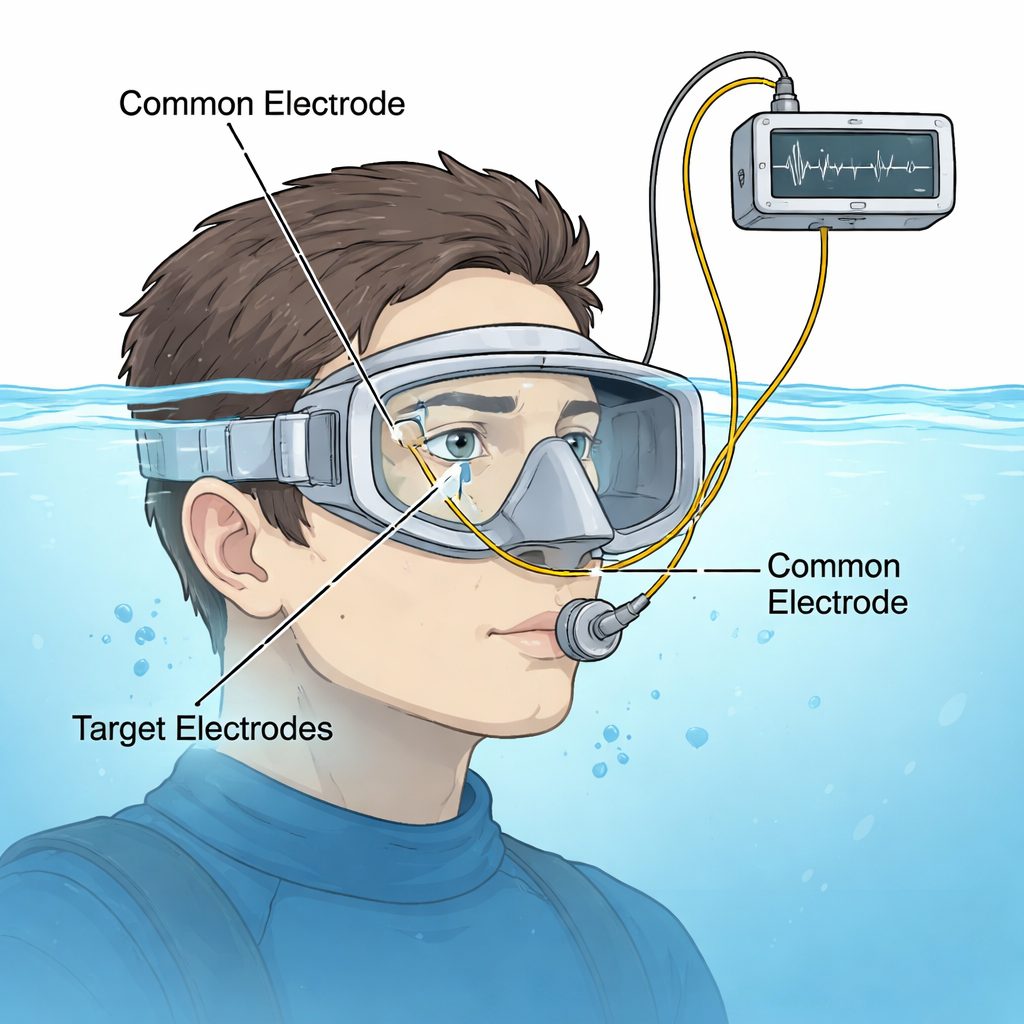
On land, eye activity is usually recorded either with cameras that track the pupil or with electrodes attached around the eye to capture electrooculograms (EOGs)—the small voltages created as the eyeball moves. Camera systems are bulky and hard to waterproof, while conventional EOG requires several electrodes fixed to the skin. The authors had previously shown that the ocean can act as a giant electrical contact: if one electrode touches the sea and another is isolated on the body, heart and muscle signals can be measured without wiring both sides of the circuit. In this work they ask whether the same seawater-based method can capture EOG signals from divers, giving information about blinks and where they are looking.
Turning a Dive Mask into a Sensor
To test this idea in the lab, eight healthy men wore a standard diving mask adapted with simple medical electrodes. Two “target” electrodes were taped to the skin near the right eye inside the air-filled space of the mask—one above the eye and one to the right. A third “common” electrode was fixed on the outside of the mask frame, directly touching salt water in a small tank. With the volunteer on all fours and their face submerged, the skin around the mask contacted the water, effectively turning the diver’s face into a large shared electrode linked through seawater. The researchers amplified the tiny voltages between each target electrode and the common electrode while the person blinked or shifted their gaze up, down, left, and right in time with a metronome and visual markers.
Reading Blinks and Eye Direction from Tiny Signals
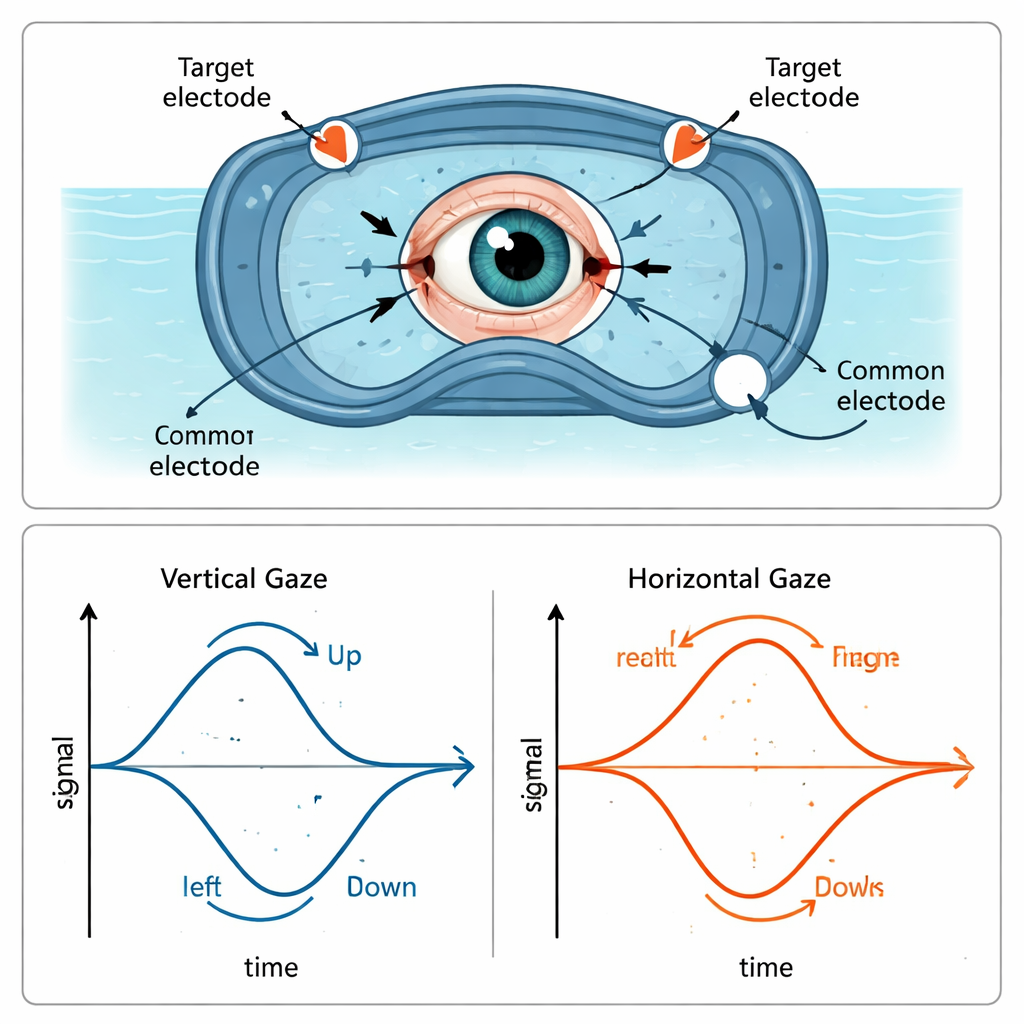
The recordings showed clear, repeatable patterns. During regular blinking, the voltage at the upper electrode produced sharp peaks several hundred millionths of a volt in size, much larger than those at the right-side electrode. This indicated that blinks are most easily detected by watching the signal above the eye. When the volunteers alternated their gaze between markers above and below the central point, the upper electrode signal swung between positive and negative levels; looking up and down produced distinct average voltages. For left–right gaze, the right-side electrode responded more strongly, with larger voltage swings when the eye moved horizontally. By combining the signals from both electrodes, the team could separate “up,” “down,” “left,” and “right” looks into distinct clusters, suggesting that both the direction and approximate angle of gaze can be inferred from this simple underwater setup.
Checking the Physics Behind the Mask
To understand why this works, the researchers built a basic electrical model of the eye and surrounding tissue. The front of the eye (cornea) behaves like a slight positive pole and the back (retina) like a negative pole, roughly like a tiny battery. As the eye rotates, the relative distances between this internal “battery” and each skin electrode change, altering the electrical resistance pathways and the measured voltages. In their model, they represented these pathways as resistors and showed mathematically that moving the gaze from down to up should produce a measurable voltage change at a single side electrode referenced to a seawater-connected common electrode. They then verified the model on land using three skin electrodes near the eye and observed voltage changes and relationships that matched their predictions, supporting the physical explanation.
What This Could Mean for Safer Diving
The study demonstrates that a diver’s blinks and eye movements can be detected underwater by using seawater itself as part of the measuring circuit. With only two small electrodes inside a mask and one outside in contact with seawater, it is possible to track when a diver blinks and where they are looking. For a non-specialist, this means that future dive masks could quietly monitor both vital signs and signs of fatigue, distraction, or stress without bulky cameras or complicated wiring. The authors plan to refine their models, improve signal-processing methods, and test new mask designs in the open ocean. Ultimately, such technology could help prevent accidents by warning dive partners or surface teams when a diver’s body—and especially their brain—is no longer coping well with the underwater world.
Citation: Saiki, T., Araki, N., Nakatani, S. et al. Measuring electrooculograms of a simulated underwater diver by utilizing conductivity of seawater. Sci Rep 16, 5706 (2026). https://doi.org/10.1038/s41598-026-35528-z
Keywords: underwater eye tracking, diver safety, electrooculography, seawater conductivity, bioelectric sensors