Clear Sky Science · en
An improved seam carving method for enhancing the visual field of tunnel vision patients
Helping People See More With Narrow Vision
For people with tunnel vision, simply walking down a busy street can be dangerous: cars, bikes, and pedestrians may lurk just outside their narrow field of view. This study explores a smart way to reshape everyday camera images so that more of the scene fits into that limited "window" without shrinking or distorting the important objects. The work could inform future visual aids, such as smart glasses or phone apps, that help users navigate more safely and confidently.
Squeezing the Scene Without Losing What Matters
Modern displays—from phone screens to head‑mounted devices—often show the world through cameras. For someone with normal sight, there is plenty of room to display a wide scene. But for a person with tunnel vision, only a narrow central region is truly visible. A simple fix is to shrink or crop the picture, yet that usually cuts off key objects or squashes faces and buildings in odd ways. The authors build on a technique called seam carving, which cleverly narrows an image by removing thin paths of “least important” pixels. Their goal is to redesign seam carving so it better serves people with severe visual field loss, keeping critical details intact while still compressing the scene into a smaller width.
Teaching the Computer What to Protect
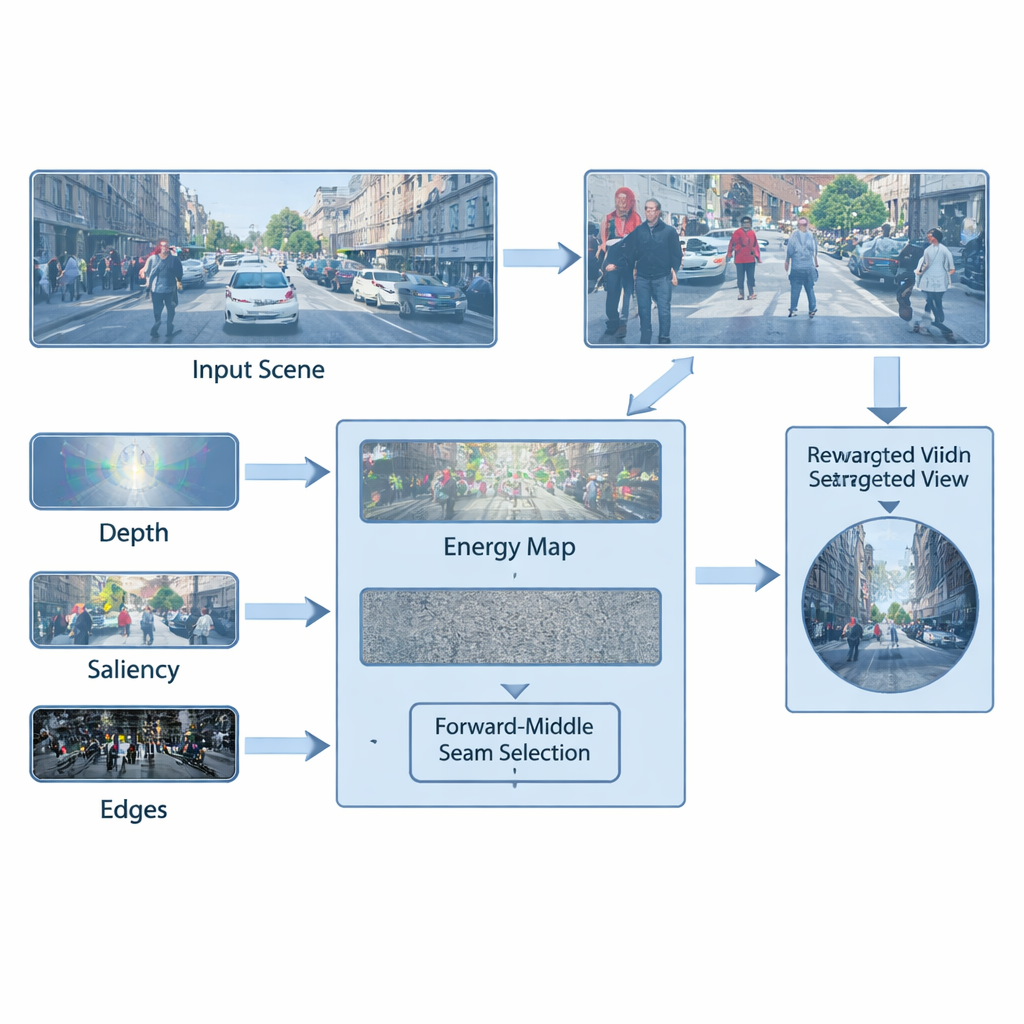
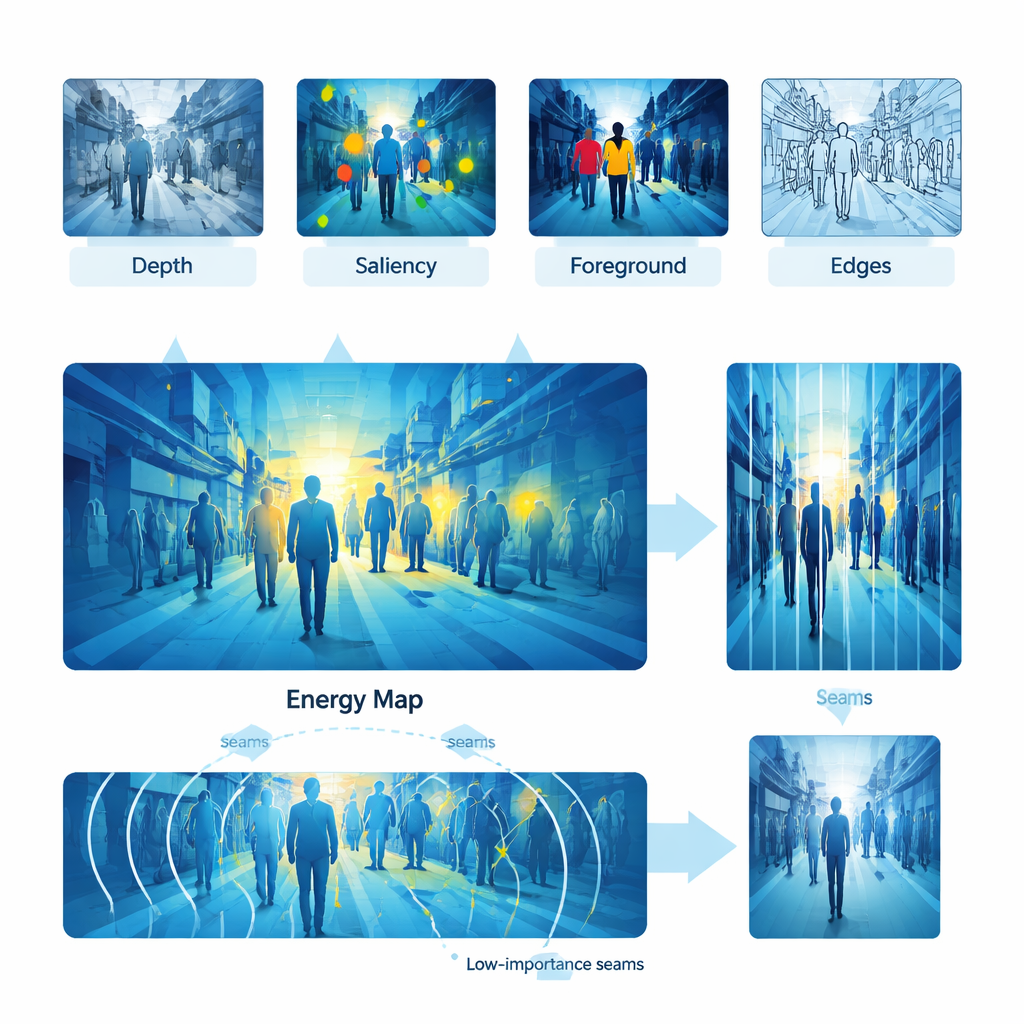
The first challenge is deciding which parts of a picture really matter. Instead of relying on a single clue, the researchers combine four different types of information for every pixel. A depth map estimates how far objects are from the viewer, so nearer obstacles can be treated as more important. A saliency map highlights regions most likely to catch human attention—such as people or bright signs. Foreground segmentation marks the main subjects in front of the background. Finally, edge detection finds the outlines and fine structures that make up the shape of objects. By fusing these four maps across several scales, the method creates a rich “energy map” that strongly marks important content and downplays unimportant regions such as empty walls or sky.
Smarter Paths for Carving the Image
Once the energy map is built, the system must decide exactly where to carve the seams—thin, connected paths of pixels to remove. Traditional seam carving looks from top to bottom, removing the paths with the lowest overall energy. This can lead to subtle but harmful distortions, such as bending building edges or breaking up objects that should stay intact. The new approach introduces a forward‑looking "forward‑middle" strategy. Instead of starting at the top, it starts from the middle of the image—where a viewer’s attention naturally tends to fall—and spreads calculations upward and downward. It also estimates how removing each potential seam will affect nearby pixels in the future, favoring choices that keep edges straight and objects continuous. The image is then narrowed pixel by pixel along these carefully chosen paths.
Putting the Method to the Test
To judge how well their system works, the authors ran it on a standard collection of photographs used to evaluate image resizing methods and compared it with six existing techniques, including classic seam carving, warping, and hybrid methods. They measured how closely the retargeted images preserved structure, recognizable features, perceived visual quality, and color distribution using seven different quality scores. Across almost all of these measures, the new method came out on top, especially in preserving structure and distinctive details that help someone recognize objects and navigate. A combined score that summarizes all metrics improved by about 30 percent over basic seam carving, and formal statistical tests confirmed that these gains are highly unlikely to be due to chance.
What This Means for Everyday Vision Aids
In plain terms, the study shows that a camera image can be squeezed sideways to fit into a tunnel‑like field of view while still keeping people, obstacles, and key landmarks clear and correctly shaped. By paying attention to depth, attention‑grabbing regions, main foreground objects, and edges—and by choosing smarter paths when trimming pixels—the method creates compact views that remain visually trustworthy. While this work focuses on still images, the same ideas could support future video‑based aids, personalized settings for different patients, and clinical tests to see whether such retargeted scenes actually help users move more safely through the world.
Citation: El-Torky, D., El-Regaily, S., Moadamani, A. et al. An improved seam carving method for enhancing the visual field of tunnel vision patients. Sci Rep 16, 4814 (2026). https://doi.org/10.1038/s41598-026-35527-0
Keywords: tunnel vision, image retargeting, seam carving, visual aids, assistive technology