Clear Sky Science · en
Hematological and clinical-chemistry parameters of kratom users: a comparative study of users and non-users in Southern Thailand
Why a Southeast Asian leaf matters to you
Kratom, a tree native to Southeast Asia, has quietly become a global herbal product, sold in head shops, online stores, and wellness circles. Supporters claim it eases pain, boosts energy, and helps people cut back on opioids, while critics warn of liver and kidney damage. This study from Southern Thailand, where kratom has been used traditionally for generations, asks a simple but important question: what does long-term kratom use actually look like in the blood and basic health tests of everyday users?
A village under the microscope
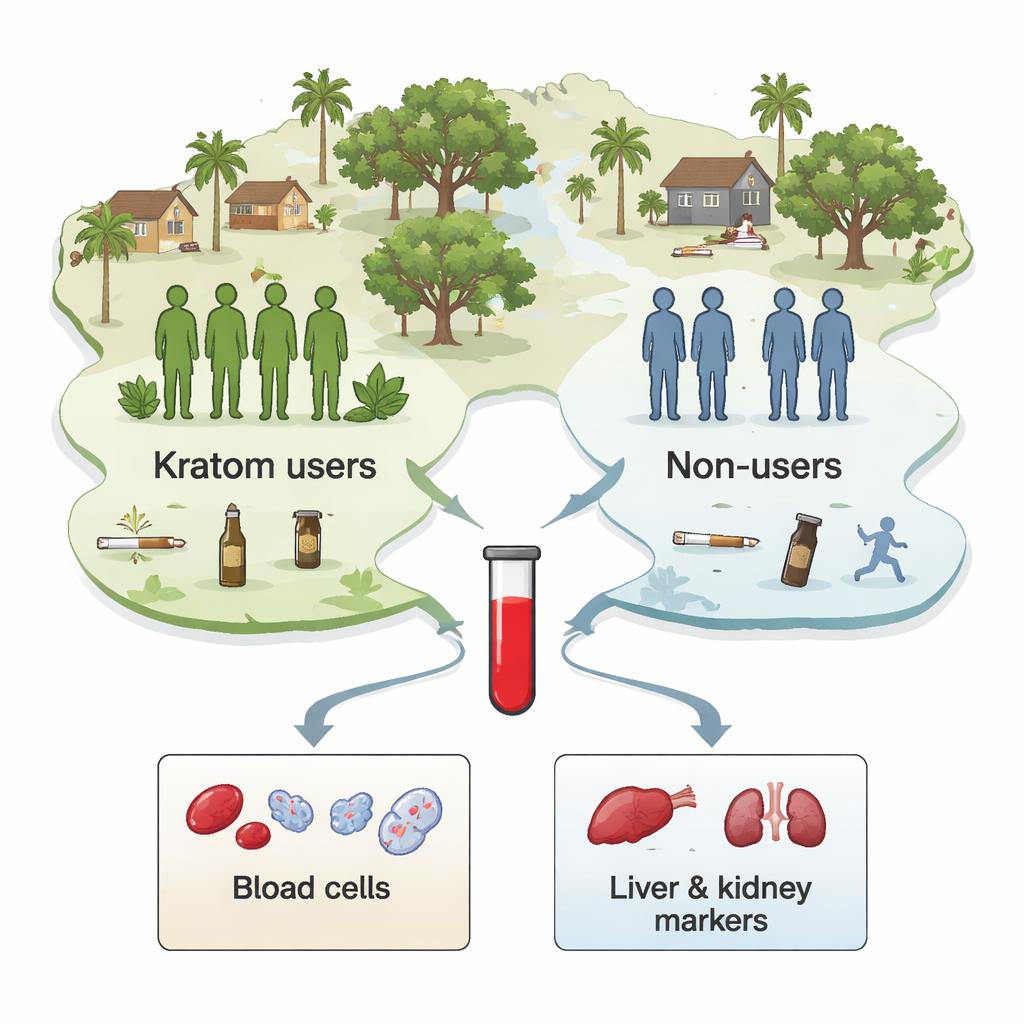
Researchers worked in Nam Phu, a rural sub-district in Southern Thailand where kratom use is woven into daily life and regulated by a local community charter. They enrolled 581 adults who had lived there for at least a year: 285 were registered kratom users and 296 were non‑users from the same community. Everyone answered questions about their health, habits such as smoking, drinking, and exercise, and for users, how long and how much kratom they consumed. After an overnight fast, all participants gave blood samples for a complete blood count and standard tests of liver and kidney function, as well as blood sugar.
Balancing the scales
At first glance, kratom users and non‑users looked similar in age, but quite different in lifestyle. Users were far more likely to be men, to smoke, and to drink alcohol, and they tended to have a lower body mass index (BMI) than non‑users. Because these differences can distort results, the team used statistical methods to “level the playing field,” adjusting for age, sex, BMI, smoking, and alcohol use. This step is crucial: without it, any changes seen in blood tests might wrongly be blamed on kratom when they really reflect who is more likely to use it and how they live.
What blood tests really showed
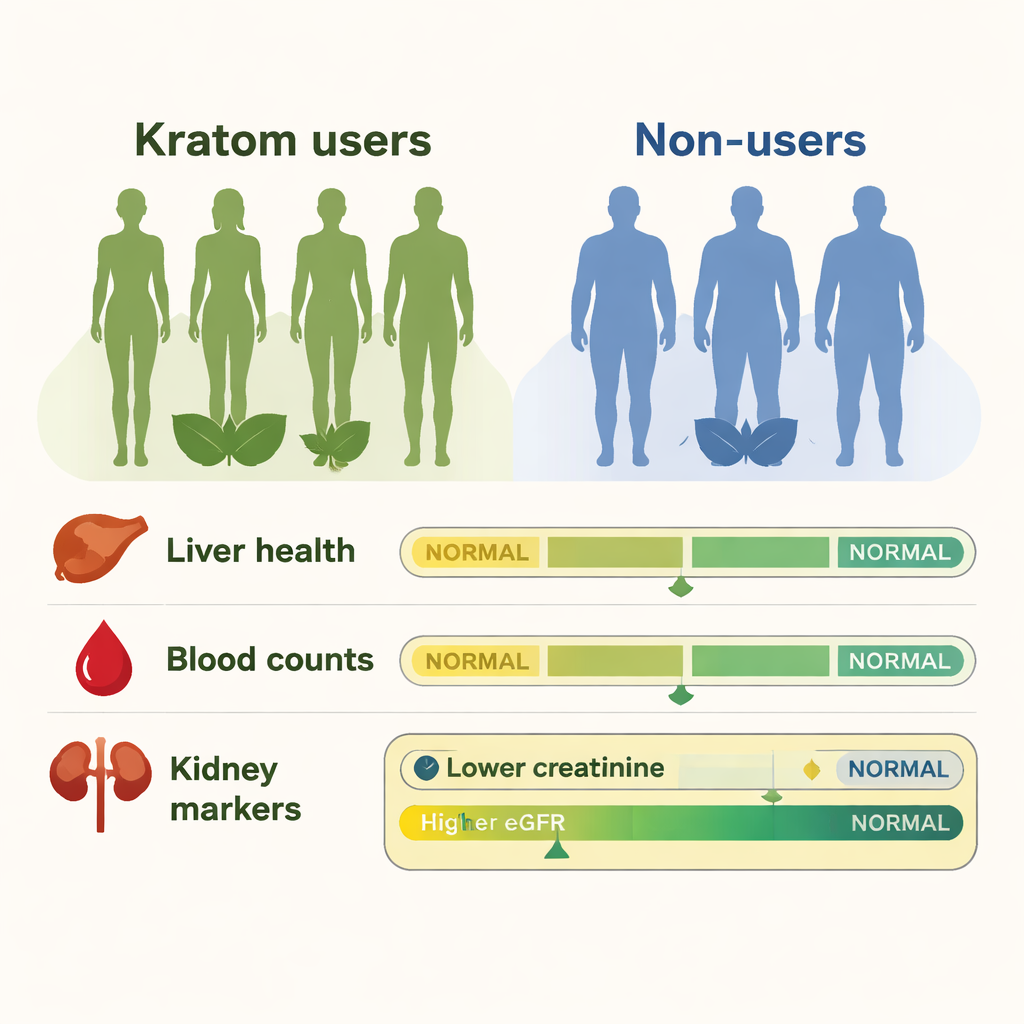
Before adjustment, kratom users seemed to have several oddities in their blood counts—slightly more white and red blood cells and fewer platelets than non‑users. But once lifestyle and body differences were taken into account, these gaps disappeared, and all values for both groups stayed comfortably inside normal clinical ranges. The same story held for liver tests. Although some raw numbers differed slightly, after proper adjustment there was no sign that long‑term, traditional kratom use was harming the liver: key enzymes and bilirubin were similar between users and non‑users and sat in the normal range.
A twist in kidney numbers
The one consistent difference emerged in kidney‑related markers. Kratom users had lower levels of creatinine—a waste product tied closely to muscle mass—and therefore a somewhat higher estimated glomerular filtration rate (eGFR), a standard formula‑based estimate of kidney filtering power. At first, that might sound like kratom is protecting the kidneys. The authors, however, caution against that conclusion. Because users also had lower BMI, and likely less muscle overall, they probably produce less creatinine to begin with. The resulting higher eGFR is best seen as a quirk of body build and calculation, not evidence that kratom supercharges kidney health. Even when the researchers split users by how long they had taken kratom or how many leaves they used each day, most blood and liver values stayed normal, though heavier users showed somewhat lower creatinine, blood urea nitrogen, and albumin—again hinting more at body composition and nutrition than outright organ damage.
What this means for everyday users
For people worried that traditional, daily kratom chewing inevitably wrecks the liver or blood, this community snapshot offers a reassuring, if cautious, message. Among long‑term users in this Thai village, basic blood counts and standard liver tests looked much like those of their non‑using neighbors once differences in sex, weight, smoking, and drinking were properly accounted for. Kidney‑related numbers were different, but in ways that likely reflect leaner bodies rather than direct harm—or benefit—from the plant itself. The study cannot prove kratom is risk‑free, especially in other settings, higher doses, or with mixed substances, but it does suggest that, within a traditional pattern of use, its effects on routine lab tests are subtle rather than dramatically toxic.
Citation: La-up, A., Saengow, U. & Aramrattana, A. Hematological and clinical-chemistry parameters of kratom users: a comparative study of users and non-users in Southern Thailand. Sci Rep 16, 5314 (2026). https://doi.org/10.1038/s41598-026-35524-3
Keywords: kratom, liver function, kidney markers, traditional medicine, herbal safety