Clear Sky Science · en
Finite element analysis and clinical application of percutaneous sustentaculum tali screw fixation for Sanders type II and III calcaneal fractures
Why broken heels matter
Breaking the heel bone is more than a painful inconvenience—it can permanently change the way a person walks, stands, and works. Traditional surgery for these injuries often involves large cuts and metal plates, which can lead to infections, slow healing, and long hospital stays. This study explores a gentler way to repair certain heel fractures using just a few small screws placed through tiny skin openings, and tests whether this simpler method is strong and safe enough for everyday life.
A new way to fix a shattered heel
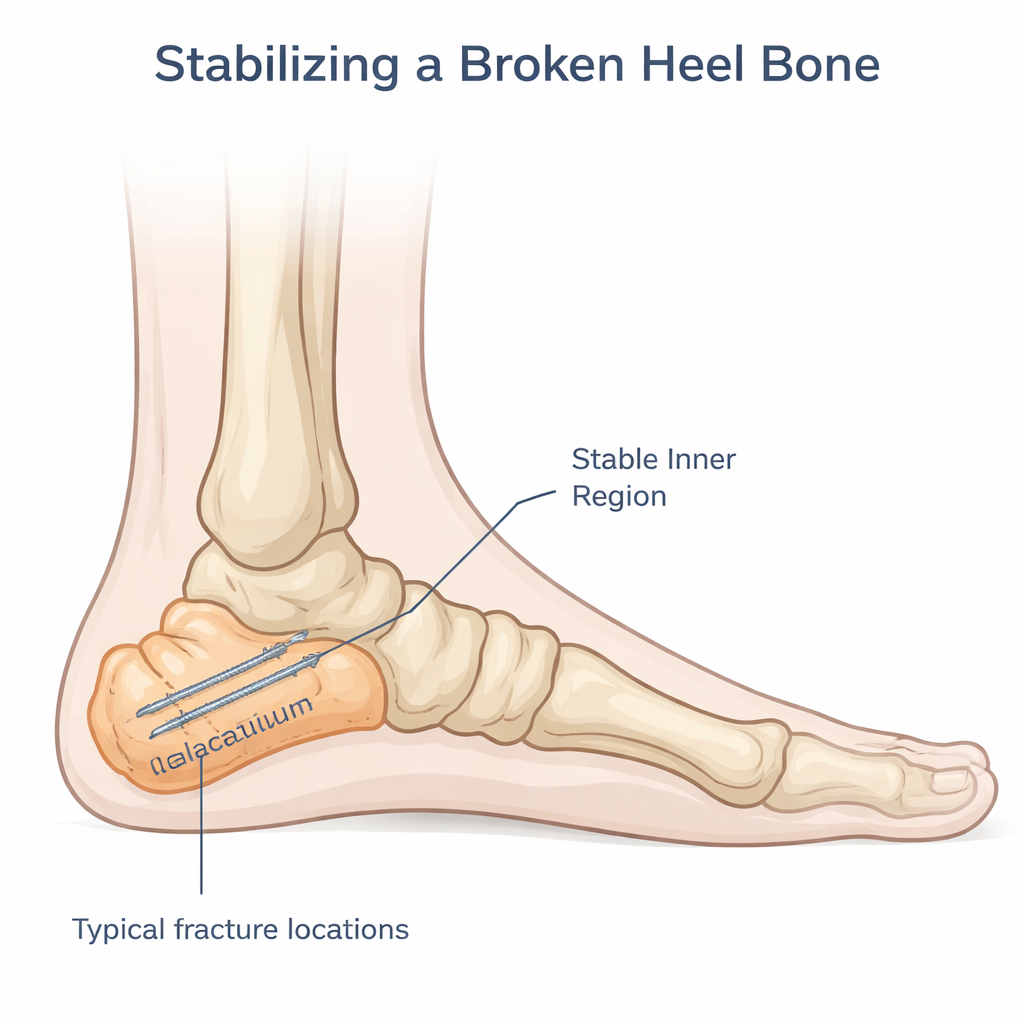
The heel bone, or calcaneus, helps absorb the impact every time we take a step. In some common injuries, called Sanders type II and III fractures, the smooth joint surface that meets the ankle bone is cracked and pushed out of place. Surgeons increasingly favor “minimally invasive” techniques for these injuries, which use small incisions instead of large open cuts. A key target is a dense inner ledge of bone called the sustentaculum tali, which usually stays put even when the rest of the heel breaks apart. If screws can be anchored securely into this stable island of bone, the broken pieces around it may be held in good alignment without the need for a large metal plate.
Testing strength on the computer
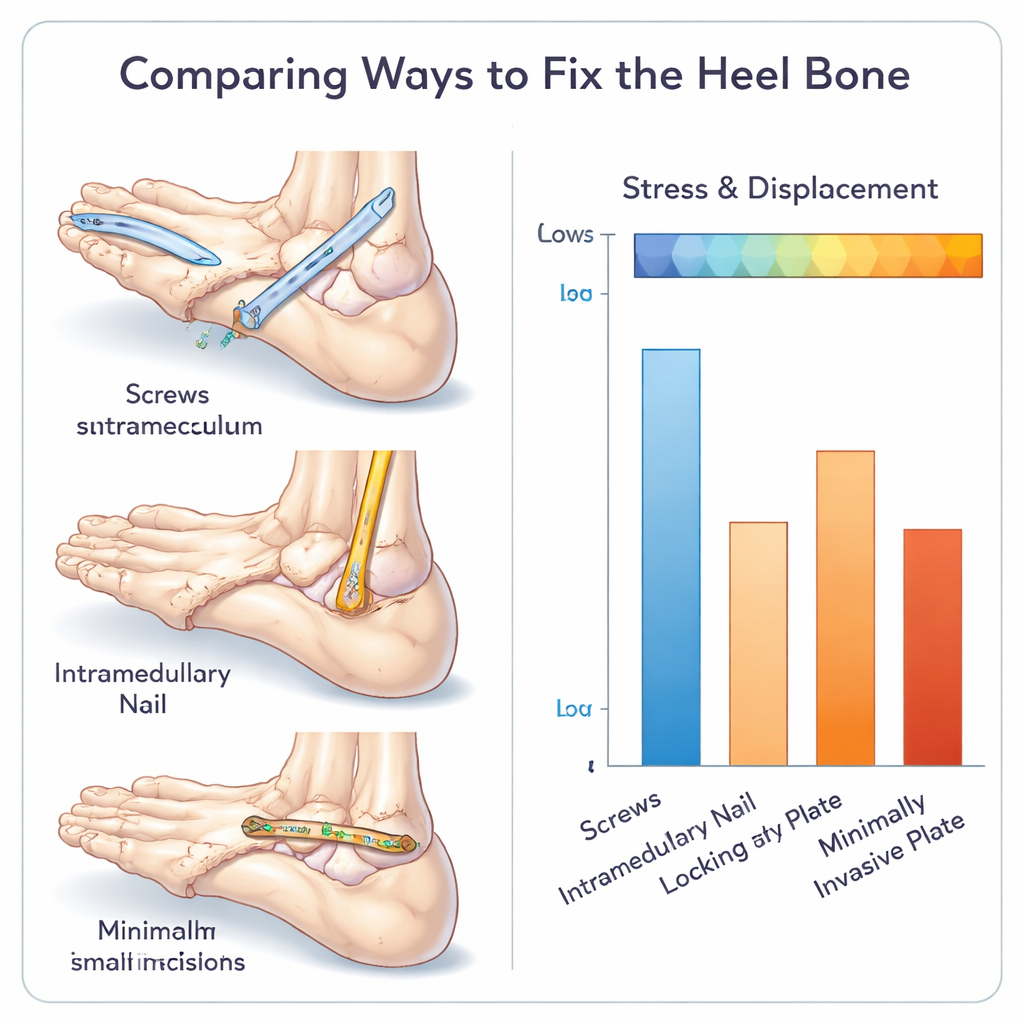
To see how well this screw-based method holds up, the researchers first built a detailed three-dimensional computer model of a fractured calcaneus from CT scans. They created three typical fracture patterns and then “repaired” each pattern in four different ways: with three screws aimed into the sustentaculum tali, with a rod placed inside the bone (an intramedullary nail), with a rigid locking plate on the side of the heel, and with a slimmer minimally invasive plate. Using finite element analysis—a standard engineering tool—they simulated how body weight is transmitted through the heel during standing. They measured how much stress each implant and bone region experienced, and how far the fracture fragments moved under load.
How the screw construct compares
The computer tests showed that the three-screw construct into the sustentaculum tali produced some of the lowest stress levels in both the bone and the hardware. In contrast, the intramedullary nail model produced the highest internal bone stresses, and the locking plate model concentrated the most stress within the metal itself. Importantly, in all four repair methods, the tiny movements between fracture pieces stayed far below a commonly accepted limit for bone healing. That means all approaches looked mechanically stable, but the percutaneous screw method managed to achieve this stability while keeping stresses comparatively modest—suggesting less risk of screw loosening or hardware fatigue.
Putting the method to the clinical test
Numbers from computer models only matter if they match what happens in real patients. The team therefore examined 23 people with displaced intra‑articular heel fractures who underwent this percutaneous screw technique. Most had Sanders type II or III injuries. All operations were performed through small incisions with careful X‑ray guidance, and most patients did not require bone grafts. A structured rehabilitation program gradually increased weight bearing over several months. At an average of about 13 months after surgery, patients were evaluated using standard foot function scores and a pain scale. Most achieved “good” to “excellent” function with very low pain ratings, and there were no major wound-healing problems reported.
What this means for patients and surgeons
Taken together, the computer simulations and patient follow‑up suggest that fixing selected heel fractures with three carefully placed screws into the sustentaculum tali can be as stable as more complex hardware, while avoiding many of the drawbacks of large incisions and bulky plates. For patients, this may translate into smaller scars, less risk of wound complications, and a quicker return to comfortable walking. However, the authors stress that this approach is not suitable for every fracture pattern, and their study involved a relatively small number of patients followed for only about a year. Larger, longer studies are needed before this technique can be considered a universal solution, but the results provide encouraging evidence that a simpler, less invasive repair can still offer strong and reliable support for a broken heel.
Citation: Han, H., Li, X., Ha, C. et al. Finite element analysis and clinical application of percutaneous sustentaculum tali screw fixation for Sanders type II and III calcaneal fractures. Sci Rep 16, 4911 (2026). https://doi.org/10.1038/s41598-026-35521-6
Keywords: calcaneal fractures, minimally invasive surgery, screw fixation, finite element analysis, foot and ankle