Clear Sky Science · en
Predictive modeling of millet growth in pesticide- and vinasse-amended soils using SHAP regression interpretation
Why this matters for our food and soil
Modern farming relies on pesticides to protect crops and on industrial by-products like vinasse, a nutrient-rich liquid from sugarcane processing, to fertilize fields. But mixing these chemicals and residues in soil can have hidden effects on plant growth and long-term soil health. This study asks a practical question with big implications: can we use advanced computer models to untangle how these substances interact in the soil and affect a hardy forage crop, pearl millet, over time?
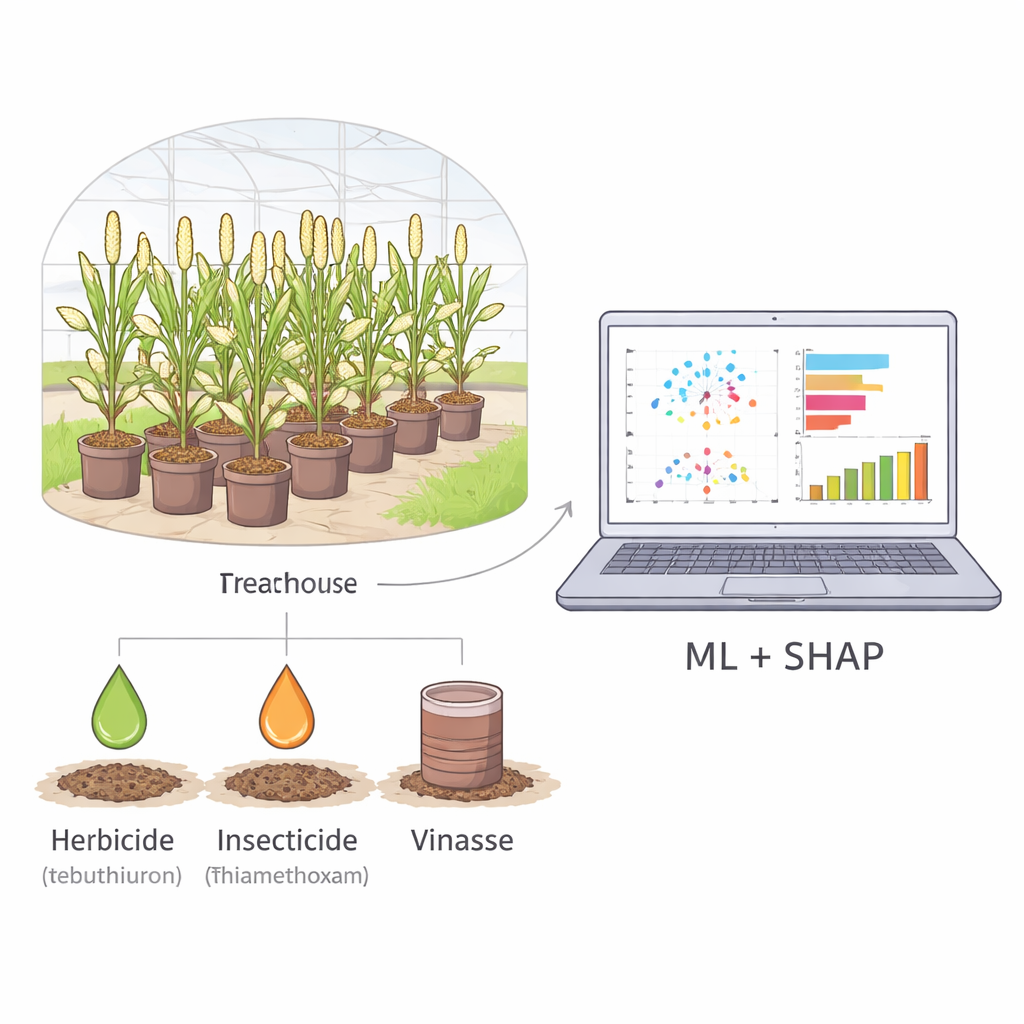
A test bed for a changing farm soil
The researchers grew pearl millet plants in pots under greenhouse conditions, simulating real-world sugarcane areas where pesticides and vinasse are common. They focused on two widely used products: tebuthiuron, a long-lasting weed killer, and thiamethoxam, an insecticide, along with vinasse, which is often applied as a liquid fertilizer. By combining the presence or absence of each of these three inputs, they created soils with different contamination and fertilization scenarios. The team then monitored how the millet plants responded through basic yet telling measurements: the dry weight of roots and shoots, and the greenness of leaves, which reflects chlorophyll and overall plant health.
Letting the data speak with machine learning
Instead of looking for simple one-to-one cause-and-effect relationships, the authors turned to a suite of machine-learning tools. These computer models are designed to find patterns in complex, noisy data that traditional statistics often struggle with. They tested nine regression methods, from straightforward linear models to more flexible techniques like random forests and Gaussian process regression. To make sure the models were not just accurate but also understandable, they used a method called SHAP (Shapley Additive Explanations), which shows how much each factor—time, pesticides, and vinasse—pushes predictions up or down for each plant.
Time is the quiet giant in plant growth
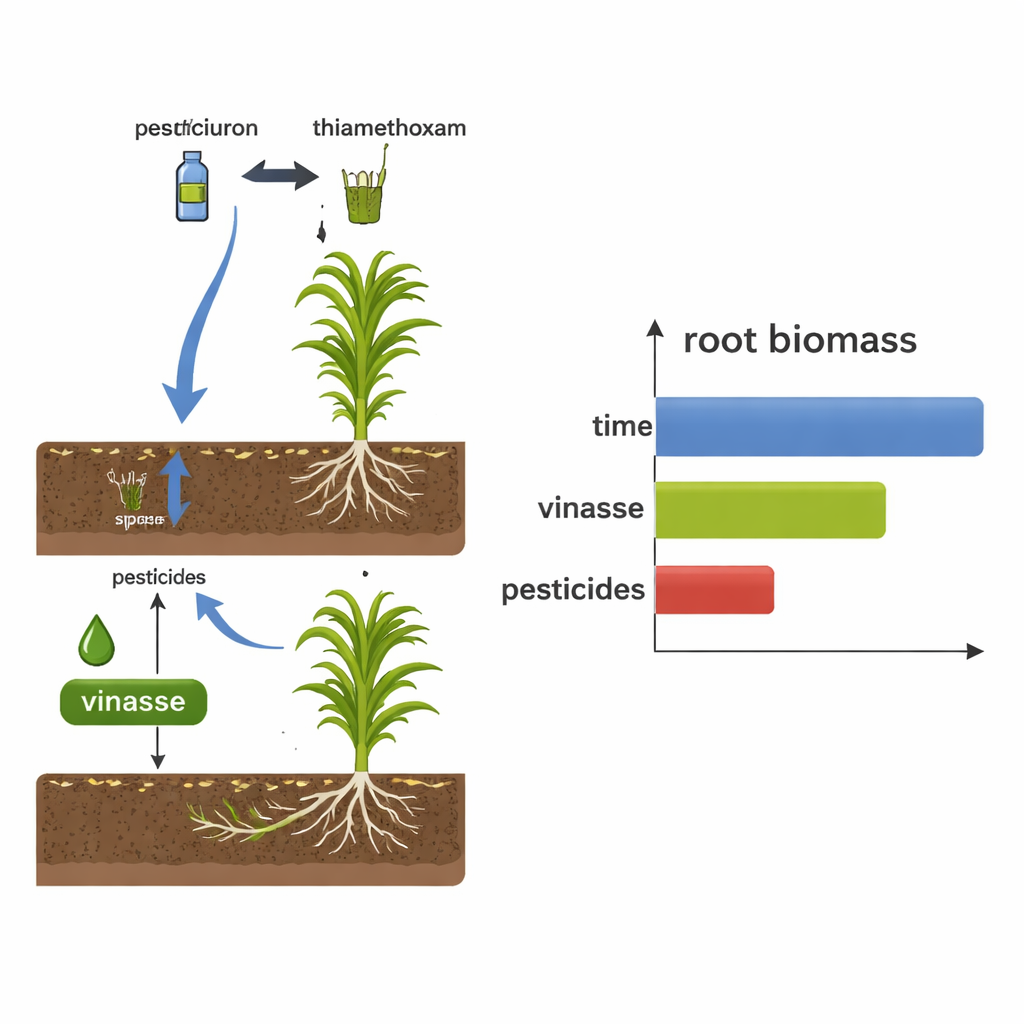
Across all the models, one message was clear: time was the dominant driver of the predictions. When the number of days since sowing was included, models did a modest but meaningful job of anticipating root and shoot biomass. When time was removed, their accuracy collapsed, explaining almost none of the variation in plant growth. SHAP analyses confirmed this, showing that time consistently had the strongest influence on predicted biomass, while the pesticides and vinasse played smaller, context-dependent roles. This makes biological sense—root and shoot systems develop gradually, and their responses to chemicals accumulate or fade over weeks rather than appearing all at once.
Good and bad actors in the soil mix
The models also picked up subtler signals about how each soil additive affected millet growth. Vinasse tended to support plant development, acting as a soil conditioner and nutrient source that often boosted shoot biomass in the simulations. In contrast, tebuthiuron and, to a lesser extent, thiamethoxam generally showed neutral or negative contributions, consistent with their reputation as persistent chemicals that can stress non-target plants and soil life. Importantly, the models suggested that the interplay among these factors—how vinasse changes soil conditions, how pesticides break down or linger, and how all this shifts over time—is too complex to be captured by any single snapshot measurement.
What this means for smarter, safer farming
For a general reader, the key takeaway is that predicting plant growth in chemically treated soils is not just about which products are present, but about how long plants have been exposed and how those substances interact as conditions change. The study shows that interpretable machine learning can reveal these time-sensitive patterns, even when the data are messy and the effects are modest. While the models were not perfect crystal balls, they reliably confirmed that vinasse can help plant growth and that persistent pesticides may hold it back, all under the strong guidance of time. This kind of approach can help farmers, agronomists, and regulators design management strategies that keep soils productive while reducing the long-term risks of chemical build-up.
Citation: Frias, Y.A., de Almeida Moreira, B.R., Valério, T.S. et al. Predictive modeling of millet growth in pesticide- and vinasse-amended soils using SHAP regression interpretation. Sci Rep 16, 6935 (2026). https://doi.org/10.1038/s41598-026-35512-7
Keywords: pesticide-contaminated soils, pearl millet, vinasse fertigation, machine learning in agriculture, soil remediation