Clear Sky Science · en
Short-term nitrogen enrichment alters microbial phosphorous limitation in Pinus taiwanensis forest soils
Why extra fertilizer matters underground
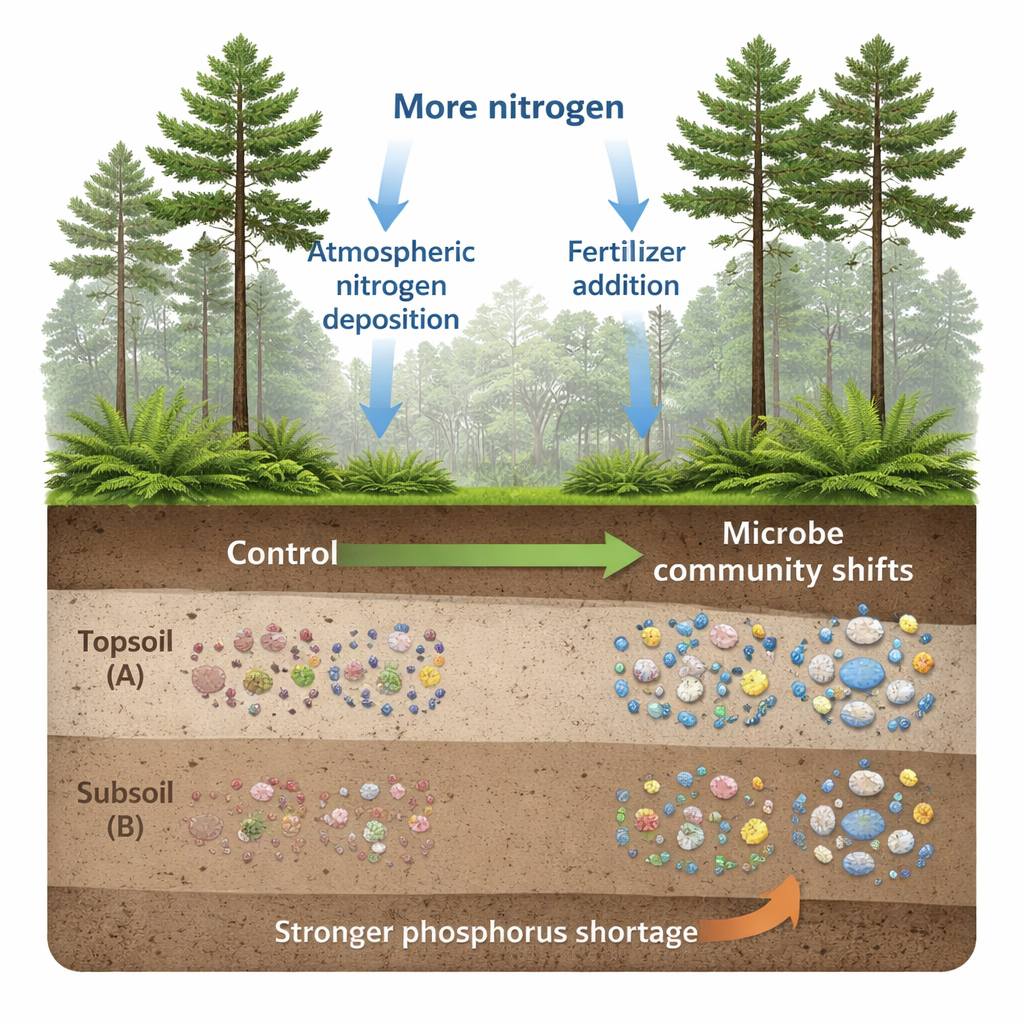
Across the globe, human use of nitrogen fertilizers is changing the chemistry of soils—even in remote forests far from farms. This study looks beneath the forest floor in a subtropical pine woodland in China to ask a deceptively simple question: when more nitrogen falls from the sky or is added to the soil, do the microbes living there get more of what they need, or do they simply run into a shortage of something else? The answer turns out to be important not only for tree growth, but also for how much carbon these forests can lock away and how stable their ecosystems remain under continued pollution.
Hidden life in a mountain pine forest
The researchers focused on Pinus taiwanensis, a pine species that forms nearly pure stands on steep, nutrient-poor slopes in southeastern China. In such forests, soil microbes—bacteria and fungi—are the unseen workforce that recycles dead leaves and wood, freeing nutrients that trees can reuse. These organisms rely mainly on three elements: carbon as fuel, nitrogen to build proteins, and phosphorus to make DNA and energy-carrying molecules. When the balance among these elements is off, microbial growth and activity can be choked, even if one nutrient, such as nitrogen, seems plentiful. The team wanted to know how a realistic increase in nitrogen, similar to that from air pollution, would shift this balance in the soil.
A controlled dose of nitrogen
To probe this, scientists established a three-year field experiment in a protected pine forest. They laid out a grid of 15-by-15 meter plots and added nitrogen in the form of urea at two levels: a low dose matching current high-deposition conditions and a high dose roughly double that amount, along with control plots that received no extra nitrogen. Each year they sampled both topsoil and deeper soil layers. In the lab they measured soil chemistry, microbial biomass, and the activity of enzymes that microbes secrete to “mine” carbon, nitrogen, and phosphorus from dead organic matter. They also used DNA sequencing to track which bacterial and fungal groups became more or less common under different nitrogen levels.
Microbes hit a phosphorus wall
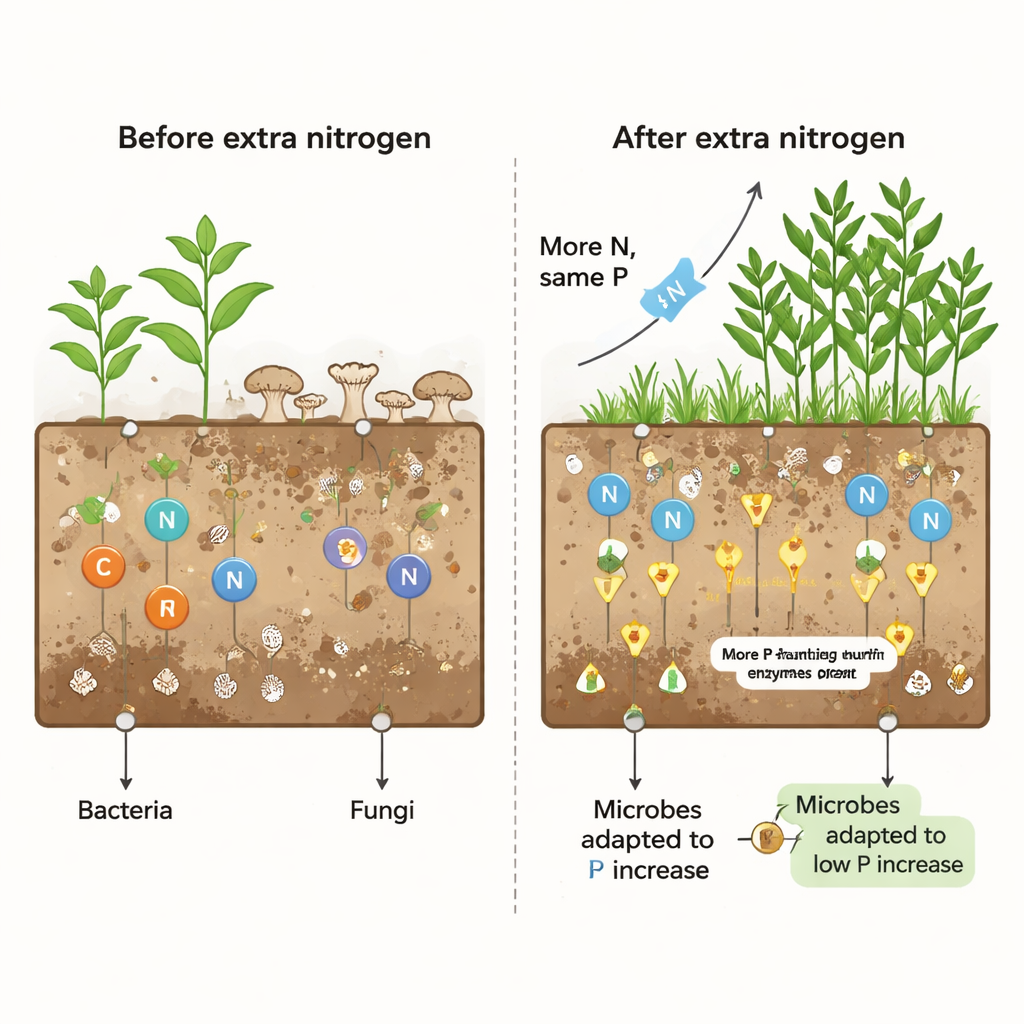
One might expect extra nitrogen to free microbes from nitrogen scarcity and allow them to grow faster. Instead, the data showed that, in this forest, microbes were already mainly constrained by phosphorus, and added nitrogen pushed them even harder against that limit. Several independent indicators converged on this conclusion. Ratios of enzyme activities shifted in a way that signals stronger phosphorus hunger, and a mathematical measure called the “vector angle” stayed above the threshold associated with phosphorus shortage in all treatments, increasing further when nitrogen was added. At the same time, there was little sign that microbes were short on carbon: indicators of carbon limitation changed only weakly. In essence, extra nitrogen acted like stepping on the gas when the real problem was a missing gear—phosphorus.
Community reshuffle and microscopic markers
Extra nitrogen did not simply make microbes work harder; it changed who was doing the work. Bacterial groups that thrive in richer conditions, such as Proteobacteria and Actinobacteria, became more common, while groups adapted to leaner soils declined. Fungal communities also shifted, though they responded more to overall nitrogen availability and microbial biomass than to soil acidity. Using a statistical tool that highlights diagnostic species, the authors identified specific bacterial and fungal lineages whose abundance closely tracked measures of nutrient stress. In particular, members of the bacterial phylum Chloroflexi and several fungi in the class Tremellomycetes stood out as “biomarkers” of phosphorus limitation. Chloroflexi appear especially well equipped to release bound phosphorus by producing potent phosphatase enzymes, allowing them to prosper where phosphorus is scarce.
What this means for forests and their future
For a non-specialist, the key message is that simply adding more of one nutrient does not guarantee healthier soils or faster tree growth. In this subtropical pine forest, short-term nitrogen enrichment did not solve a nitrogen problem; it sharpened a phosphorus problem. Microbes responded by reorganizing their communities and investing more in tools to strip phosphorus from stubborn soil compounds. That adjustment may help them cope for a while, but it also signals that continued nitrogen pollution could leave these forests increasingly dependent on limited phosphorus supplies. For land managers and policymakers, the study suggests that protecting the productivity and carbon-storage capacity of such forests may require paying attention to phosphorus inputs and soil biology, not just to nitrogen emissions.
Citation: Cui, J., Chen, Y., Yuan, X. et al. Short-term nitrogen enrichment alters microbial phosphorous limitation in Pinus taiwanensis forest soils. Sci Rep 16, 5051 (2026). https://doi.org/10.1038/s41598-026-35511-8
Keywords: nitrogen deposition, phosphorus limitation, soil microbiome, subtropical pine forest, ecoenzymatic stoichiometry